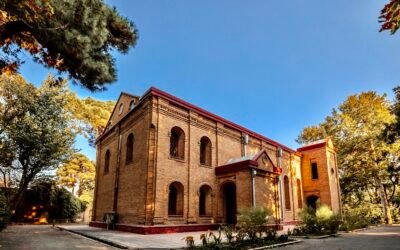
The Gurdwara Nanaksar Sahib in Chak Fateh Binder has a direct connection with the life of Guru Nanak. Now, it is at risk of collapsing.
by Massimo Introvigne

Chak Fateh Bhinder is a village in Daska tehsi of Sialkot district of Pakistan’s Punjab. It is not a famous village, except that Guru Nanak, the founder of the Sikh religion, stopped there after completing his fourth udasi (peregrination). This makes the village sacred for the Sikh, and a new shrine called Gurdwara Nanaksar Sahib was built there at the beginning of the 20th century.
In theory, the Pakistani government is committed to preserve sacred and historical places of worship of minority religions. In practice, this is not always the case, particularly when the buildings are far away from the main cities and do not attract large crowds of pilgrims, nor significant donations.
The largest Sikh representative body, Shiromani Gurdwara Parbandhak Committee (SGPC), has now written to the Pakistani government claiming that the Gurdwara in Chak Fateh Binder is in an obvious state of disrepair. Large cracks have appeared on the building and some doors and windows appear to have been removed. The Gurdwara is now at serious risk of collapsing.


SGPC has requested immediate action by the Pakistani government, or that it allows the same SGPC to send volunteers to repair the building.
The non-implementation of commitments about preserving their historical buildings is part of the problems Pakistan faces when dealing with religious minorities. Despite commitments to improving their lot, decisive action rarely follows, and the minorities are often victims of violence perpetrated by Islamic ultra-fundamentalists and condoned by the local police.

Those interested in the problems of religious liberty in Pakistan, and understanding French, may find of interest an interview with the undersigned that is part of the projects of the French organization Observatoire Pharos.


Massimo Introvigne (born June 14, 1955 in Rome) is an Italian sociologist of religions. He is the founder and managing director of the Center for Studies on New Religions (CESNUR), an international network of scholars who study new religious movements. Introvigne is the author of some 70 books and more than 100 articles in the field of sociology of religion. He was the main author of the Enciclopedia delle religioni in Italia (Encyclopedia of Religions in Italy). He is a member of the editorial board for the Interdisciplinary Journal of Research on Religion and of the executive board of University of Pennsylvania Press’ Nova Religio. From January 5 to December 31, 2011, he has served as the “Representative on combating racism, xenophobia and discrimination, with a special focus on discrimination against Christians and members of other religions” of the Organization for Security and Co-operation in Europe (OSCE). From 2012 to 2015 he served as chairperson of the Observatory of Religious Liberty, instituted by the Italian Ministry of Foreign Affairs in order to monitor problems of religious liberty on a worldwide scale.