A national meeting in Shanxi shows how official Protestant bodies are shaping doctrine around Party ideology.
by Wang Zhipeng
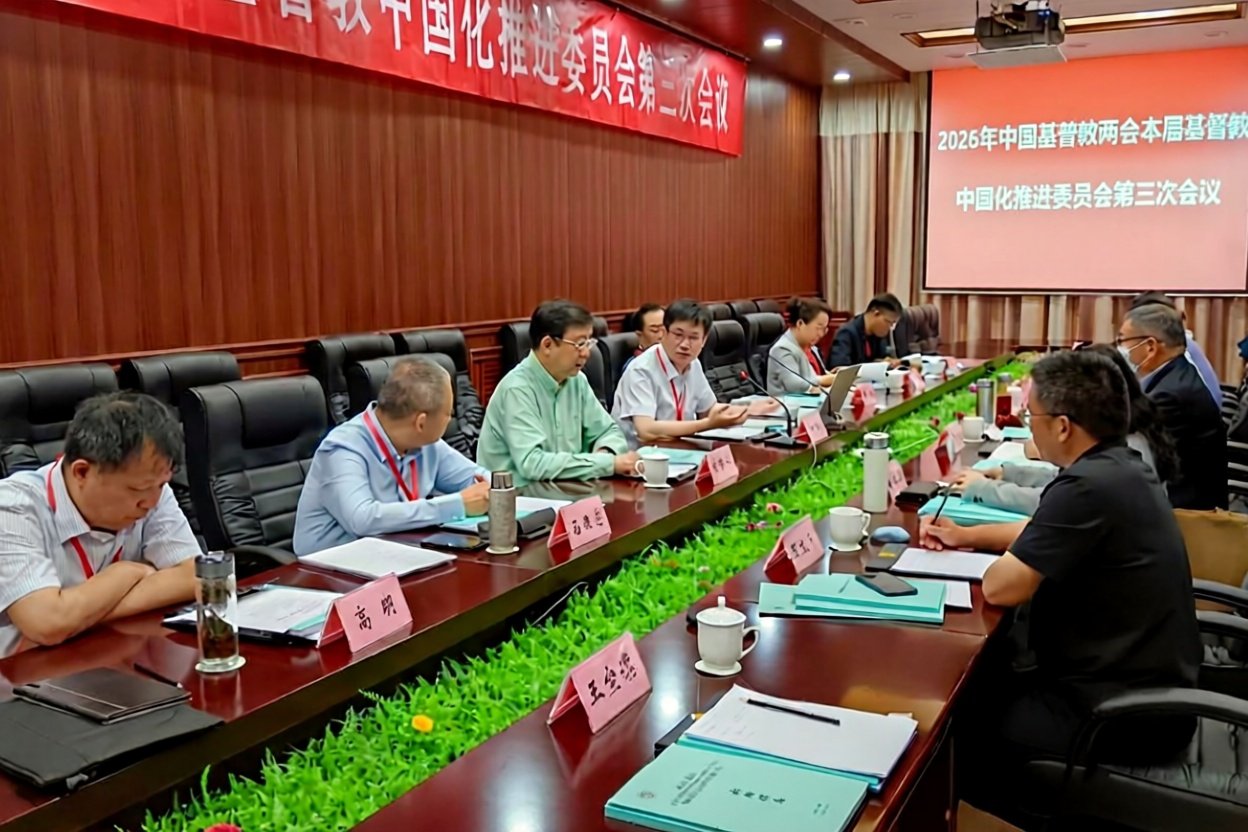
The government-controlled Three-Self Church has intensified its efforts to redefine Christian teaching to align with the political expectations of the Chinese state. On May 19–20, the national leadership of the Three-Self Movement and the China Christian Council met in Yangquan, Shanxi, to advance two new doctrinal texts titled “Questions and Answers on the Sinicization of Christianity” and “Reader on the Sinicization of Christianity.” These publications are being designed as authoritative guides for pastors, preachers, and congregations, and their purpose is to embed the Sinicization program into the daily life of Protestant communities throughout the country.
The meeting opened with the national anthem and continued with collective study sessions on speeches delivered by Xi Jinping during his inspection tour of Shanxi and during a Politburo study session. These references shaped the entire gathering. The participants did not discuss the Gospel, the teachings of Jesus, or the pastoral needs of the faithful. Their attention was directed to the political vocabulary accompanying the Sinicization campaign. The editors of the two forthcoming books were instructed to ensure that the texts reflect the correct political orientation, present a theological narrative compatible with state ideology, and demonstrate cultural depth as defined by the Party’s understanding of Chinese civilization.
The leaders of the Three-Self Church described the project as a major undertaking. They emphasized the need for a disciplined editorial process, the cultivation of a unified approach, and the creation of materials that can withstand what they called the tests of history and practice. The discussions focused on how to embed Chinese cultural themes into Christian teaching and how to construct a theological discourse that expresses what officials describe as socialism with Chinese characteristics. The participants debated chapter structures, case studies, and examples that illustrate the integration of Christianity into the Communist Party’s cultural framework.
The meeting also included field visits intended to gather local experiences in promoting Sinicization. These visits are part of a broader effort to ensure that the new publications reflect the practices already being implemented in grassroots churches. The goal is to create a national template to guide sermons, Bible study sessions, and church administration. The process reveals how the Three-Self Church is being shaped into an institution that transmits political ideology through religious language.

The absence of any reference to Jesus, the Gospel, or the core doctrines of Christianity was notable. The meeting’s agenda revolved entirely around political study, cultural integration, and the construction of a theological vocabulary that supports the Party’s objectives. The forthcoming “Questions and Answers” and “Reader” are being designed as tools for this purpose. They will function as catechisms of Sinicization, teaching believers how to interpret their faith through the lens of national identity, cultural conformity, and political loyalty.
This development mirrors what is happening in the state-controlled Catholic Church, which has been mobilized to promote Party doctrine while ignoring the papal encyclical “Magnifica Humanitas” and other official Catholic documents. The Protestant side is now producing its own doctrinal materials that reflect the same priorities. The Sinicization of Christianity has become a process in which theology is rewritten to serve the state’s ideological needs, and the ThreeSelf Church has accepted the role assigned to it.
The meeting in Shanxi shows how far this process has advanced. The official Protestant leadership is preparing texts that will shape the religious education of millions of believers. These texts will guide them toward the CCP’s political expectations, presented as the proper framework for understanding Christian faith in China.

Uses a pseudonym for security reasons.