How occult ideas and deep esoteric structures shaped the painter who transformed modern art.
by Massimo Introvigne*
*A paper presented at the 112th National Conference of the Italian Theosophical Society, “Thought-Forms as Architectures of the Soul,” Padova, May 30, 2026.
Article 3 of 4. Read article 1 and article 2.
So far, I have deliberately not mentioned Wassily Kandinsky in this historical summary, and I now turn back to Ringbom’s approach to his relationships with “Thought-Forms” and Theosophy. This is a central theme in the history of Theosophy’s influence on modern art and warrants in-depth examination.
Kandinsky’s journey from figurative Symbolism to abstraction is one of the most studied transformations in the history of art. Yet for decades, the spiritual and esoteric dimensions of this journey were minimized or ignored. Ringbom’s achievement was to show that Kandinsky’s artistic revolution cannot be understood without taking his engagement with Theosophy, Anthroposophy, occult science, and the broader esoteric culture of early twentieth-century Europe seriously.
To appreciate the force of Ringbom’s argument, we must first understand the intellectual and cultural environment in which Kandinsky lived during his Munich years (1896–1914).
Munich at the turn of the century was a vibrant center of artistic and spiritual experimentation. The city hosted a flourishing Theosophical Society, numerous occult groups, and a lively culture of public lectures on esoteric topics. Rudolf Steiner, then General Secretary of the German Section of the Theosophical Society, lectured frequently in Munich before founding Anthroposophy. His talks attracted artists, musicians, writers, and intellectuals seeking a synthesis of science, religion, and aesthetics.
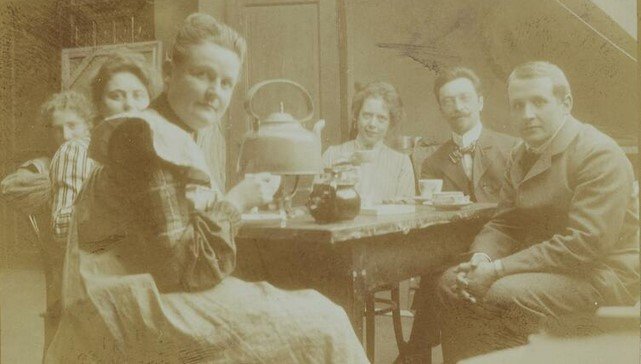
Kandinsky and his companion Gabriele Münter were part of this milieu. They attended lectures, read Theosophical literature, and participated in discussions about the spiritual dimension of art. Their circle included figures such as Marianne von Werefkin and Alexej von Jawlensky, both of whom were deeply interested in Theosophical ideas. Werefkin’s journals are a crucial source for understanding the group’s engagement with Blavatsky, Steiner, and other occult thinkers.
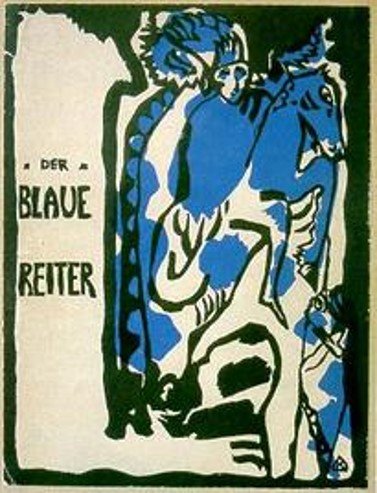
This environment shaped the formation of the Blue Rider movement in 1911. The “Blue Rider Almanac,” edited by Kandinsky and Franz Marc, included essays on folk art, children’s drawings, medieval miniatures, and non-Western art—sources that Kandinsky believed expressed a more direct, spiritual relationship to form and color. The “Almanac” also included an essay by the composer Arnold Schoenberg, whose atonal music Kandinsky saw as a parallel to his own artistic quest.
In this context, Ringbom argued, Kandinsky’s turn to abstraction was not merely a formal innovation but a spiritual project.
Ringbom summarized his interpretation of Kandinsky’s esoteric development in ten theses. These theses remain a useful framework for understanding the painter’s spiritual world and his possible relationship with “Thought-Forms,” even if some details require revision.
First, Ringbom noted that Kandinsky was fascinated by the new physics of the early twentieth century, especially the discovery of the atom’s internal structure. Like many Theosophists, he interpreted these discoveries as evidence of a subtler, more spiritual reality underlying the material world. The idea of “refined matter,” perceptible only by “inner senses,” resonated with his desire to move beyond the visible.
Second, as many other artists did, in 1907, Kandinsky read the German edition of Schuré’s “The Great Initiates,” a book that presented the history of religion as a series of esoteric revelations. Schuré was a leading Theosophist, and his vision of a coming “Epoch of the Great Spiritual” deeply impressed Kandinsky and reinforced his belief that art could play a role in humanity’s spiritual evolution.
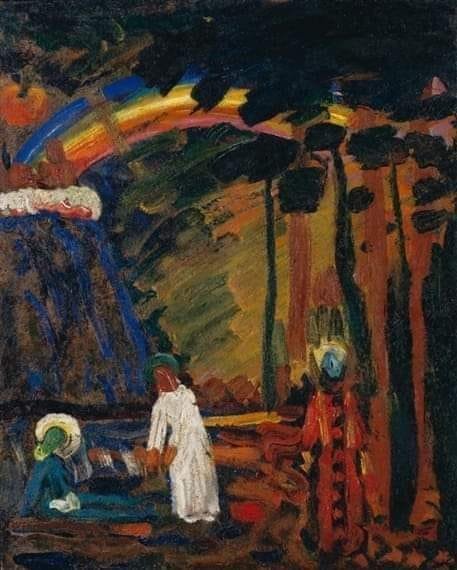
Third, Kandinsky and Münter were part of a Munich circle that included several artists in close contact with Steiner. Maria Strakosch Giesler introduced them to Steiner’s lectures, and Werfkin’s journals record their discussions of his ideas. According to Werefkin, Kandinsky’s “Ariel Scene from Goethe’s Faust II” (1908) was inspired by a Steiner lecture on the same subject.
Fourth, Kandinsky read and annotated Steiner’s “Theosophie” and issues of “Lucifer Gnosis.” He also read Blavatsky and Besant. Ringbom claimed that Kandinsky read “Thought Forms,” though this remains uncertain. What is clear is that he was immersed in the Theosophical worldview.
Fifth, Kandinsky’s notebooks refer to Spiritualism, and he defended controversial scientists associated with parapsychology, such as Johann Karl Friedrich Zöllner. He believed that these researchers were unjustly maligned by academic materialism. His friend Thomas de Hartmann, a composer with multiple occult interests, later became a close associate of George Gurdjieff. According to Olga de Hartmann, Kandinsky participated in parapsychological experiments, including table lifting and telepathic communication.
Sixth, Ringbom argued that Kandinsky’s exposure to Theosophy led him to seek the “inner content” or “inner sound” of reality. This concept became central to his theory of art. He believed that colors and forms could express spiritual vibrations, just as music expresses emotional states, a theme central to “Thought-Forms.”
Seventh, Kandinsky’s theory of “inner necessity” was his solution to the problem of how abstract art could be objective rather than arbitrary. He argued that each work of art responds to three necessities: the artist’s personality, the style of the time, and the “purely and eternally artistic” necessity. The third element, he believed, was universal and spiritual. Ringbom saw this as a direct inheritance from Theosophy.
Eighth, Ringbom traced Kandinsky’s evolution from figurative Symbolism to abstraction through a series of works, including his depictions of the Last Judgment and “Composition VII” (1913). He argued that Kandinsky gradually abandoned external forms to depict the “inner essence” of things.
Ninth, Ringbom reported that Kandinsky believed that humanity was entering a new spiritual era, which he associated with the “third kingdom” of Joachim of Fiore and Steiner. He wrote that “now we enter the great day of the revelation of this kingdom: the kingdom of the Spirit.” This millennial vision underpinned his belief that abstract art could transform society.
Tenth, Ringbom argued that Kandinsky’s post-Berlin writings, including “Point and Line to Plane” (1925), showed a more rationalist approach, but that he returned to his earlier esoteric ideas in the 1930s. He warned against “too much logic in art” and dreamed of a “Grande Synthèse,” a new synthesis of art and spirituality.
When “The Sounding Cosmos” appeared in 1970, it landed in a field that was not ready for it. For decades, esotericism had been treated by academic culture as an intellectual embarrassment. From the Enlightenment onward, and especially under the influence of positivism and Marxism, esoteric movements were often portrayed as reactionary, irrational, or pathological. After World War II, this suspicion hardened. Esotericism was frequently associated with fascism or with the “irrational” forces that had supposedly undermined European civilization. In such a climate, to suggest that the founders of modern art had drawn inspiration from Theosophy and “Thought-Forms” was to risk contaminating them with precisely what the canon had been constructed to exclude.
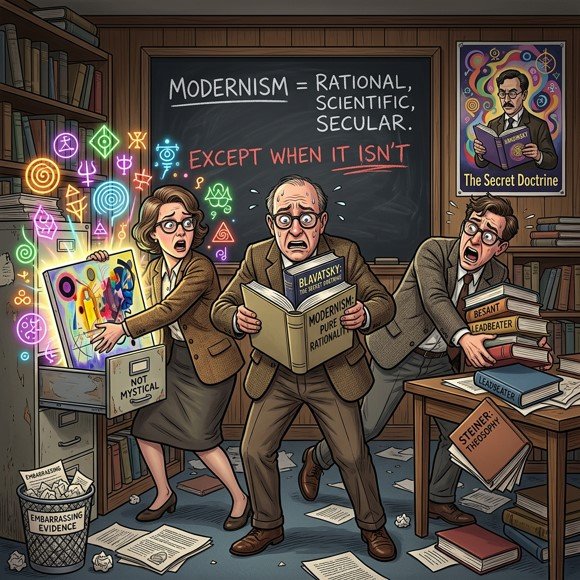
Ringbom was acutely aware of this. In private letters, he complained that the “irrational sources of modernism” had been swept under the carpet by a scholarly community anxious to preserve the respectability of the modern movement. He felt that every piece of evidence had to be “hammered into the thick heads” of that community. At the same time, he was himself ambivalent about Theosophy. To Theosophists, he insisted that he did not intend to attack their movement or to ridicule Blavatsky. To other correspondents, he spoke of “occult mumbo jumbo” and “theosophical trash culture.” He oscillated between a fascination with the imaginative power of esoteric ideas and a rationalist distrust of their truth claims. This tension runs through his work and perhaps contributed to the unease with which it was received.
The immediate reaction to “The Sounding Cosmos” was largely negative or, worse, silent. The book received no reviews in major scholarly journals during Ringbom’s lifetime. Some Kandinsky specialists were openly hostile, accusing him of sensationalism or of violating archival confidentiality. Access to certain documents in the Kandinsky archives in Munich was restricted, partly in response to his work. For many, the safest strategy was to ignore the book. It did not fit the prevailing narrative, and it seemed to threaten the hard-won status of modern art as a serious, rational, progressive enterprise.
Yet the questions Ringbom raised did not go away.
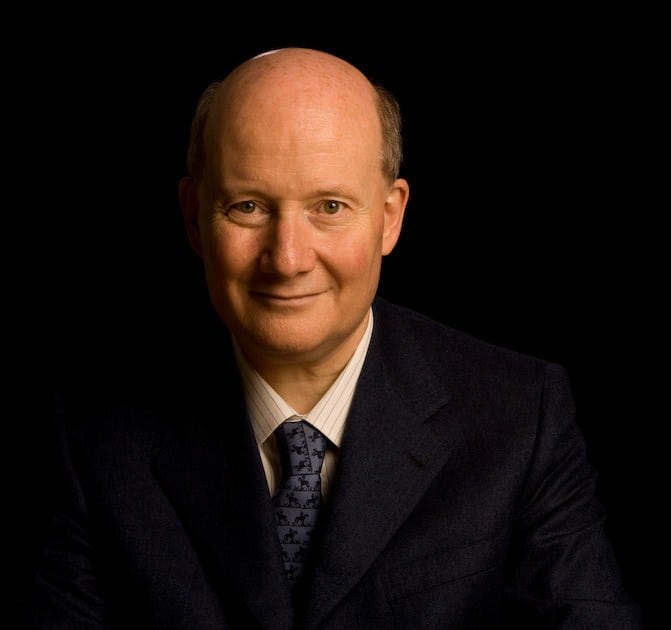
Massimo Introvigne (born June 14, 1955 in Rome) is an Italian sociologist of religions. He is the founder and managing director of the Center for Studies on New Religions (CESNUR), an international network of scholars who study new religious movements. Introvigne is the author of some 70 books and more than 100 articles in the field of sociology of religion. He was the main author of the Enciclopedia delle religioni in Italia (Encyclopedia of Religions in Italy). He is a member of the editorial board for the Interdisciplinary Journal of Research on Religion and of the executive board of University of Pennsylvania Press’ Nova Religio. From January 5 to December 31, 2011, he has served as the “Representative on combating racism, xenophobia and discrimination, with a special focus on discrimination against Christians and members of other religions” of the Organization for Security and Co-operation in Europe (OSCE). From 2012 to 2015 he served as chairperson of the Observatory of Religious Liberty, instituted by the Italian Ministry of Foreign Affairs in order to monitor problems of religious liberty on a worldwide scale.