The 1994 tragedy had multiple causes, but hate speech spread by the media was crucial. The lesson should be remembered when confronting hate speech today.
Massimo Introvigne*
*A paper presented at the Fourth World Conference for Religious Dialogue and Cooperation, Skopje, North Macedonia, June 24, 2026.
Article 1 of 2
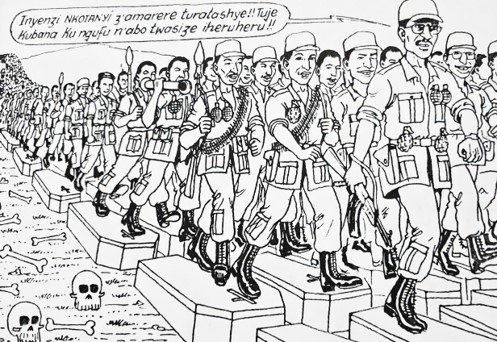
Media can, tragically, play a decisive role in generating violence against minorities. Before any physical attack takes place, before any weapon is raised, there is often a long preparatory phase in which words, images, and narratives reshape the moral landscape. They redefine who belongs and who does not, who is human and who is not, who deserves protection and who can be sacrificed. This is why the study of media is indispensable when we examine the darkest chapters of human history.
In 2011, I served as the OSCE Representative for combating racism, xenophobia, and intolerance and discrimination against Christians and members of other religions. OSCE, the Organization for Security and Cooperation in Europe, is the largest regional security organization in the world after the United Nations. It includes Canada, the United States, all European states, the former Soviet republics, and Mongolia. During my mandate, we organized a conference in Rome on “Hate Incidents and Crimes Against Christians,” where I presented what became known as the Rome Model and was often quoted in subsequent years. Although formulated in the context of anti-Christian hostility, the model applies to any group targeted by a spiral of intolerance.
The first stage of this spiral is intolerance. Intolerance is cultural. It begins with stereotypes, ridicule, and narratives portraying a group as malignant, dangerous, or socially disruptive. The media often play a central role here. When newspapers, radio, television, or online platforms repeat negative portrayals, they create a climate in which hostility becomes normal. The second stage is discrimination. If a group is believed to threaten public harmony, laws, regulations, and administrative measures may be justified. The logic is simple: if they are dangerous, society must defend itself. The third stage is persecution. When discrimination fails to suppress the targeted group, governments or social actors may escalate to violence, imprisonment, or other radical measures. The spiral is tragically familiar. Jews in Nazi Germany were first ridiculed in caricatures and books, then discriminated against through laws, and finally exterminated in Auschwitz. Roma and Sinti communities in Europe have long suffered the same progression: stereotypes, discriminatory regulations, and recurrent episodes of persecution.
Nowhere is the tragic logic I tried to capture in the Rome Model more visible than in the genocide of the Tutsi in Rwanda. Before we examine the role of the media in that genocide, we must briefly understand the context in which it unfolded.
The categories “Hutu” and “Tutsi” are now considered “ethnosocial” by scholars. Their remote ethnic roots were not invented by colonialism, although colonial writers exaggerated the differences between them. Before German and Belgian rule, the distinction was fluid. Hutu and Tutsi shared the same language and religion, intermarried, and could move between categories by gaining or losing wealth. Colonial administrators imposed rigid ethnic identities that later fueled hatred through identity cards and racial theories. Over time, these rigid categories were internalized by both groups. By the mid-20th century, they were increasingly interpreted through Western lenses of class struggle, with Tutsi portrayed as a bourgeois elite and Hutu as a proletarian majority. This interpretation ignored the existence of wealthy Hutus and impoverished Tutsis, but it provided a convenient ideological framework for political mobilization.
As colonialism waned, tensions escalated. In Burundi, Tutsis massacred Hutus in 1972. In Rwanda, Hutu violence against Tutsis had been ongoing since 1959, forcing hundreds of thousands of Tutsis to flee to Uganda, Burundi, and Tanzania. In Uganda, many refugees joined the Rwandan Patriotic Front (RPF), a military force determined to return home. When the RPF invaded Rwanda in 1990, the Hutu-dominated government interpreted local Tutsis as a fifth column. A peace agreement was eventually signed, but radical Hutus rejected it. On April 6, 1994, the plane carrying Rwandan President Juvénal Habyarimana and Burundian President Cyprien Ntaryamira was shot down over Kigali. Whether the RPF or Hutu extremists were responsible remains debated, but the effect was immediate: the genocide, which Hutu radicals had prepared before, began.
Over one hundred days, around one million Tutsis and moderate Hutus were murdered until the RPF entered the Rwandan capital, Kigali, and put an end to the Hutu regime. To these, the five million victims of the Congo wars and the unrest in Eastern Congo that continues to the present day should be added. These wars have different causes, but, in many ways, are a by-product of the Rwandan genocide and the fact that tens of thousands of Rwandan Hutus responsible for it escaped to Congo, where they reorganized and promised revenge.
What distinguishes Rwanda from other genocides is not only the scale but the participation of ordinary civilians. In the Holocaust or the Armenian genocide, the killing was largely carried out by military units and paramilitaries. Civilians were often complicit through silence, but they did not generally become executioners. In Rwanda, the situation was radically different. When the dust settled and the question of justice arose, the first list of perpetrators contained more than 150,000 names. These were not professional killers. They were farmers, teachers, shopkeepers, and neighbors. Many more had raped Tutsi women or looted Tutsi property. During my interviews in Rwanda, I met survivors who still cannot understand how Hutu neighbors with whom they had lived peacefully for decades suddenly became assassins. Some of the killers were Catholic priests or Protestant pastors. Two Catholic Hutu nuns were later convicted in Belgium for their role in the genocide.
How did this happen? There is no single explanation. But most scholars agree that the media’s role was decisive. And here the Rome Model becomes a useful interpretive tool. Hate speech creates intolerance. Intolerance justified discriminatory measures. Discrimination paved the way for extermination. The Hutuled government had already introduced discriminatory policies against Tutsis. But it was the Hutu media that transformed discrimination into a cultural mandate for extermination. They created a climate in which killing Tutsis was not only acceptable but presented as a patriotic duty.
This is why the Rwandan genocide is not only a tragedy of political and moral collapse but also a tragedy of communication. It shows how words can kill long before weapons do. It shows how media can become the accelerant of the spiral of intolerance. It was a genocide, in many respects, broadcast on the airwaves.
Two major sources help us understand this process: the study UNESCO commissioned from Reporters Without Borders in 1995, and the proceedings of a 2004 symposium at Carleton University in Ottawa. Both converge on a central insight: extremist media in Rwanda provided the ideological justification, the emotional conditioning, and, at times, the operational guidance that made mass participation in killing possible. This is precisely the kind of acceleration of the spiral of intolerance described in the Rome Model.
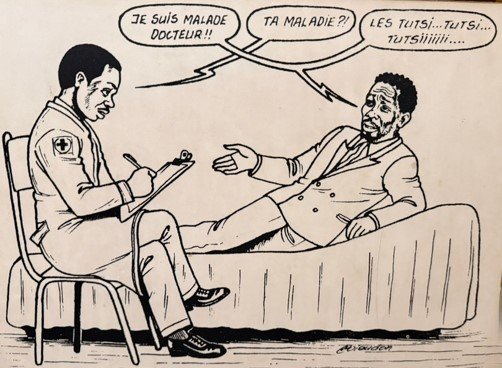
The extremist magazine “Kangura” and the radio station Radio Télévision Libre des Mille Collines (RTLM) were the two pillars of this architecture. “Kangura,” active since 1990, disseminated racist caricatures, conspiracy theories, and the infamous “Hutu Ten Commandments.” These commandments codified hostility toward Tutsi as a moral duty: they warned Hutu men against marrying Tutsi women, discouraged economic relations with Tutsi, and demanded their exclusion from public life. Presented as a normative code, they transformed prejudice into a quasi-religious ethic, preparing the ground for more radical measures.
RTLM, launched only months before the genocide, became the most influential voice of Hutu extremism. Its broadcasts reached rural areas where many were illiterate, and the radio was the primary source of information. RTLM alternated news and propaganda with extremely popular music from Zaire (now RD Congo), which contributed to its success. Its hosts spoke with expressive laughter, sneers, and a tone of mocking familiarity that made hatred feel like entertainment. They joked about Tutsi victims, described their suffering with glee, and used a visceral language that bypassed rational resistance. Because it sounded like a neighbor’s voice rather than a government decree, it was particularly persuasive.
Dehumanization was relentless. Tutsi were called “cockroaches,” “snakes,” “hyenas,” and “vermin.” These metaphors were psychological tools designed to strip the Tutsi of their humanity. When a group is described as vermin, extermination becomes not murder but hygiene. RTLM broadcasts declared that “cockroaches” had to be killed before they multiplied, or that “snakes” had to be eliminated because they were enemies of the nation. Such language made killing appear as a form of necessary cleansing.
Historical narratives reinforced this dehumanization. RTLM invoked the memory of the 1959 Hutu revolution, portraying it as a heroic uprising against Tutsi domination, and warned that Tutsi were plotting to restore their former power and enslave the Hutu majority. A largely imaginary past was weaponized to justify present violence. Listeners were told that if they did not act, history would repeat itself. The genocide was framed as preemptive self-defense, a way to prevent a supposed Tutsi conspiracy from succeeding.
Cultural references deepened the emotional impact. Songs broadcast on RTLM included lyrics urging Hutu to “cut the snake,” a metaphor for killing Tutsi. Music, which normally unites communities, was turned into a tool of mobilization for murder. The combination of music, humor, and hate speech created a powerful emotional cocktail that made violence feel not only justified but exhilarating.
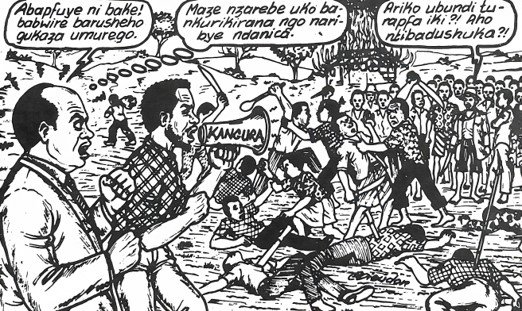
“Kangura” complemented this work in print. Its cartoons depicted Tutsi as insects, rats, or snakes, visually reinforcing the verbal dehumanization heard on the radio. Articles warned of Tutsi conspiracies, portrayed them as “enemies within,” and urged Hutu to “take a stand” and “wipe them out once and for all.” The magazine published lists of supposed traitors and RPF collaborators, effectively issuing death warrants. Tutsi women were depicted as seductive spies, Tutsi men as foreign invaders. The message was that Tutsi were not simply political opponents but existential enemies whose elimination was both legitimate and urgent.
RTLM and “Kangura” did not merely incite hatred; they helped coordinate action. During the genocide, RTLM broadcasts, particularly through anchorwoman Valérie Bemeriki, who was later sentenced to life imprisonment for her role in the genocide, named individuals, identified hiding places, and directed militias to specific locations. The station announced roadblocks, described the clothing of those trying to escape, and urged listeners to “work,” a coded term for killing. This operational role turned the radio into a command center. The International Criminal Tribunal for Rwanda later confirmed that media leaders bore responsibility for genocide, recognizing that communication can be a weapon as deadly as any machete.
The propaganda created a destructive feedback loop. Dehumanizing rhetoric made violence psychologically easier. Once violence began, it reinforced the belief that Tutsi were dangerous and had to be eliminated. The more people participated, the more they felt compelled to justify their actions, and the more they embraced the ideology that had led them to kill. The media provided the narrative framework that made this self-justification possible.
The lack of alternative information sources amplified the impact of this propaganda. In Rwanda, radio was ubiquitous and trusted. When RTLM declared that Tutsi were plotting to exterminate Hutu, many listeners believed it. When the station urged them to kill, many felt they were acting in defense of their families and their nation. The propaganda did not create hatred from nothing, but it magnified existing tensions and gave them a lethal direction.

Massimo Introvigne (born June 14, 1955 in Rome) is an Italian sociologist of religions. He is the founder and managing director of the Center for Studies on New Religions (CESNUR), an international network of scholars who study new religious movements. Introvigne is the author of some 70 books and more than 100 articles in the field of sociology of religion. He was the main author of the Enciclopedia delle religioni in Italia (Encyclopedia of Religions in Italy). He is a member of the editorial board for the Interdisciplinary Journal of Research on Religion and of the executive board of University of Pennsylvania Press’ Nova Religio. From January 5 to December 31, 2011, he has served as the “Representative on combating racism, xenophobia and discrimination, with a special focus on discrimination against Christians and members of other religions” of the Organization for Security and Co-operation in Europe (OSCE). From 2012 to 2015 he served as chairperson of the Observatory of Religious Liberty, instituted by the Italian Ministry of Foreign Affairs in order to monitor problems of religious liberty on a worldwide scale.