Seven centuries apart, a medieval military order and a Taiwanese self-cultivation community raise the same question: what happens to a state that refuses to repair a wrong it has committed?
by Peggy Chen*
*A paper presented at the session “New Perspectives on the Tai Ji Men Case“ of the CESNUR 2026 conference, Taichung, Taiwan, October 12, 2026.
Political and religious history offers many examples of communities that clashed with state power. Such conflicts cannot all be explained in the same way. Some involved genuine political rivalry, others theological disputes or economic interests, and many a combination of these factors. Communities separated by centuries, cultures, and institutional structures cannot simply be treated as historical equivalents.
The Knights Templar and Tai Ji Men are therefore compared here for a reason other than any similarity in the kind of organization they are. The Templars were a medieval Catholic military-religious order with property across several countries, political influence, and papal privileges. Tai Ji Men is a modern Taiwanese civilian self-cultivation community rooted in spiritual practice, martial arts, ethics, and traditional culture. This comparison explores the relationship between political power, spiritual communities, unresolved injustice, and collective memory.
What happens after an injustice has taken place? Does it disappear once the original political actors die, a court case ends, or the institution concerned ceases to exist? Or can it survive in social memory and continue to shape how later generations perceive authority, morality, and justice?
The Templar case offers an unusually long historical perspective on this question. Tai Ji Men, by contrast, is a contemporary case, situated within modern discussions of freedom of religion or belief (FoRB) and of the use of administrative and legal mechanisms in disputes involving spiritual communities. Here, the affected community still exists and actively seeks institutional redress. My concern in this paper has nothing to do with supernatural punishment or historical destiny. I ask the concrete question of whether unresolved injustice can become a persistent moral wound, one capable of entering collective memory and weakening the credibility of the institutions that failed to repair it.
Founded around 1120, the Knights Templar emerged in the context of the Crusades as a religious military order committed to protecting Christian pilgrims and defending the Latin Christian presence in the Holy Land. Over time, the Order developed an extensive international network of houses, estates, financial activities, and military resources. Although it had strong roots in the French-speaking world, its members, properties, and activities extended across Latin Christendom. Its wealth and unusual degree of institutional autonomy made it a powerful actor in medieval society.
By the beginning of the fourteenth century, the circumstances that had sustained the military orders were changing. The loss of the last Crusader strongholds in the Holy Land in 1291 raised questions about their future purpose, while relations between monarchies, the papacy, and religious institutions were being redefined.
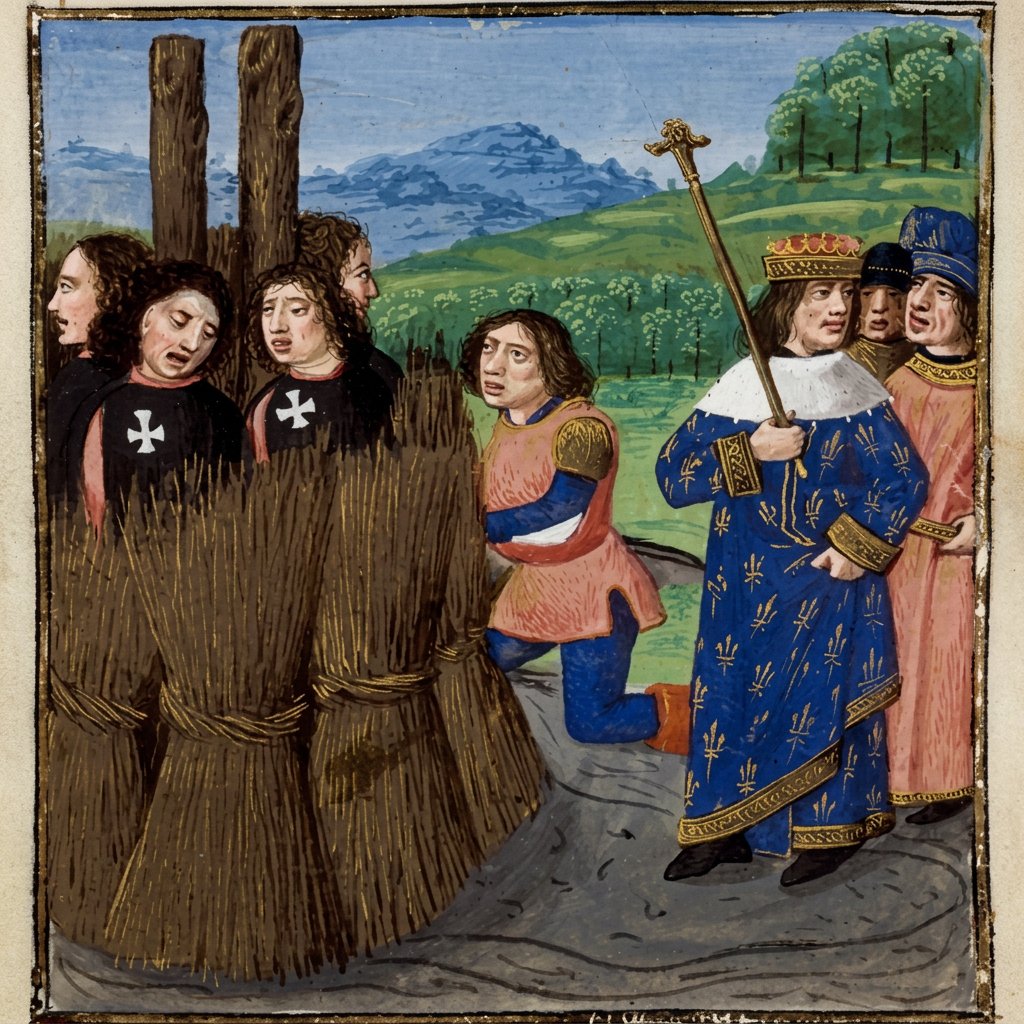
On 13 October 1307, King Philip IV of France ordered the arrest of all Templars in his kingdom. They were accused of heresy, idolatry, and blasphemous initiation rituals, among other religious and moral offenses. Many confessions were extracted under torture, and their evidentiary value has remained a subject of historical debate ever since.
Philip IV’s motives cannot be reduced to a single explanation. His financial difficulties and the Order’s assets certainly played a role, but historians have also pointed to royal centralization, the desire for political control, and resentment of the Templars’ autonomy. The papacy did not simply echo the king’s position, and Pope Clement V tried at various moments to assert ecclesiastical authority over the proceedings. Under intense political pressure, and with the Order’s reputation already destroyed, Clement V nonetheless suppressed the Templars in 1312. In March 1314, Grand Master Jacques de Molay was burned at the stake in Paris.
The memory of his death soon acquired a significance extending far beyond the judicial proceedings. A near-contemporary chronicle attributes to Molay a declaration that God would avenge the Templars’ deaths. This early tradition later grew into the much more elaborate “Templar curse.” Both Clement V and Philip IV died within months of Molay, in 1314, and within a few years the French monarchy entered a dynastic crisis as Philip’s sons died one after the other without male heirs. These events prove no causal connection, yet they helped turn the Templar affair into a powerful cultural memory of injustice and retribution.
The Order disappeared, while the memory of the injustice it suffered lived on. Over the following centuries, chronicles, legends, scholarship, and popular culture kept returning to the Templars’ fate. Modern research has substantially clarified the proceedings. The rediscovery in the Vatican archives of the so-called Chinon Parchment showed that in 1308 Clement V had absolved the Order’s leaders of heresy. Yet no institutional restoration capable of repairing the injustice in any practical sense has ever taken place. The Templar case thus illustrates one possible afterlife of unresolved injustice, in which the victim community no longer exists, and others inherit, reinterpret, and preserve its memory.
The Tai Ji Men case presents a fundamentally different situation, because its protagonists are still alive. Tai Ji Men is a menpai (similar to a school) of qigong, martial arts, and self-cultivation. In 1966, its current Shifu (Grand Master), Dr. Hong Tao-Tze, established the Tai Ji Men Qigong Academy in Taiwan. Its practices combine traditional martial arts, qigong, ethical cultivation, cultural heritage, and spiritual belief. Although Tai Ji Men is not a religion in the conventional institutional sense, conscience, self-discipline, and spiritual practice play central roles in the community’s life.
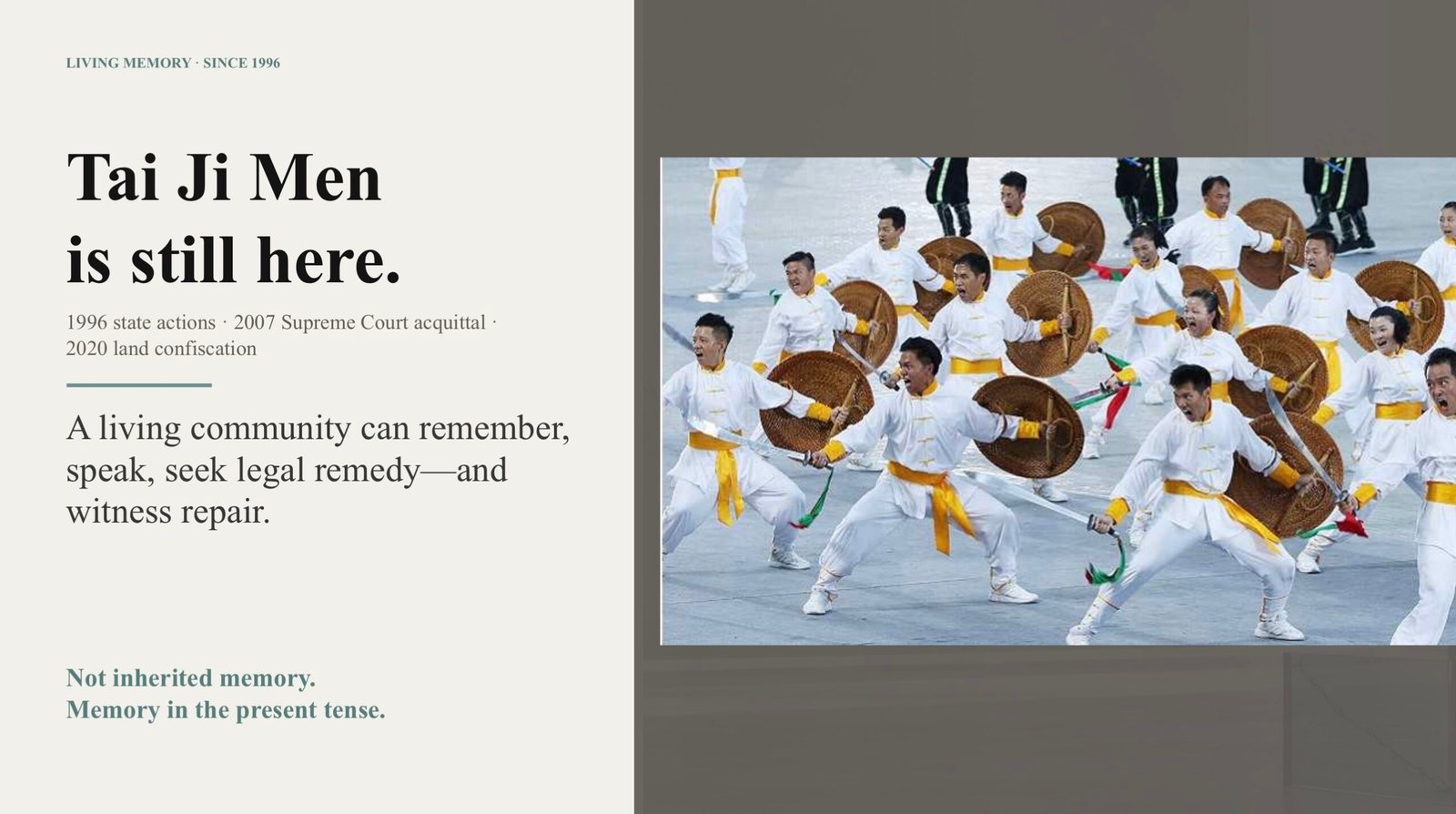
For decades, Tai Ji Men’s dizi (disciples) have taken part in cultural exchanges, public-interest activities, and initiatives promoting peace and moral education. The community has never defined its mission in terms of political power. Its prolonged conflict with the Taiwanese state began in 1996, during a crackdown that targeted several religious and spiritual groups. Criminal accusations, media stigmatization, administrative actions, and tax measures followed. Although the Supreme Court acquitted Dr. Hong of all charges, including tax evasion, in 2007, the tax bills based on the same allegations were not withdrawn, and in 2020 the state confiscated land intended to become a self-cultivation center. The result has been a controversy lasting three decades, which intersects directly with modern scholarship on human rights and administrative justice.
Tai Ji Men has consistently sought remedies through legal procedures, public advocacy, and non-violent action, and its dizi have continued to take part in international cultural, peace, and public-interest activities despite the unresolved dispute with the state. This creates a significant moral tension. A democratic state may celebrate a community’s cultural and diplomatic contributions while failing to repair what that community experiences as a serious institutional injustice. What is at stake goes beyond persecution and touches on the very capacity of modern democratic institutions for self-correction.
The case has spanned several political administrations, raising a difficult institutional question: why can an injustice remain unresolved even after the original political context has changed?

Here the contrast with the Templars could hardly be greater. The Templars disappeared and became passive subjects of historical reconstruction, whereas Tai Ji Men remains a living, active community. Its members produce, articulate, and transmit the memory of what happened to them, instead of waiting for later historians to do it. They have also transformed their collective experience of injustice into broader educational and advocacy efforts concerning conscience, tax reform, and FoRB. The Templar case is an inherited memory of injustice, while Tai Ji Men is a living memory engaged in constructive moral resistance.
This distinction lets the comparison move beyond organizational differences and illustrate two distinct stages in the life of an unresolved injustice. In the Templar case, the institution vanished while the memory survived. Later generations reconstructed the episode through historical documents, religious imagination, and legend. The persistence of the “curse” narrative may reflect a cultural response to a perceived failure of earthly justice. Societies whose institutional avenues of repair are closed may construct narratives in which divine, historical, or symbolic justice eventually intervenes.
Collective memory is how communities remember, interpret, transmit, and give moral significance to the past, and scholarship asks why certain memories survive and how they function. The Tai Ji Men case raises this question before the transition from lived experience to distant history is complete. What will future generations inherit? If an institutional dispute lasting several decades remains unaddressed, the memory transmitted may go well beyond administrative or tax details. It may become a story about whether a democratic state could honor its own constitutional and human rights promises.
The effects of unresolved injustice may also extend beyond the direct victims. It may erode public confidence that the government treats its citizens fairly. It may undermine institutional legitimacy by widening the gap between the values a state proclaims and how its procedures actually work. And it may weaken a society’s moral self-understanding, shaking its confidence in the democratic promise of legal reliability. Such harm is neither mystical nor abstract. It is tangible, and it is at once moral, cultural, and institutional.
Both cases ultimately bring us back to conscience, understood here as a society’s capacity for moral self-reflection and its ability to confront discrepancies between proclaimed democratic principles and actual institutional conduct. In this light, unresolved injustice is a critical test of collective conscience. An institution may gain a short-term administrative or political advantage by refusing to acknowledge an error, yet that refusal may inflict long-term damage on its own moral authority.
Historical rehabilitation matters. Public acknowledgment cannot undo past suffering or resurrect a suppressed medieval order, but it can reshape collective memory by showing that a society can engage in critical self-examination. Tai Ji Men offers a distinctive opportunity in this respect, since repair can still happen in the present and need not be only retrospective. Because the community is alive, its members can still take part in dialogue, pursue a legal resolution, and witness institutional correction. The ultimate contrast is between an injustice that has passed irreversibly into legend and one for which meaningful institutional repair remains possible—and is still being actively pursued.
The Knights Templar and Tai Ji Men are separated by seven centuries, by different civilizations, and by very different structures. Their comparison nonetheless sheds light on a broader dynamic: injustice against a spiritual community does not necessarily fade with time. Serious wrongs left uncorrected may become embedded in collective memory and affect a society’s moral self-understanding. For a state, the most damaging consequence may come as a quiet, enduring erosion of institutional legitimacy and public trust, even without any immediate political crisis.
For societies committed to religious freedom, spiritual diversity, and the rule of law, correcting institutional errors has little to do with special tolerance toward a specific group. It is part of defending the state’s own moral credibility. Comparing these two cases leaves us with a final question. If a state fails to repair an injustice committed in the name of authority, what does it ultimately risk losing: the trust of the targeted community, its institutional legitimacy, or part of its own moral memory?

Peggy Chen graduated at Université Sorbonne Paris Nord with a MD in modern French literature. She works as a freelancer in online marketing and is a volunteer of the Association of World Citizens and a Tai Ji Men dizi (disciple). She has attended taxpayers’ rights conferences in the Netherlands and Moldova.