How an exiled queen claimed to be an incarnation of the spirit and transformed a spiritual movement into an anti-colonial revolt.
by Massimo Introvigne
Article 2 of 3. Read article 1.
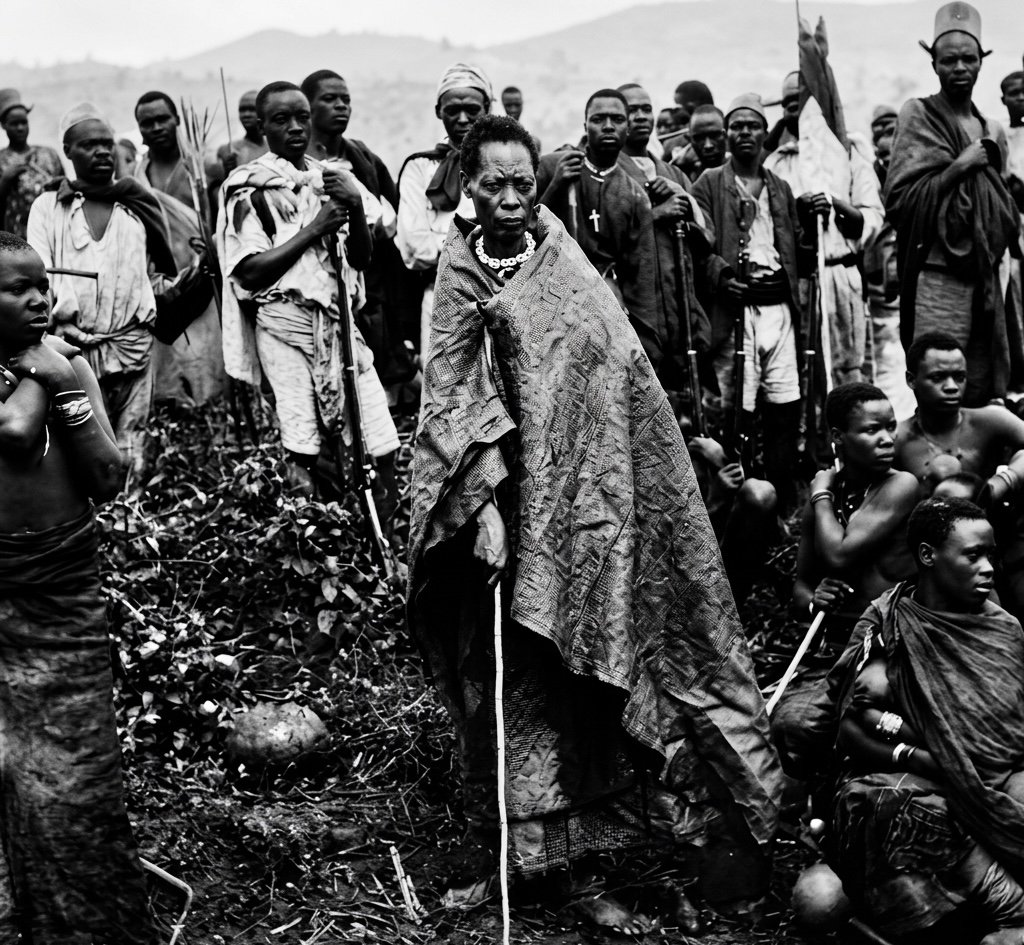
The “abagirwa” or “bagirwa” (singular: “mugirwa”), the mediums or priests of the Nyabingi cult, acquired great power. People respected and feared them, and their influence extended beyond the spiritual sphere. They were criticized for the frequency and intensity of their requests for offerings and for the authority they exercised over their followers. Indeed, bagirwa might be called “kings,” which exacerbated tensions with the court. A man living near the border with Rwanda in Uganda told anthropologist Elizabeth Hopkins that “my cattle died of 1936 rinderpest, and when I was in sorrows then there came to me a Munyarwanda man [a Rwandese] and told me that I should not cry because my cattle died, as there was a new king at a village called Kibeho [in Rwanda]… that he is saving people by giving them cattle as presents.” The “new king” was a mugirwa of the Nyabingi cult.
Many abagirwa were women, giving the cult a distinctive character in the region. Additionally, in the words of political scientist Murindwa Rutanga, “The selection of young females into the ranks of Nyabingi religion was highly secretive, mysterious, and frightening. This process always took place at night. The sign for the selected girl was a metallic rod, which would be placed in between the thighs of the chosen girl. From that morning, it would be clearly known how Nyabingi had selected so-and-so into its service. No one would object or contradict this choice.”
These girls did not follow the usual path of marriage and family, even though senior abagirwa could arrange marriages within the cult. Some of them became figures of considerable power and renown.
The cult of Nyabingi went through several phases. In present-day Uganda and Rwanda, it became a vehicle for early peasant social protest. A decisive moment came after the death of Rwanda’s King Kigeli IV Rwabugiri (1840–1895) in 1895. Rutarindwa (d. 1896) succeeded him, but a coup in 1896 replaced him, bringing Musinga (1883–1944) to the throne. One of Rwabugiri’s wives, Muhumuza (d. 1944 or 1945), contested the succession, claiming that her son, Ndungusi (d. 1912), was the legitimate heir. She fled to Uganda and presented herself as an incarnation of Nyabingi. Muhumuza was familiar with the cult, which her husband, Rwabugiri, had tried to suppress by executing several abagirwa. Yet she did not fit the traditional profile of the abagirwa, who were usually chosen as young girls. She joined the cult as a mature woman and transformed it into a political force.
Devotees believe that Nyabingi’s presence in the medium “is manifest through stylized trembling movements, ventriloquism, and the ability to hold a dialogue with the spirit in an esoteric language and falsetto.” Colonial officers reported on Muhumuza that “by dint of years of training, she has acquired a high falsetto voice and professes inability to walk normally, her method of position being on tip-toe in a crouching position with the aid of two sticks. The chiefs, with scarcely an exception, trembled whenever her look was directed toward them.”
Some historians have interpreted the movement led by Muhumuza, which attracted several Hutus, as an early anti-Tutsi Hutu insurrection. This interpretation is anachronistic, although it is true that among her followers there might have been individuals who had participated in the earlier rebellion led by Nyirashirembere, known as Nyirafugi, the Mistress of Fugi (d. 1892 or 1895). Nyirafugi had been confined for mental illness, but she escaped and began preaching in Fugi, in southern Rwanda, presenting herself as an incarnation of the Creator God Imana. She gathered followers among local Hutus and used slogans hostile to Tutsi chiefs. The Rwandan army defeated the movement. Nyirafugi escaped to Burundi, was sent back to Rwanda, and was executed.
Ndungusi eventually became a mugirwa like his mother, and together they led anti-colonial Nyabingi revolts against the Germans in Rwanda and the British in Uganda. In Rwanda, Ndungusi joined an anti-German insurrection by the Twa (“Pygmies”), the third ethnosocial group in Rwanda with the Tutsi and the Hutu, and one that is small, marginalized, and despised. German forces crushed the revolt, and the Twa leader Basebya (d. 1912) was executed. Basebya remains a legendary figure in Rwanda and is celebrated in folk tales and popular songs. However, as reported by José Kagabo and Vincent Mudandagizi in a study on Twa-connected folklore, “his mother was said to be the daughter of a great Tutsi chief”. According to custom, she was abandoned in the forest, as was done with unmarried mothers, then taken in by the Twa and later married by one of them. She was said to have given birth to Basebya. This rumor is highly revealing of the general ideas about the Twa: to justify the military successes and the renown of one of them, it becomes necessary to invent for him a lineage that is, at least in part, foreign to his own group.
Félix Dufays (1877–1954), a Catholic White Father priest from Luxembourg, reported that Basebya controlled a significant territory and that he had to secure his permission to found a mission there.
The Germans claimed that they had also killed Ndungusi in 1912. However, in subsequent years, several men appeared, claiming to be Ndungusi and insisting that the German reports were false. One of these Nyabingi abagirwa claiming to be Ndungusi was arrested as late as 1930.
Muhumuza herself was detained by the Germans in 1908 but escaped in 1911. A joint German-British operation led to her arrest in 1911. She was deported to Mengo, a neighborhood of Kampala, where the British reported with concern that she continued to hold court and receive Nyabingi devotees for several years. She died in 1944, or, according to other sources, in 1945.

Massimo Introvigne (born June 14, 1955 in Rome) is an Italian sociologist of religions. He is the founder and managing director of the Center for Studies on New Religions (CESNUR), an international network of scholars who study new religious movements. Introvigne is the author of some 70 books and more than 100 articles in the field of sociology of religion. He was the main author of the Enciclopedia delle religioni in Italia (Encyclopedia of Religions in Italy). He is a member of the editorial board for the Interdisciplinary Journal of Research on Religion and of the executive board of University of Pennsylvania Press’ Nova Religio. From January 5 to December 31, 2011, he has served as the “Representative on combating racism, xenophobia and discrimination, with a special focus on discrimination against Christians and members of other religions” of the Organization for Security and Co-operation in Europe (OSCE). From 2012 to 2015 he served as chairperson of the Observatory of Religious Liberty, instituted by the Italian Ministry of Foreign Affairs in order to monitor problems of religious liberty on a worldwide scale.