The court case is a classic example of anti-cult bias. The children should be allowed to return home.
by Susan J. Palmer
Article 3 of 3. Read article 1 and article 2.
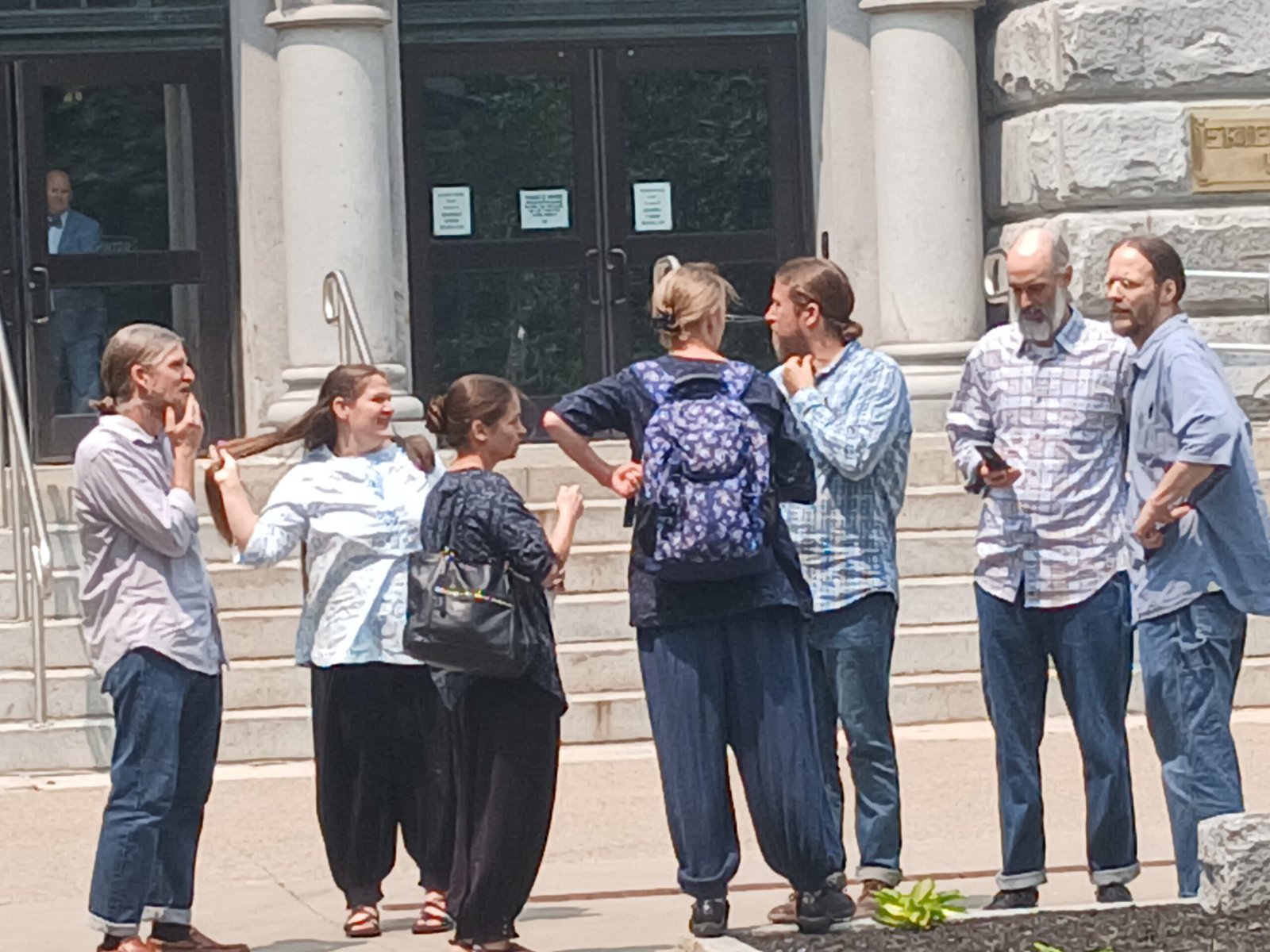
The trial opened on July 16, 2026, at the Erie County Courthouse in Buffalo. That day, all but one of the six lawyers representing the children insisted there were no signs of neglect; that the children loved their parents and were begging to come home. They also pointed out that several children had suffered abuse during their five months of foster care. One child was burned, another taken to hospital because a lock of hair had been torn out of her scalp by another foster child. The parents’ ten lawyers also spoke of neglect in the foster homes; the children often sat alone for hours in front of a television. Ironically, the children were not provided with teachers and had received no education over five months of foster care. Yet, the CPS had objected to the parents’ continuing compliant home-schooling.
The confessed rapist appeared in chains on the opening day of the trial. His three children had also been seized by CPS, leaving his young wife bereft of her disgraced husband and her children. Thus, he was also one of the ten parents on trial. He wore an orange suit, and his head was shaven. (One brother explained he wouldn’t be allowed to keep the hair tie that all the men used to keep their collar-length hair tied at the back of their necks.)
The prisoner asked the judge for permission to make a statement, which she granted. He stood up in court and declared his regret at bringing shame and disaster upon his community. He also stated that no one had been aware of his plan for the girl, that he had perpetrated the crime secretly; that it happened under cover of darkness. He had asked her to meet him in the print shop in the early morning hours when everyone was asleep. (This was an important admission, because the members were being investigated for possibly facilitating or covering up the crime).
In their analyses of conflicts and controversies involving children in new religious movements (NRMs), scholars have identified anti-cult activists as the “moral entrepreneurs” behind the action. And what about the overwhelming majority of NRMs that are unresearched and hold uneventful track records—groups whose ex-members and second-generation adults have not yet complained? Is it fair or appropriate that members of NRMs must suffer being framed as child abusers, negligent parents, or “pedophiles,” or find their community dubbed as “the next Waco” in the morning newspapers, despite no evidence of any wrongdoing? Is it fair for religious parents to lose custody of their beloved children just because some obscure anti-cult group, or self-made podcaster, or estranged husband or wife in the throes of a custody battle has branded their religion as a “cult”?
Academic researchers need to craft and promote a more nuanced, value-free paradigm that will serve to counter the current misinformation and prejudices regarding “kids in cults” that prevail in the mass media, judicial system, and among law enforcement agents and social workers. As the history of the Twelve Tribes has shown, this ignorance and anti-cult bias will often have real-world and tragic implications for innocent parents and children.
I have read of cases where children were removed by social workers simply because their parents held unsavory beliefs. A poignant example is the breast-feeding baby whose mother was in the Aryan Nations, hence a believer in White Supremacy. But why punish the baby? Do babies imbibe racial prejudice through their mother’s milk? And why not allow for the future possibility that the mother might change her beliefs, or that the child might grow up to reject her parents’ faith?
While policewomen and social workers are presumably motivated by sincere concerns about the safety of children in their investigations of obscure, unconventional religions, can the same be said for family court judges, journalists, and politicians who have expressed the opinion that, for the child, just living in a spiritual commune or “cult”—in itself—constitutes harm, or risk of harm?
In my experience as an expert witness for the Twelve Tribes, The Family International, and other NRMs embroiled in child-custody disputes in Canada, the USA, England, France, and Germany, I have heard judges, lawyers, and social workers raising the same issues and asking the same kinds of questions.
Question One is: “Should we allow the children of our nation to grow up in cults—environments where they are indoctrinated into unrealistic, useless views of the world?”
My response to that is: “How are the beliefs found in ‘cults’ any more unrealistic, useless, or phantasmagoric than those found in conventional religions—like the Virgin Birth or the Risen Christ?”
Question Two is: “But do their teenagers have the power to leave? If so, are they equipped to survive in our normal society?”
My answer is: “That depends on which NRM they were raised in. There are many examples of successful actors, film directors, and novelists who were raised in unconventional religions, such as the Children of God, the Church Universal and Triumphant, Tenrikyo in Japan, and the Institute for the Harmonious Development of Man at Fontainebleau, France. Many NRMs raise their children with a strong work ethic and teach them useful practical skills like cabinet making, farming, cooking, auto repair, building construction, and home renovation. Some of Twelve Tribes’ second generation who left the community have become solar engineers, successful business entrepreneurs, medical assistants, and one is an air traffic controller.”
Question Three is: “How can we even talk about the possibility of children, born into the cults, exercising their ‘constitutional right’ to choose their own faith?”
My response to that statement is: “Of course children have not yet developed the intellectual capacity to deal with issues of religious freedom. But when children, seized by social workers and dumped in a strange foster home, begin to scream, cry, and vomit, they are exercising their natural human right to demand to be with their own, beloved, familiar parents.” Moreover, the right to family integrity is recognized as a coveted liberty interest by the U.S. Constitution, worthy of the highest standard of protection (strict scrutiny) under the 5th and 14th Amendments.

What I have often detected (or suspected) is that, behind a judge’s decision to award custody to the secular “irreligious” parent, is a distinct bias; that our pluralistic, secular culture is superior to the inferior cultures of the “cults.” This bias is driven by the concern that if children remain with religious parents, they risk being deprived of an education, “critical thinking” skills, future job opportunities, and all the pleasures and privileges of the modern secular world.
One might point out that the same bias was behind the Canadian and Australian governments’ decisions to place the children of indigenous people in residential schools.
The Twelve Tribes have weathered child welfare investigations and/or police raids in eight countries, prompted by concern over their methods of childrearing and discipline. Sociologists Rigal-Cellard, Palmer, and Melanson found that in all but one country (Germany), the Twelve Tribes were permitted to keep their children and pursue their alternative home schooling and disciplinary practices.
As the trial in Hamburg continues to progress at a “snail’s pace,” the CPS recently offered to dismiss one family’s petition if they agreed to hold joint custody of their two young daughters (4 and 1) for an indeterminate period with the maternal grandmother. The parents gladly agreed, and their case of neglect has been dismissed. The CPS found no evidence of neglect against this family; their only objection was that they lived in a Twelve Tribes home. As of this writing, four families are still caught up in the court process, and their twelve children in foster care are clamoring to return home.
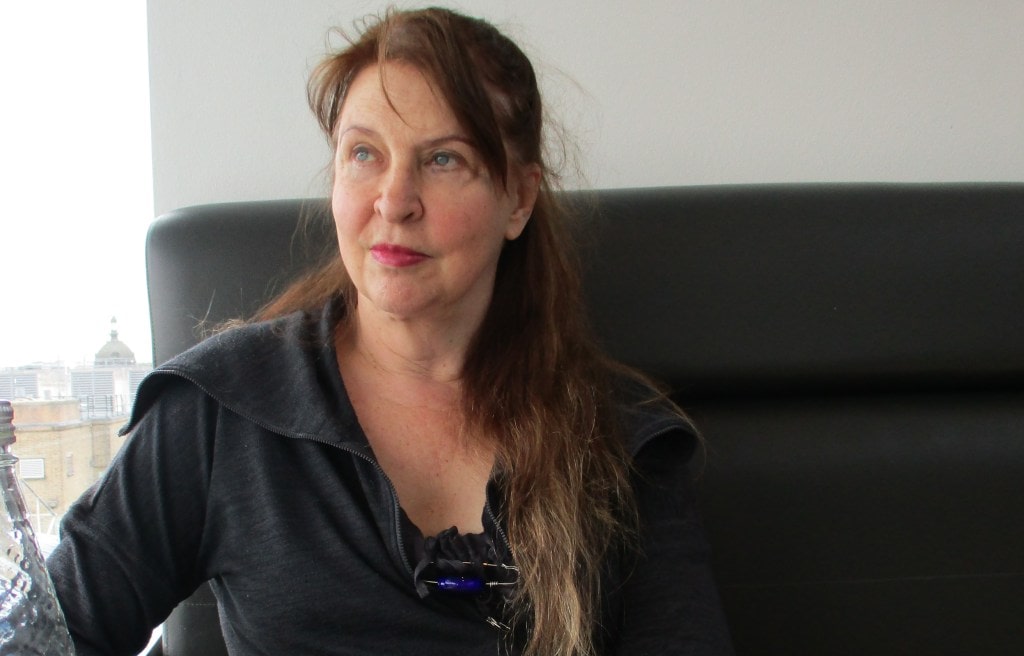
Susan J. Palmer is an Affiliate Professor in the Religions and Cultures Department at Concordia University in Montreal. She has directed the Children on Sectarian Religions and State Control project at McGill University, supported by the Social Sciences and the Humanities Research Council of Canada (SSHRC). She is the author of fourteen books, notably The New Heretics of France (Oxford University Press, 2012).