The Agency for Cultural Affairs vows to go on with its drastic measures to liquidate the Unification Church if the dissolution decision is confirmed on appeal.
by Massimo Introvigne

As specialists of China, we at “Bitter Winter” have grown accustomed to the ritual: a government agency releases a draft policy restricting liberty, solemnly invites “public comments,” and then—like a magician pulling a rabbit from a shredder—announces that the negative feedback was either irrelevant, misinformed, or suspiciously coordinated. Now, it happens in a democratic country, Japan. In fact, Japan’s Agency for Cultural Affairs has taken this cynical choreography to new heights with its draft guidelines for the liquidation of religious corporations—guidelines that seem tailor-made to strip the former Unification Church of its assets while pretending to uphold religious freedom.
On September 3, 2025, the Agency unveiled its draft for how “designated religious corporations” should be liquidated after dissolution. The only currently “designated” organization is the Family Federation for World Peace and Unification, formerly known as the Unification Church. Note that, if the first-degree dissolution decision is confirmed on appeal, liquidation will start immediately notwithstanding a likely appeal to the Supreme Court.
The guidelines include provisions for a long-term window for filing claims, including “late applications” from hypothetical future victims; a compensation foundation to act on behalf of the dissolved religious entity; “consultation services” and “explanatory meetings” that seem designated for fishing for new “victims,” and liquidators empowered to dispose of all assets, including those tied to religious use. The guidelines provide that “non-religious real estate should be disposed of first”—a cosmetic nod to religious freedom, so long as it doesn’t interfere with liquidation.
In short: a blueprint for asset seizure dressed up as victim relief. The draft even suggests that members may continue using facilities “insofar as this does not interfere with liquidation”—a bit like telling someone they can keep living in their house until the bulldozers arrive.
But here’s where the farce turns Orwellian. After receiving 2,649 public comments—many of them expressing concern over religious freedom violations—the Agency decided to ignore them. Why? Because the remarks “closely echoed” arguments found on the Family Federation’s website. In other words, if you’re a member of the targeted religion, your opinion doesn’t count. If you’re not, but happen to agree with them, you don’t count either. This is not public consultation. It’s ideological gatekeeping.
Among the discarded concerns were statements like: “In deference to freedom of religion, assets devoted to religious purposes should not be used as resources to repay debts.” And: “Granting liquidators authority to manage or dispose of a corporation’s property constitutes an infringement of religious freedom.”
The Agency answered that these points were “already discussed” in expert panels, so no need to revise the draft. Translation: thanks for your input, now kindly watch us ignore it.
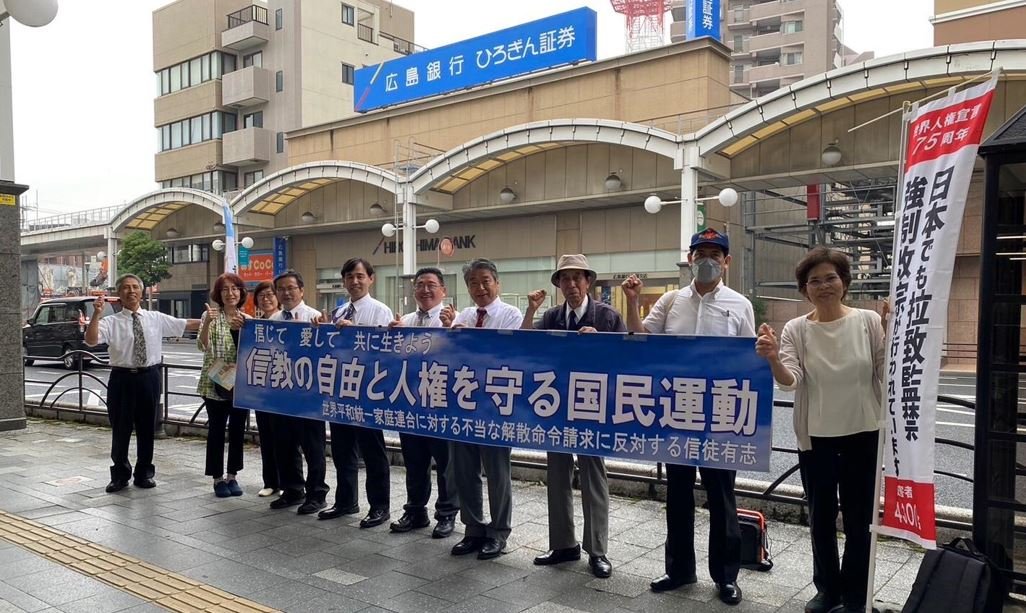
The resemblance to China’s legislative theater is uncanny. There, too, draft laws are published for comment, only to be rubber-stamped regardless of public reaction. Japan’s Agency for Cultural Affairs seems to have borrowed the Chinese playbook wholesale: solicit feedback, dismiss dissent, and bulldoze ahead.
The United Nations has already condemned Japan’s treatment of the Unification Church. In a blistering report, UN Special Rapporteurs warned that “the civil tort rulings on which the dissolution decision was based on relies on the violation of ‘social appropriateness’ which were deemed to constitute a serious harm to ‘public welfare’. As previously noted by the Human Rights Committee the concept of ‘public welfare’ is vague and open-ended and may permit restrictions exceeding those permissible under the International Covenant on Civil and Political Rights.”
In short, the United Nations statement implied that the dissolution of the Unification Church and the liquidation of its assets because its behavior is regarded as not “socially appropriate” may constitute a violation of the right to freedom of religion or belief.
A government agency that drafts liquidation guidelines under the guise of victim relief, invites public comment only to dismiss it as “cult” propaganda, and ignores international warnings about religious discrimination also violates freedom of religion or belief and the basic principles of democracy. If this is cultural policy, it’s the culture of authoritarianism.
Japan’s Agency for Cultural Affairs may claim to protect “victims,” but its real victim is freedom of religion or belief. And those who defend religious liberty are reduced to a chorus of voices the government refuses to hear.

Massimo Introvigne (born June 14, 1955 in Rome) is an Italian sociologist of religions. He is the founder and managing director of the Center for Studies on New Religions (CESNUR), an international network of scholars who study new religious movements. Introvigne is the author of some 70 books and more than 100 articles in the field of sociology of religion. He was the main author of the Enciclopedia delle religioni in Italia (Encyclopedia of Religions in Italy). He is a member of the editorial board for the Interdisciplinary Journal of Research on Religion and of the executive board of University of Pennsylvania Press’ Nova Religio. From January 5 to December 31, 2011, he has served as the “Representative on combating racism, xenophobia and discrimination, with a special focus on discrimination against Christians and members of other religions” of the Organization for Security and Co-operation in Europe (OSCE). From 2012 to 2015 he served as chairperson of the Observatory of Religious Liberty, instituted by the Italian Ministry of Foreign Affairs in order to monitor problems of religious liberty on a worldwide scale.