A Spanish painter celebrated across Europe sought in Theosophy a spiritual grammar capable of transforming the Ten Commandments into a metaphysical journey.
by Massimo Introvigne
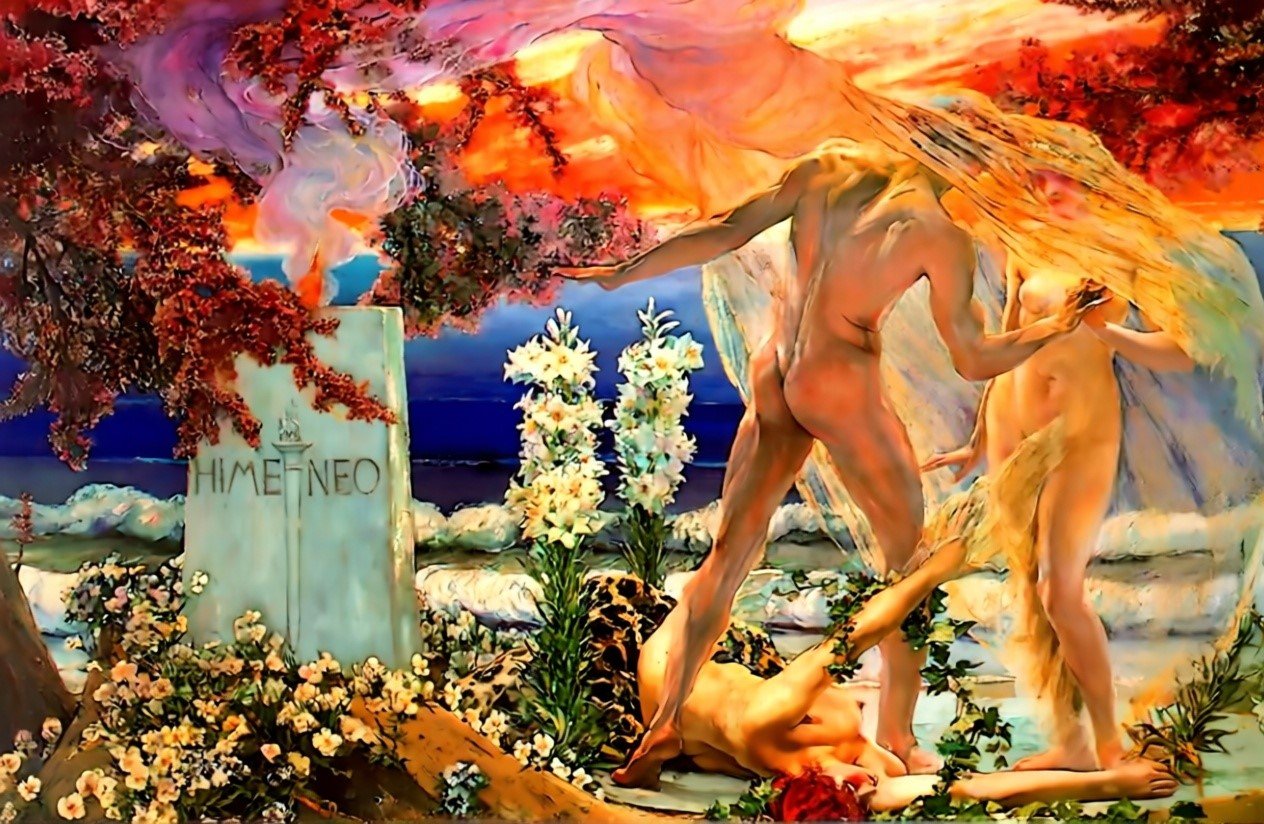
José Villegas Cordero, born in Seville in 1844, was one of the most admired Spanish painters of his generation. He trained at the Escuela de Bellas Artes and in the Prado’s galleries, where he copied Velázquez, Goya, Titian, and Ribera. Rome shaped his artistic maturity through the influence of Eduardo Rosales and Mariano Fortuny. His international reputation grew steadily, and he became a member of fourteen European academies. From 1901 to 1918, he served as director of the Prado Museum, reorganizing collections, archives, and conservation systems with unusual energy. He produced more than a thousand paintings and three hundred portraits. His final years were marked by blindness, and he died in 1921.
Behind this official biography, a spiritual itinerary developed that connected him to Theosophy. Mario Méndez Bejarano (1857–1931), in his “Historia de la filosofía en España hasta el siglo XX,” called him “a steadfast Theosophist.” He attended the Centro de Estudios Teosóficos of Seville, active in the calle Sierpes, which gathered young intellectuals who combined civic engagement with metaphysical aspirations. Villegas absorbed symbols, readings, and ideas from this environment.
Villegas affirmed that art needed an ideal and that symbolic painting offered a new horizon. Out of this conviction emerged the most ambitious project of his life: “The Decalogue,” a cycle of twelve large canvases conceived between 1902 and 1916 and exhibited in Madrid, Seville, and Paris.
The painter wrote a poetic commentary for the exhibition held in Seville in November 1916. It was distributed to visitors in printed form. The text interpreted the Ten Commandments as stages of a (Theosophical) spiritual ascent. Villegas replaced prohibitive language with exhortations that encouraged virtue and awareness. The cycle consisted of a “Prologue,” ten paintings dedicated to the Commandments, and an “Epilogue.” All figures were nude because he believed that clothing would introduce conventions foreign to the symbolic dimension.
Two priests, Manuel Serrano Ortega and Fraile, accused the series of heterodoxy. Federico Roldán, prosecutor of the archbishopric, defended the paintings. During the ceremony honoring Villegas, the painter thanked the people of Seville for understanding the symbolic meaning of the works and for perceiving the Theosophical ideas embedded in every tone, figure, and detail. Schoolchildren were brought by their teachers to view the cycle, and the city discussed the paintings for weeks.
The twelve paintings are preserved today in a private property in La Puebla del Río. They were reproduced by the worthy website “El Estudio del Pintor” in 2014.
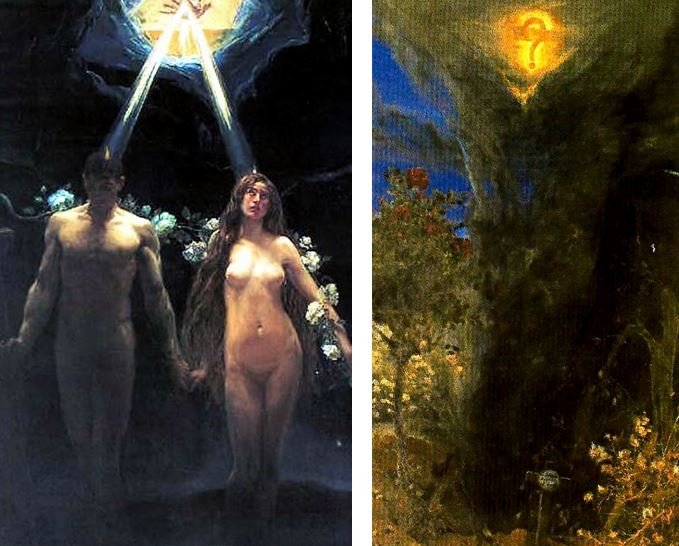
The Prologue, titled “The Creator,” presents the Supreme Maker generating the “pilgrims of Life” and linking them with “chains of roses.” The theme is the birth of the soul and its path toward light. The atmosphere recalls the Italian Quattrocento and the English Pre-Raphaelites, two constant references throughout the cycle.
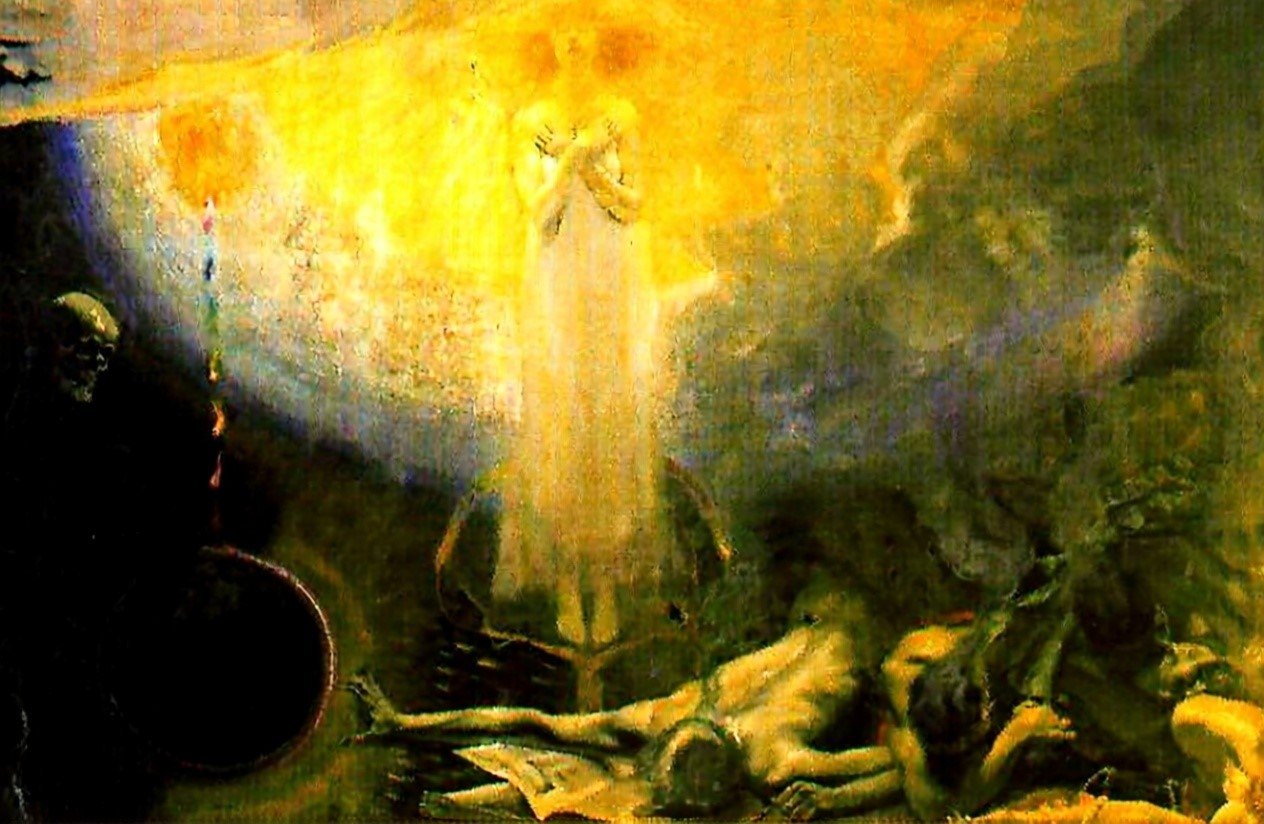
The First Commandment, “Matter Dies, the Spirit Lives,” is the most elaborate canvas. At its center stands the Tree of Knowledge, radiating a light that illuminates the phrase “Blessed are those who do not see and yet believe.” Bodies stretch among trophies of human vanity dissolved into colored vapors, each associated with a vice according to the chromatic symbolism promoted by Theosophists such as Leadbeater. A female figure dressed in white crosses her arms over her chest and rises toward a circle of celestial light. A serpent biting its tail forms the symbol of Eternity, and a skeleton observes the rotation of the circle. The composition expresses the transformation of matter and the ascent of the spirit, a core theme of Theosophy.
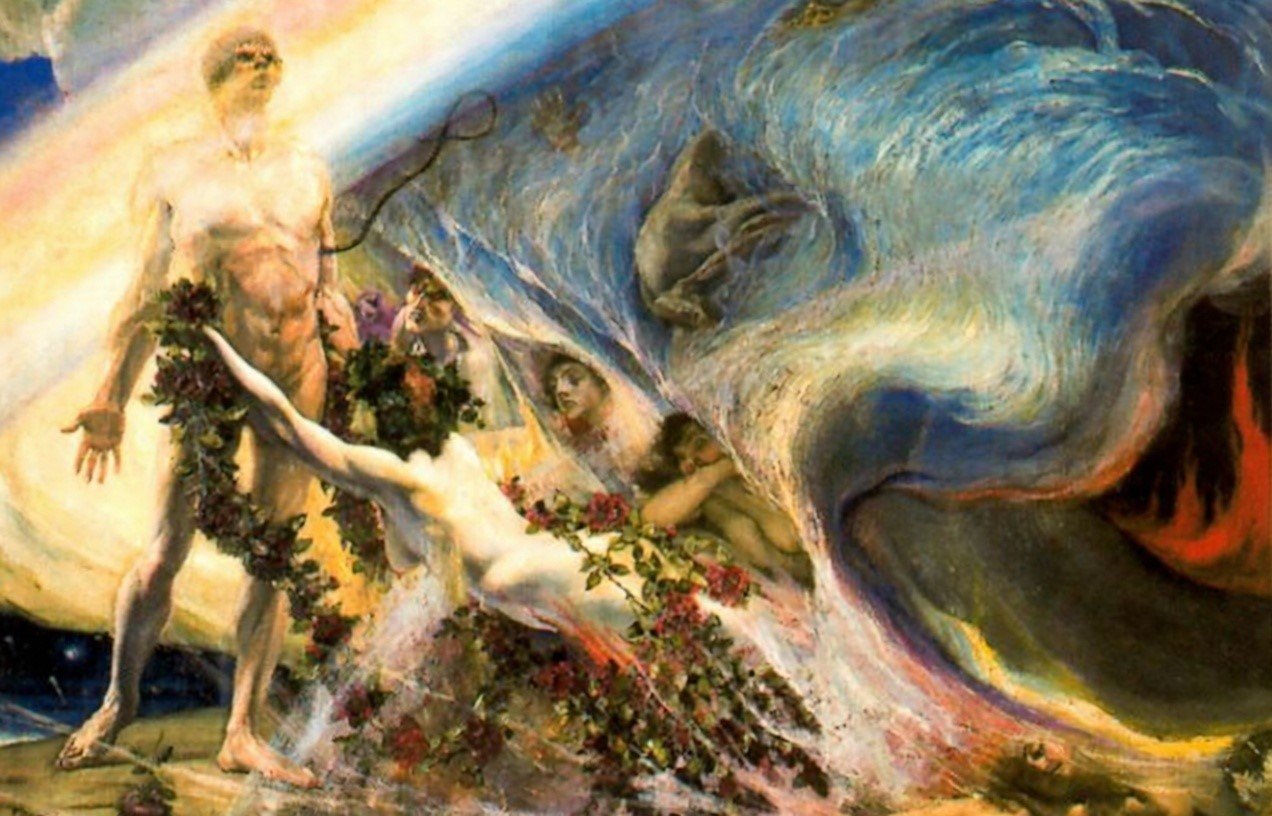
The Second Commandment, “Evils Surround and Embrace Us,” depicts the forces that envelop human consciousness: lust, sloth, gluttony, greed, envy, pride, and anger. Figures and vegetal symbols intertwine to create an atmosphere of tension. The painting conveys the struggle against impulses that distort inner clarity and obstruct spiritual elevation.
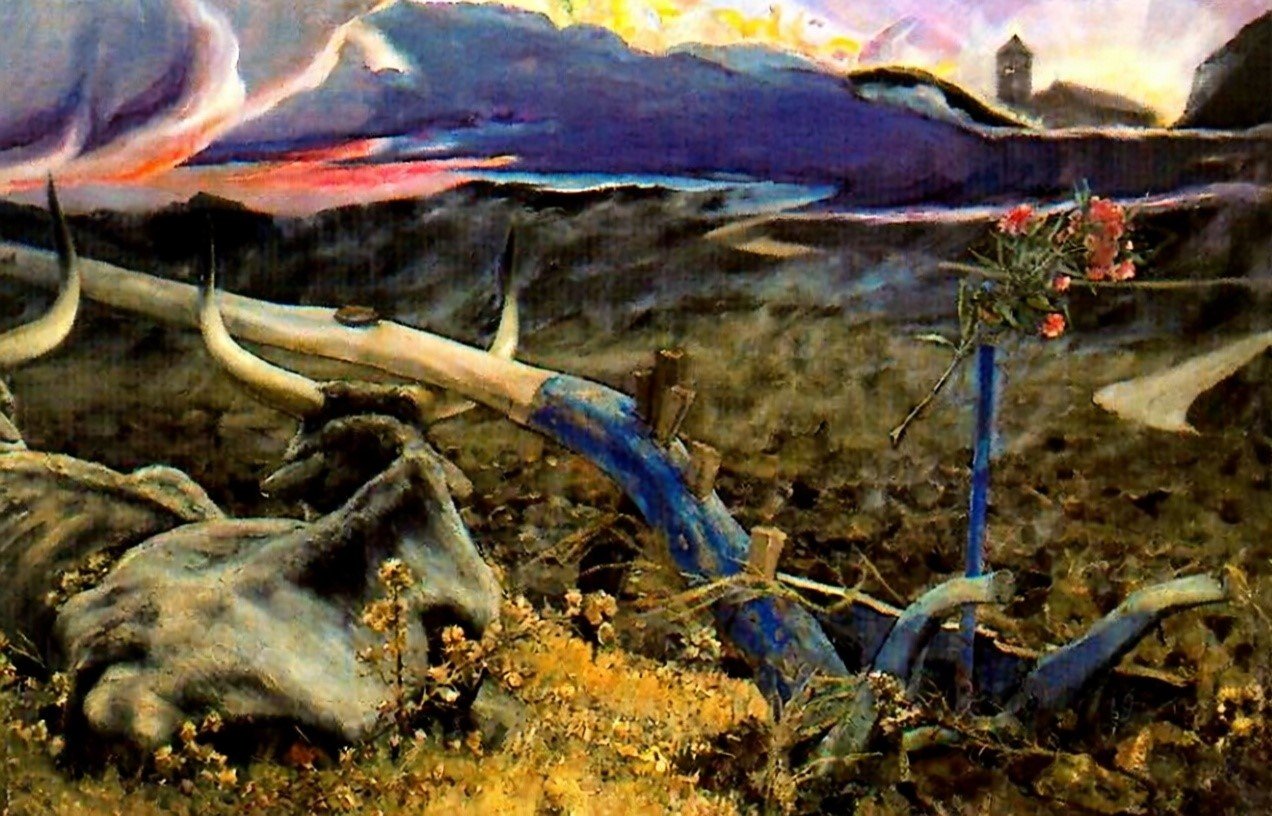
The Third Commandment, “Rest,” evokes the quiet of a rural church and the dedication of the day to the Supreme. The theme is the harmony of nature and the need for repose as a condition for interior serenity.
The Fourth Commandment, “Help Your Parents,” shows a scene of guidance and protection. Figures advance through a dark zone toward a luminous region, supported by a young man who opens the path. The painting translates gratitude and reciprocity into symbolic form.
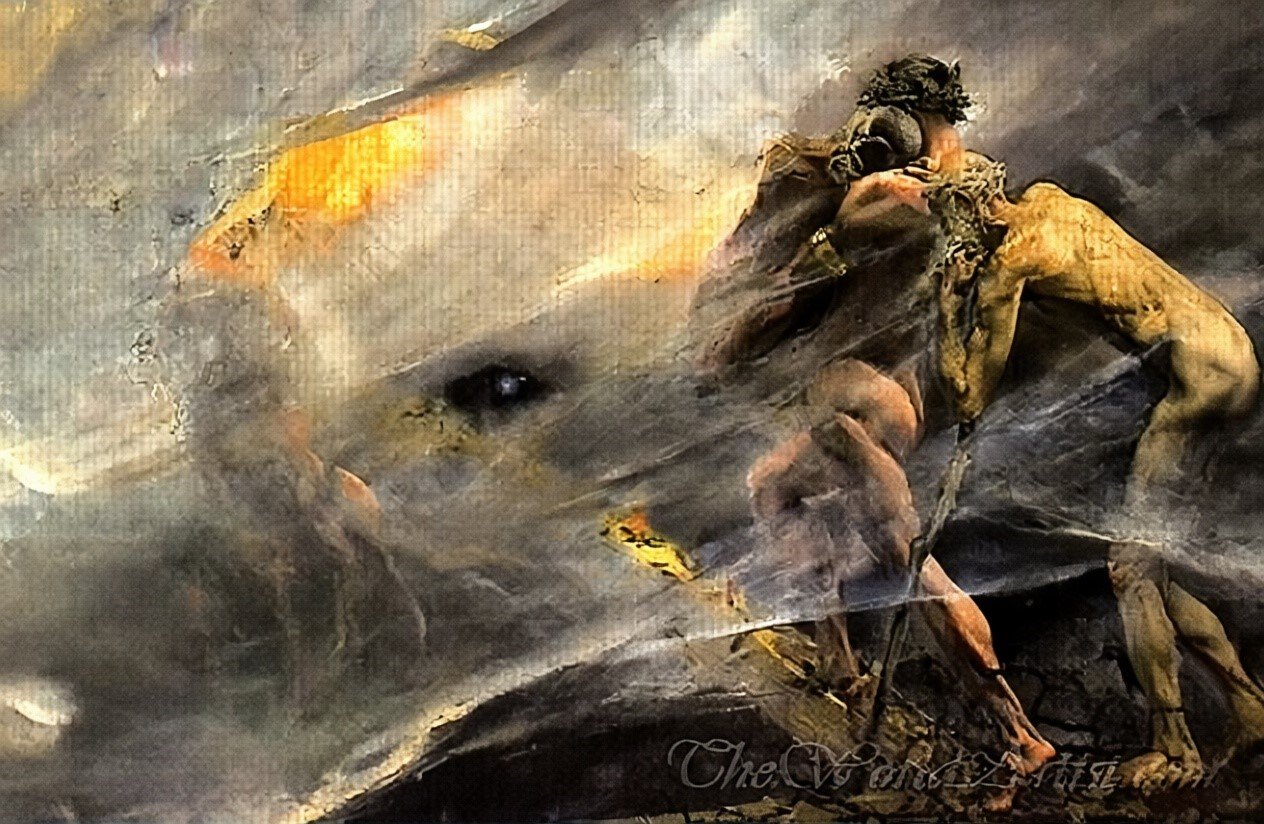
The Fifth Commandment, “Forgive Your Neighbor,” illustrates the Law of Love brought by Jesus. An olive tree grows from the roots of the cross, symbolizing reconciliation. Figures approach one another with gestures of openness, and the composition suggests the dissolution of discord (perhaps of Cain and Abel) through mercy.
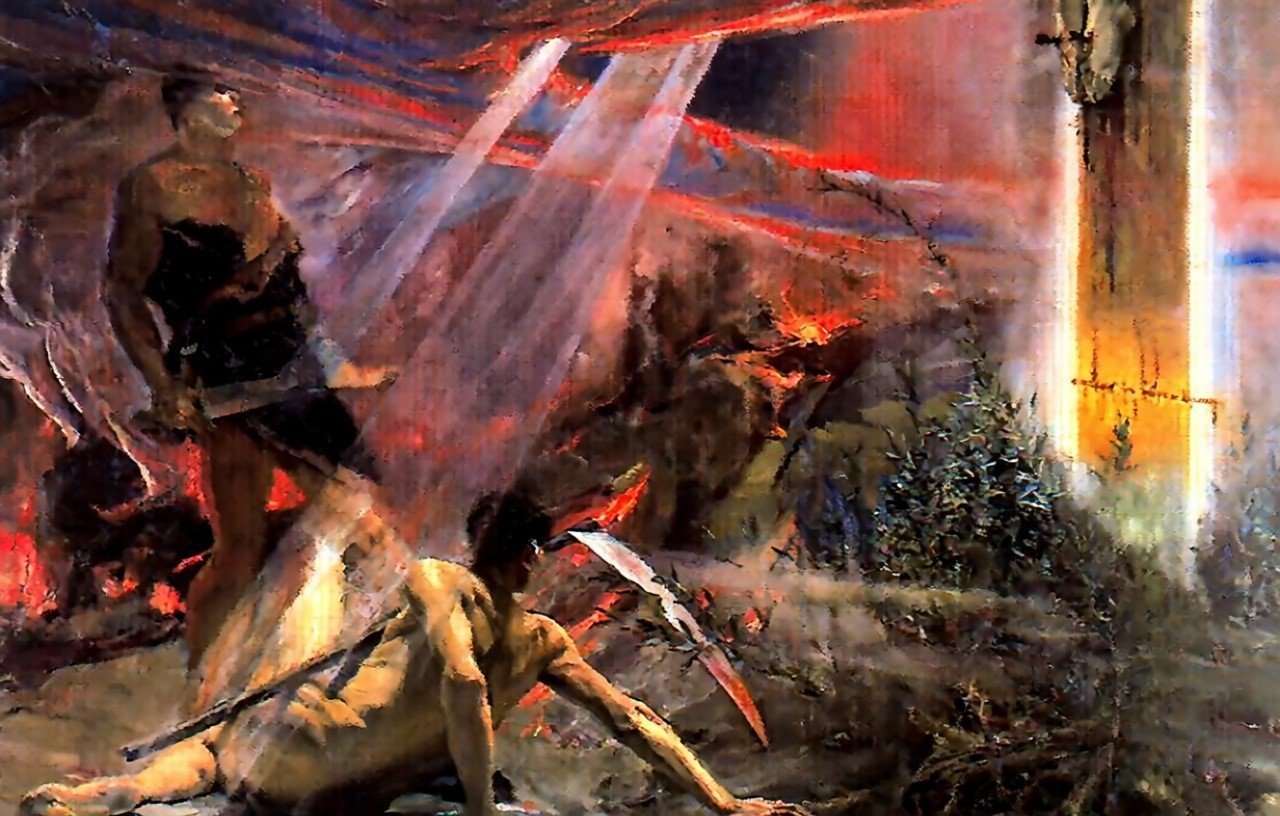
The Sixth Commandment, “Join the Companion You Have Chosen for Life,” presents the sacred fire of marriage. Lust lies defeated under a rose-colored tree, while a couple is enveloped in a golden veil. The painting expresses union as a purifying force and affirms the spiritual dimension of love.
The Seventh Commandment, “Work Illuminates the Path of Fortune,” depicts a figure advancing along a radiant path. Tools symbolizing effort and discipline accompany the scene. The light emanating from work is interpreted as the straight path of duty, capable of generating inner prosperity.
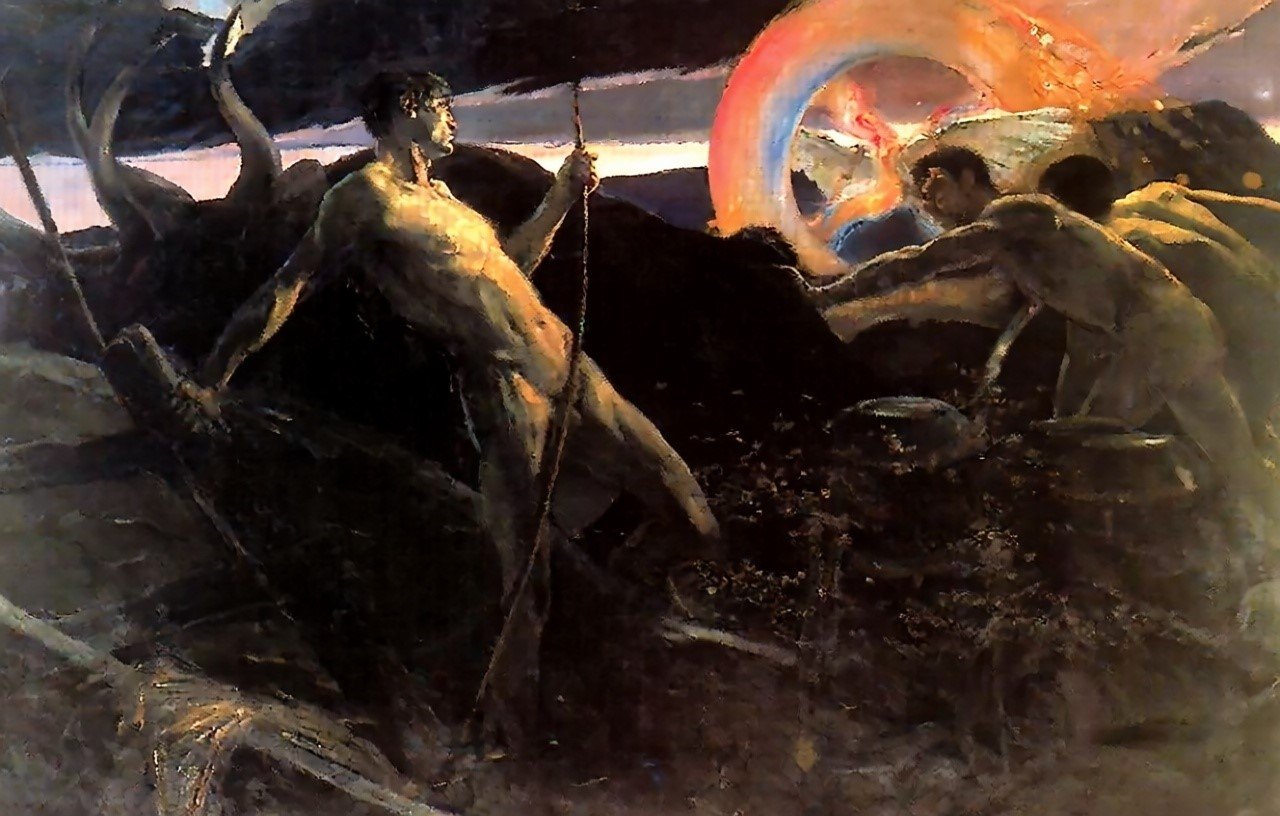
The Eighth Commandment, “Be a Light That Saves the Innocent,” shows a gesture of defense and clarification. A figure confronts a dark area where an erroneous judgment appears. At the right walks the serenity of the naked truth. The painting conveys justice as a moral responsibility.
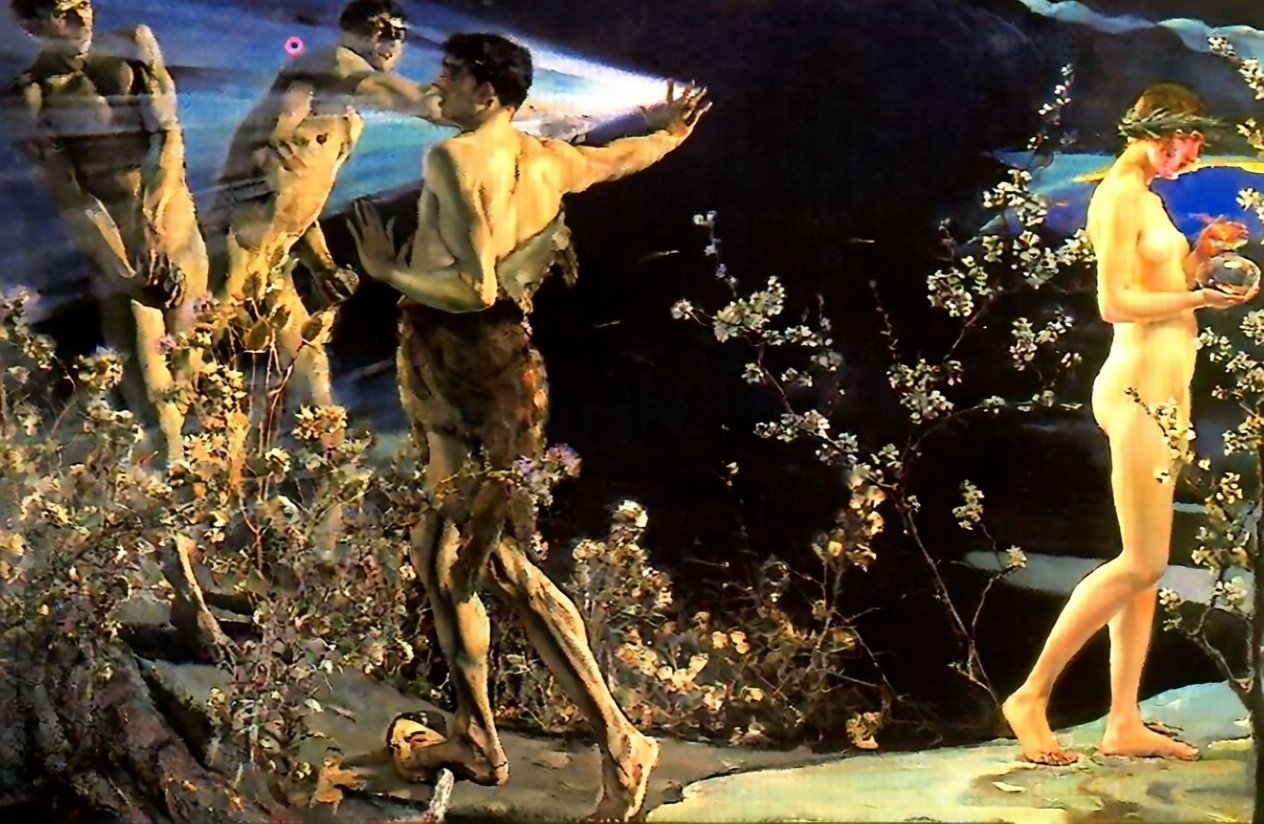
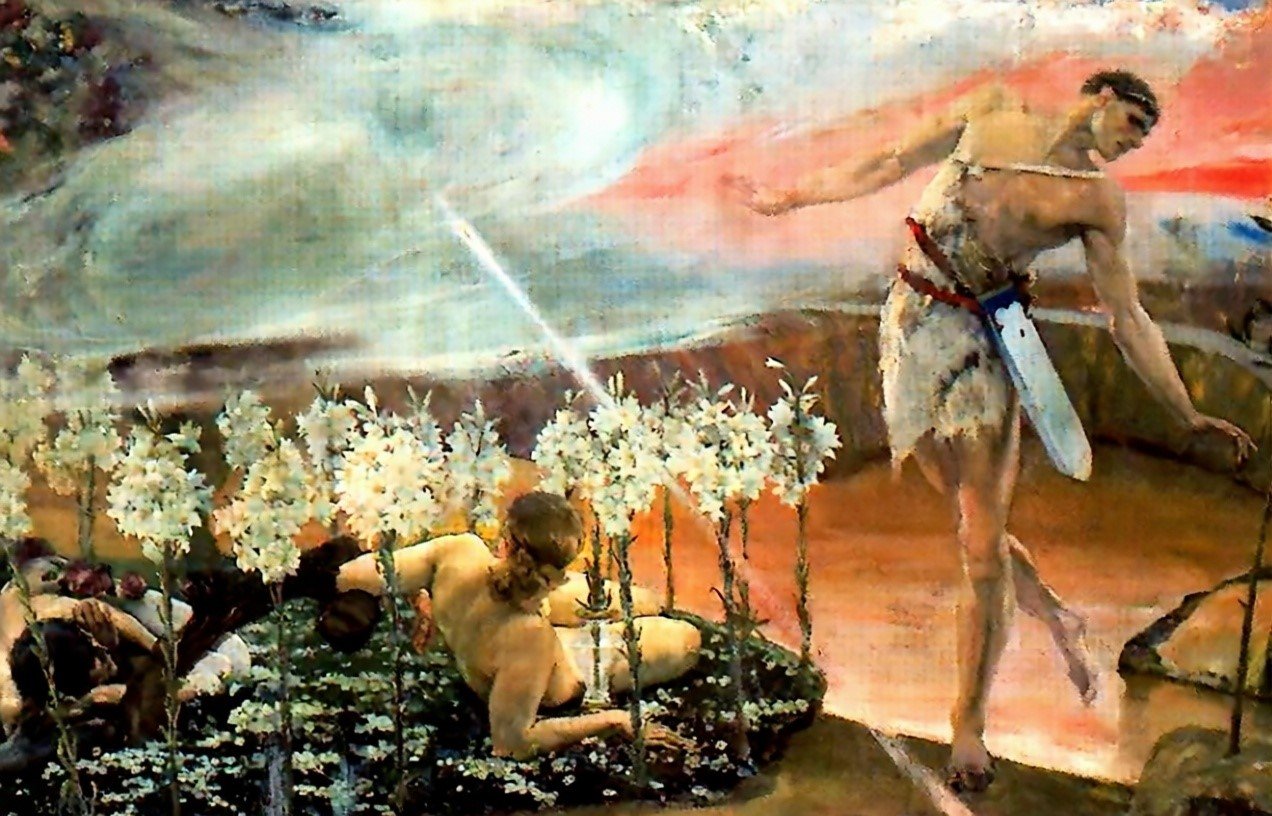
The Ninth Commandment, “Remove Every Temptation That Harms Your Neighbor,” portrays flowers of sin emitting a subtle and enervating perfume. The central figure turns away and moves toward a luminous region, leaving behind elements that disturb the conscience. The theme is vigilance over desire.
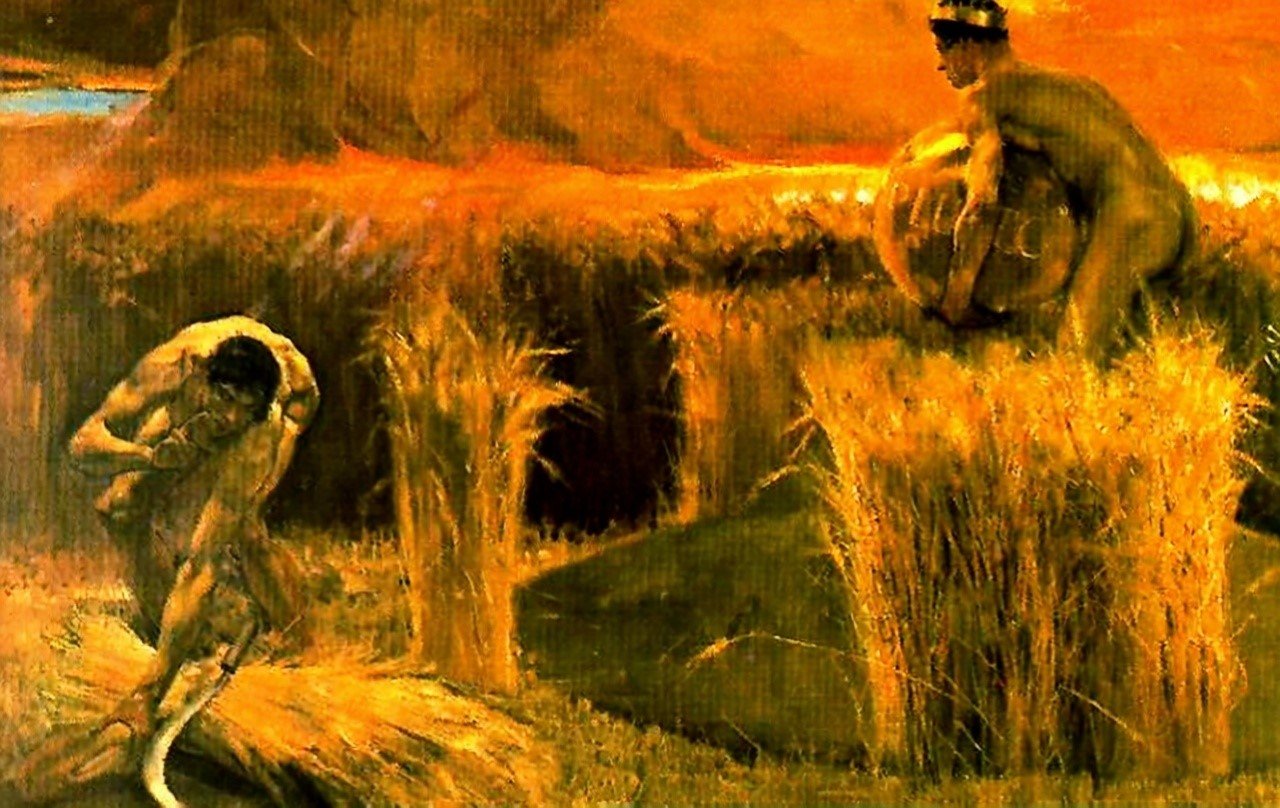
The Tenth Commandment, “Bless the Bread Produced by Your Labor,” represents the serenity of one who accepts his destiny and lives without envy. A figure lifts a simple loaf, while the generous earth appears as a source of sustenance. Another figure holds a sphere with a mythological reference to Pluto.
The Epilogue, “Death,” concludes the cycle with a Theosophical vision of transition. The soul rises towards a question mark.
Unfortunately, the paintings are unavailable to the public but remain a rare example of a Spanish artist who used Theosophy as a creative engine. He transformed the Ten Commandments into a symbolic map of spiritual evolution.

Massimo Introvigne (born June 14, 1955 in Rome) is an Italian sociologist of religions. He is the founder and managing director of the Center for Studies on New Religions (CESNUR), an international network of scholars who study new religious movements. Introvigne is the author of some 70 books and more than 100 articles in the field of sociology of religion. He was the main author of the Enciclopedia delle religioni in Italia (Encyclopedia of Religions in Italy). He is a member of the editorial board for the Interdisciplinary Journal of Research on Religion and of the executive board of University of Pennsylvania Press’ Nova Religio. From January 5 to December 31, 2011, he has served as the “Representative on combating racism, xenophobia and discrimination, with a special focus on discrimination against Christians and members of other religions” of the Organization for Security and Co-operation in Europe (OSCE). From 2012 to 2015 he served as chairperson of the Observatory of Religious Liberty, instituted by the Italian Ministry of Foreign Affairs in order to monitor problems of religious liberty on a worldwide scale.