The Belgian painter was a fervent believer in Krishnamurti’s mission. This eventually led to his break with the Theosophical Society.
by Massimo Introvigne
Article 2 of 2. Read article 1.
The second phase of Jean Delville’s relationship with Theosophy began around 1908. It was marked by deeper engagement, active involvement, and eventually disappointment. By this time, Delville had expressed a clear vision of art as a spiritual tool. However, the 1910s brought a new intensity to his esoteric interests. His writings from this decade show a growing focus on occult connections, astrological forces, and the idea that knowledgeable individuals could uncover the hidden reasons behind historical events. Delville believed wars, revolutions, and social unrest were not random but reflections of deeper spiritual currents. His analysis of the Boer War, viewed through occult and astrological lenses, illustrates this belief. He suggested that the conflict represented a clash of opposing spiritual energies and that those trained in esoteric knowledge could predict these events by interpreting cosmic signs.
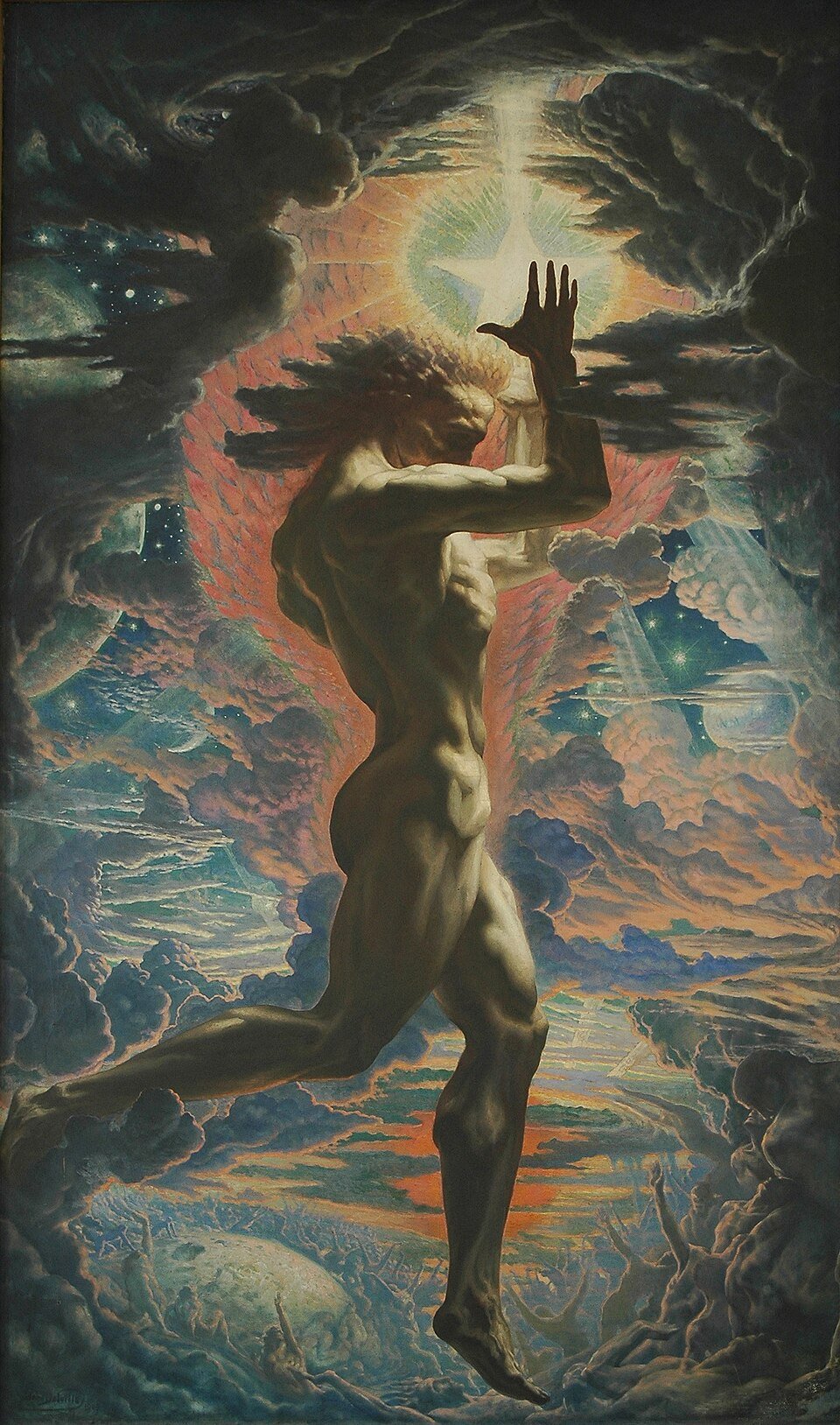
Delville’s artwork from these decades vividly reflects his continued dedication to Theosophical concepts. His 1907 painting “Prométhée” expresses spiritual striving, portraying the mythical figure as a symbol of humanity’s quest for divine knowledge.
The start of World War I in 1914 forced Delville to flee to Britain, where he stayed until the war ended. Britain had one of the most active Theosophical communities in Europe, and Delville quickly connected with its networks. He took part in study groups, attended lectures, and developed friendships with British Theosophists who shared his belief in the spiritual mission of artists.
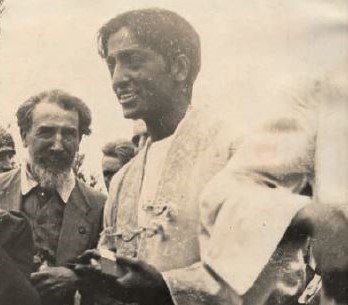
These years brought Delville face-to-face with a controversial moment in the history of the Theosophical Society: the rise of Jiddu Krishnamurti. Starting in 1911, the leaders of the Theosophical Society, Annie Besant and Charles Leadbeater, declared the young Indian boy to be the future World Teacher, a messianic figure expected to start a new spiritual era. This announcement excited Theosophical groups throughout Europe, including Belgium. Delville, already committed to spiritual evolution and higher consciousness, welcomed the idea of a new avatar. By 1912 and 1913, he was among those in Belgium who showed enthusiasm for Krishnamurti’s supposed mission and supported it with articles and booklets. Not everybody agreed, and Delville had to resign from his position as secretary of the Belgian Theosophical Society in 1913. He remained, however, the leader of the local branch of the Order of the Star in the East, created to support Krishnamurti, and maintained a prominent role in international Theosophical gatherings.
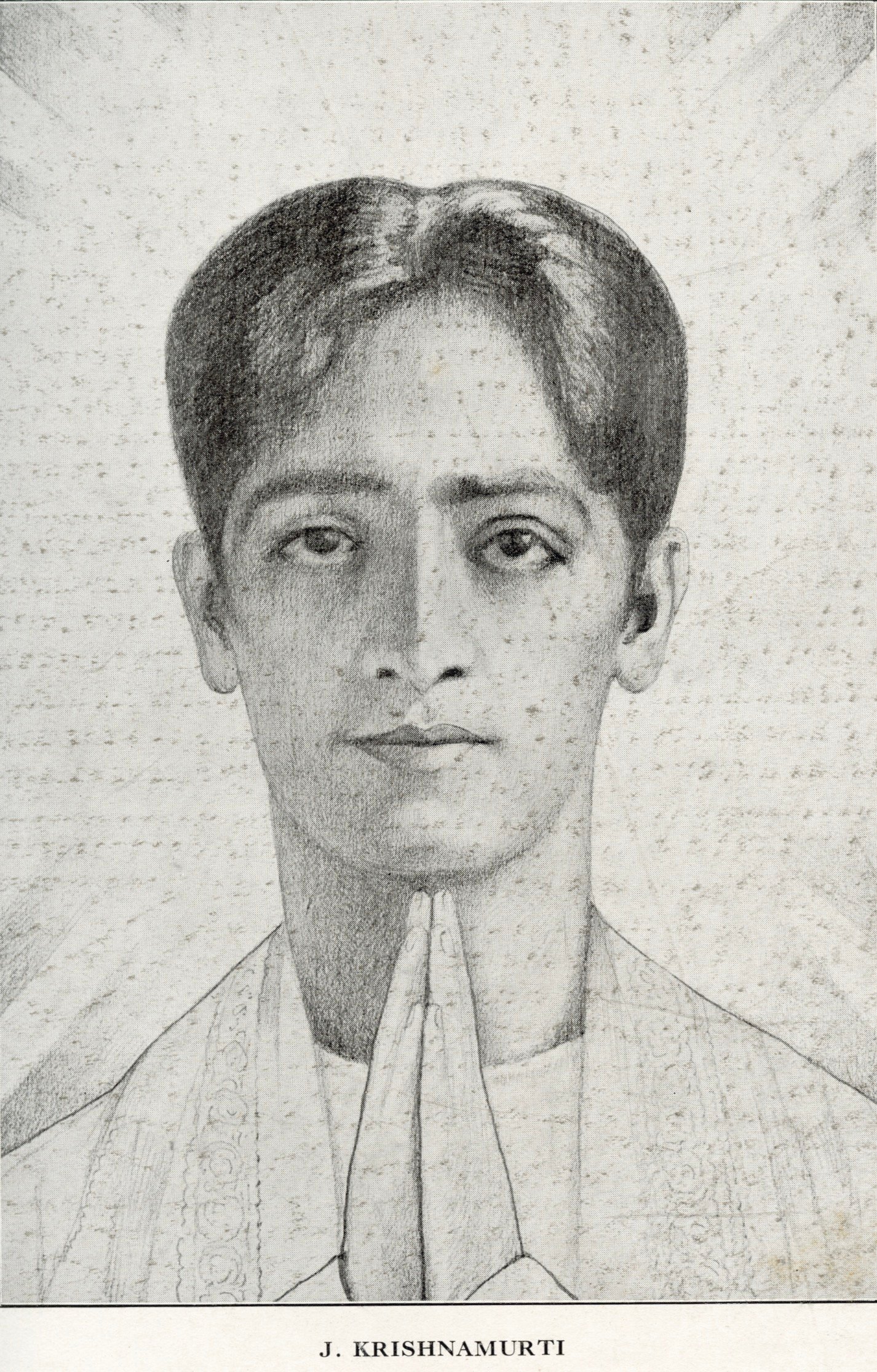
In 1929, Krishnamurti, who had reached adulthood, publicly announced that he was not the World Teacher. Delville alternated between depression and hope, speculating that perhaps these statements by Krishnamurti were his way of being the World Teacher. In 1930, Delville left the Theosophical Society. His resignation marked a clear end to his formal connection with the organization, but it did not mean a rejection of esoteric philosophy. Instead, it showed his discomfort with what he saw as internal discord.
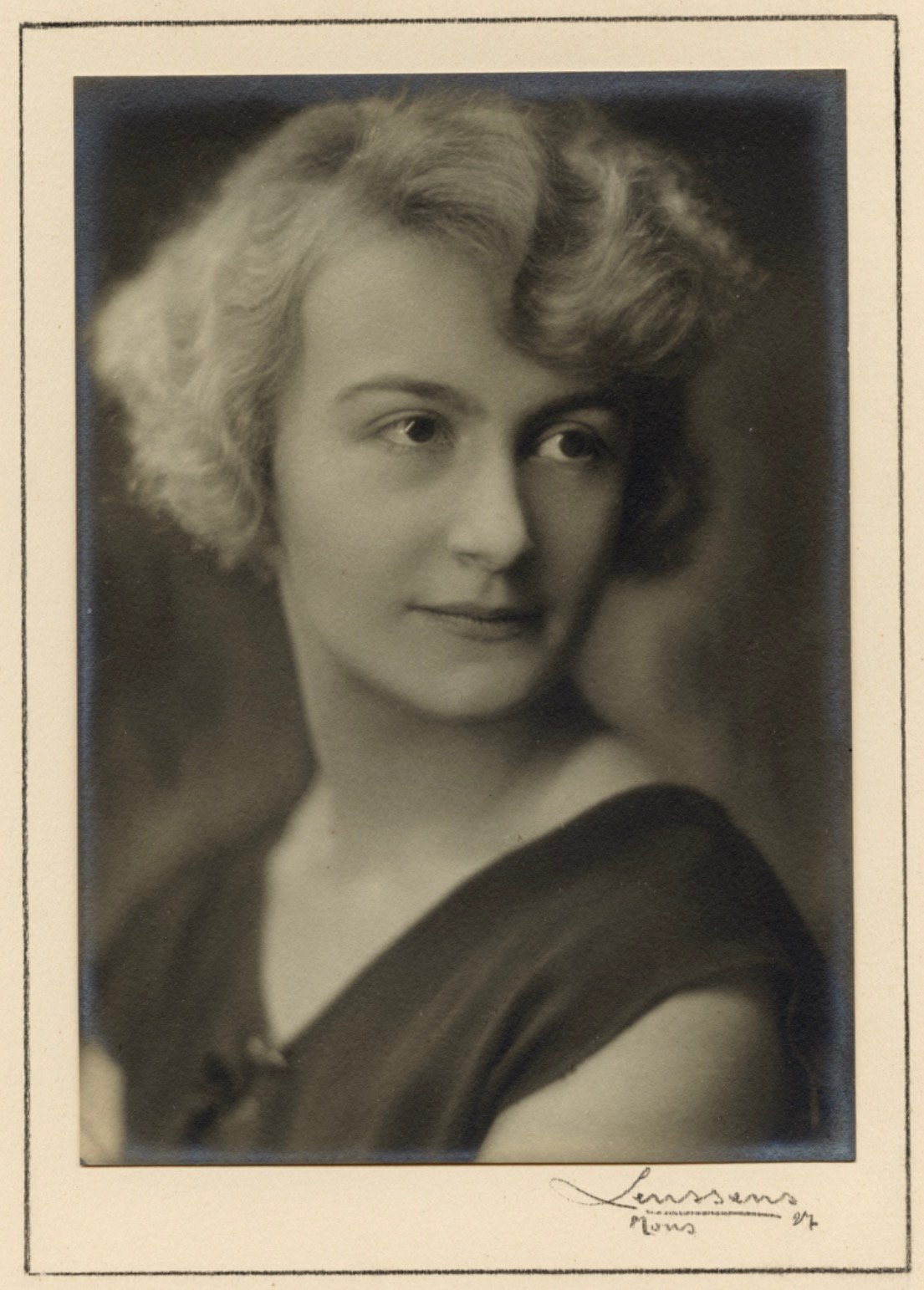
The tensions involving Krishnamurti might also have affected Delville’s family life. He left his wife and family to relocate to Mons, where he lived with his student Émilie Leclercq, who was thirty-seven years younger. Since then, he did not participate in any esoteric organization or artistic society, although he continued teaching at the Belgian Academy of Fine Arts.
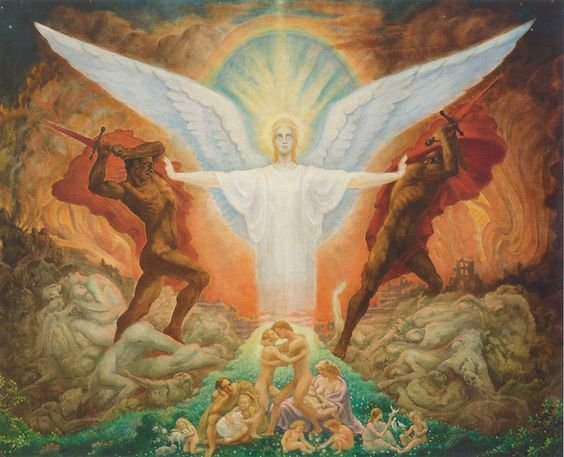
While his relatives disparaged his period in Mons as irrelevant, a leading expert on Delville, Daniel Guéguen, has shown that during these years he continued to produce works of both esoteric and artistic significance. Although he no longer took an active part in Theosophical organizations, the philosophical ideas he absorbed from the movement remained central to his worldview.
During his years in Mons, Delville undertook one of his most ambitious esoteric literary projects: a dramatic adaptation inspired by Edward Bulwer‑Lytton’s Rosicrucian novel “Zanoni.” Although the idea had first taken shape in the early twentieth century, the work itself was completed only later, during his Mons period, where Delville developed it into a substantial artistic and occult undertaking. The project grew far beyond a simple libretto. It included an extensive introductory essay in which Delville explained the spiritual and initiatory principles that guided his interpretation of Bulwer‑Lytton’s narrative, a manuscript of roughly 150 pages elaborating the dramatic structure, and a suite of ten drawings conceived as scenographic studies for a future stage production. The ensemble reveals Delville’s desire to create a total work of art in which theatre, symbolism, and esoteric doctrine converged.
Delville separated from Émilie and returned to his family in 1947, six years before he died in 1953. In 1947, he completed “Vision de la paix,” a large symbolic canvas that many consider his final spiritual testament. The painting, conceived after a lifetime of engagement with mystical philosophy, distills his belief in harmony, transcendence, and the possibility of inner illumination—an artistic summation of the esoteric ideals that had shaped his entire career.
Delville’s lifelong engagement with Theosophy shows a complex and evolving relationship. He was never just a passive follower but an active interpreter, aiming to weave Theosophical principles into a broader fusion of art, philosophy, and spiritual science. His early editorial work, theoretical writings, significant artistic projects, and involvement in esoteric lodges highlight his ongoing commitment to the notion that art could bridge the material and the divine. Even his resignation from the Theosophical Society did not mean a rejection of esoteric ideals; it expressed his desire to uphold their universal spirit against what he saw as sectarian tendencies. Throughout his life, Delville believed in the arts’ power to reveal higher realities—and guide humanity toward spiritual growth.

Massimo Introvigne (born June 14, 1955 in Rome) is an Italian sociologist of religions. He is the founder and managing director of the Center for Studies on New Religions (CESNUR), an international network of scholars who study new religious movements. Introvigne is the author of some 70 books and more than 100 articles in the field of sociology of religion. He was the main author of the Enciclopedia delle religioni in Italia (Encyclopedia of Religions in Italy). He is a member of the editorial board for the Interdisciplinary Journal of Research on Religion and of the executive board of University of Pennsylvania Press’ Nova Religio. From January 5 to December 31, 2011, he has served as the “Representative on combating racism, xenophobia and discrimination, with a special focus on discrimination against Christians and members of other religions” of the Organization for Security and Co-operation in Europe (OSCE). From 2012 to 2015 he served as chairperson of the Observatory of Religious Liberty, instituted by the Italian Ministry of Foreign Affairs in order to monitor problems of religious liberty on a worldwide scale.