A soaring trade imbalance, currency manipulation, and massive subsidies reveal how Beijing bends global rules while dismissing European concerns on fairness, security, and human rights.
by Marco Respinti
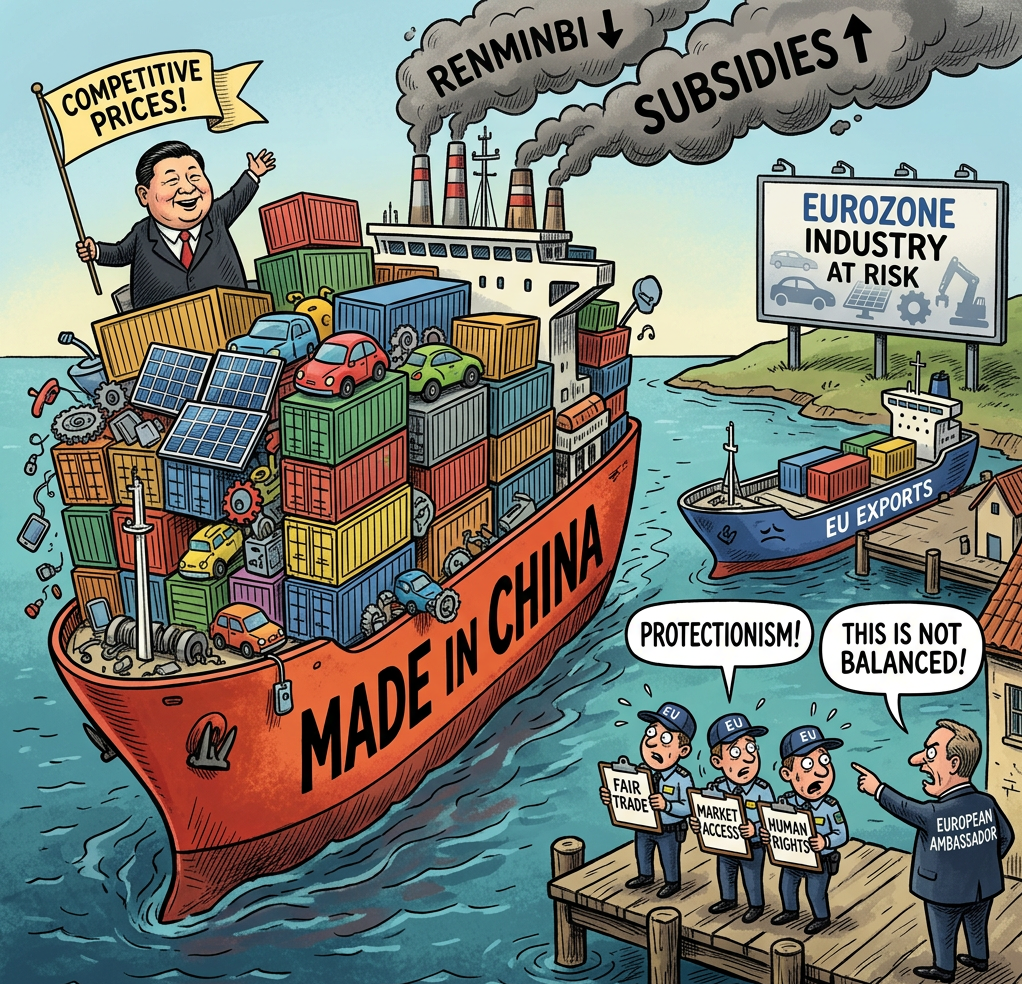
Violations of human rights and violations of commercial fairness are deeply connected, and both reveal the nature of a regime that systematically disregards international law.
The second edition of the EU–China Conference held in Beijing on May 12 offered a platform for constructive, open dialogue between stakeholders in the European Union and in China on business ties and to narrow differences in perspectives and expectations. Dialogue was suggested as the only viable path to ensure a fair and balanced business relationship between China and the EU countries.
Yet, with the trade deficit of the EU with China skyrocketing to about Euro 400 billion in 2025, it became evident in the course of the conference that the EU-China ties were in choppy waters and navigating them “beyond the inflection point,” which was the theme of the conference, would not be an easy task. On the contrary, in the coming days the EU and China could be heading for a trade war.
That the EU has a high trade deficit with China is not a problem of the EU lacking overall competitiveness. With the rest of the world, the EU’s overall trade surplus in 2025 was Euro 164.6 billion. So, where does the problem with China lie? It is that Beijing is pursuing an aggressive policy of export-led growth. Two factors have led China to adopt this strategy: sluggish domestic demand in China, which the communist government has failed to revive, and the US shielding its market with tariffs against Chinese exports. China has now found in the EU a happy dumping ground for all its surplus products.
The ruling Chinese Communist Party (CCP) will have to push up China’s growth rate at any cost. In the absence of elections in China, the legitimacy of CCP rule depends on ensuring a high growth rate of the Chinese economy. From double-digit figures in the late 20th century and the early part of the current century, the growth rate of the Chinese economy has slipped to less than five percent this year. The CCP will, therefore, have to pursue a cynical policy of export-led growth even if, as warned by Director-General of the World Trade Organization Ngozi Okonjo-Iweala at the Munich Security Conference on February 13, China’s $1.2 trillion trade surplus triggers fresh protectionist barriers worldwide.
In response to a slide in the value of the dollar in the first half of 2025, Beijing also devalued the Chinese currency, the renminbi, by over eight percent against the euro. Economic logic would dictate that the renminbi should have been revalued against the euro, given China’s huge and rising trade surplus. Instead, Chinese exporters continue to enjoy a decisive price advantage.
Europe is thus in danger of losing its industry to China. It is the eurozone core—Germany, France, Italy, the Netherlands, Belgium, and Austria—which is feeling the brunt of Chinese competition in its industrial backbone: cars, machinery, and green technology. The Chinese industrial policy, with heavy subsidies, has already nearly destroyed the EU solar panel industry, which fifteen years ago dominated world markets. Chinese producers now dominate in their place. The same scenario, buoyed by Chinese industrial policies and currency devaluation, is visible in electric cars and other green industries.
A tariff war between the EU and China is the only likely outcome of such a scenario, and early signals of this eventuality were discernible at the conference held in Beijing on May 12. According to reports, sparks flew at the conference as diplomats, officials, and experts from Europe and China clashed over their deepening trade problems. Chinese speakers were accused of dismissing Europe’s longstanding complaints and ignoring the harsh economic reality of an increasingly lopsided trading relationship. Speakers from the Chinese side, instead, accused diplomats of the EU of “bullying” and described the policies of the EU as “protectionist” efforts to decouple from China.
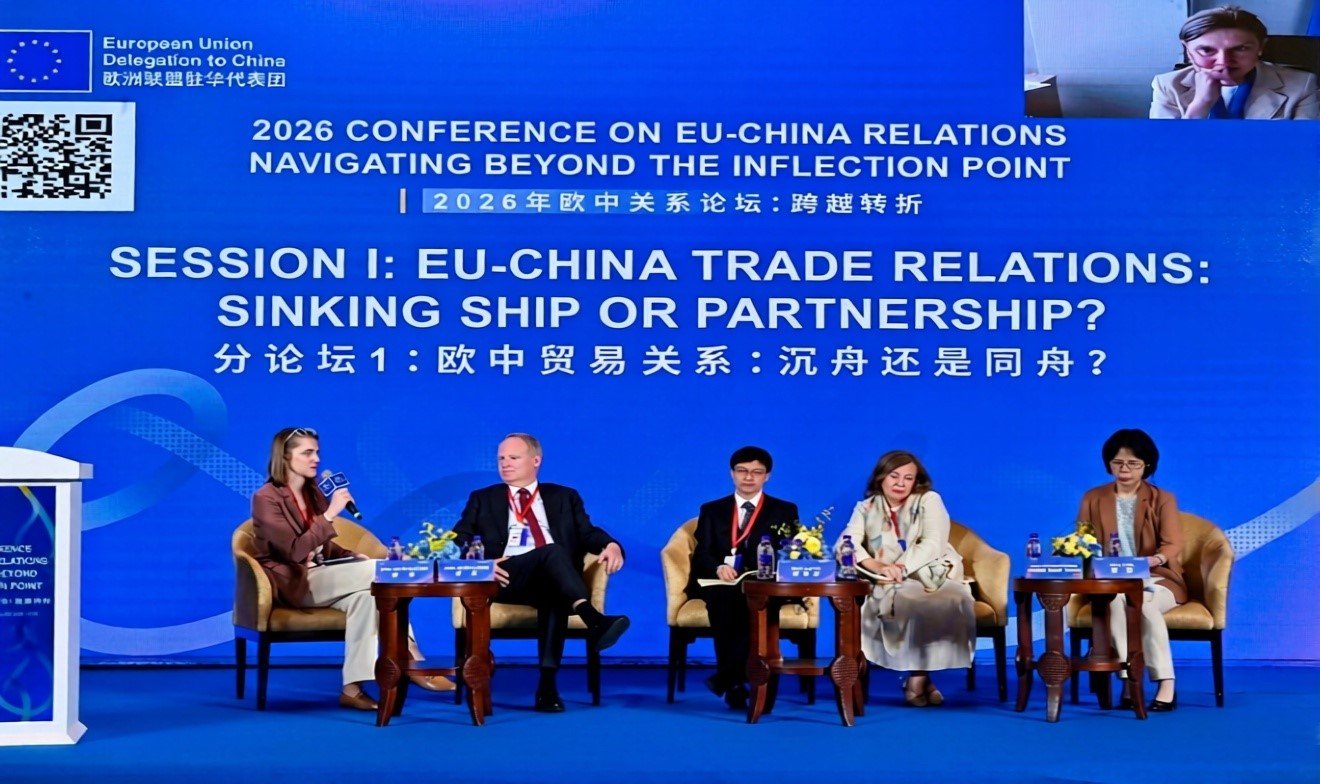
While speakers on the Chinese side rejected the accusation that Chinese business people were enjoying the unfair advantage of subsidies and argued that China’s advantages arose from market factors such as market size, innovation capabilities, and production costs, EU Ambassador to China Jorge Toledo in his keynote address made it clear that Europe’s relationship with China would depend on whether European concerns on market access, subsidies, industrial capacity, critical raw materials, security, and human rights were taken seriously by Beijing.
The refusal of Chinese speakers to accept the reality that Europe remained comparably open to Chinese goods left top European business figures and observers exasperated. Finally, President of the EU Chamber of Commerce in China Jens Eskelund summed up the nature of the trade relations between China and the EU: “It is neither a sinking ship nor a partnership. It’s a 400-meter-long giant container ship loaded with 24,000 containers going to Europe and coming back almost empty,” he said.
China is managing to keep its imports down while pushing up exports by three overlapping distortions. In China, domestic demand is low because of falling property prices. Because of this, the demand for imported products is also low. Secondly, in priority sectors such as semiconductors, machinery, cars, and aircraft, the provision of direct government subsidies, free land, cheap machinery, and state-backed lending has sharply expanded supply that weak domestic demand cannot absorb. Manufacturers in China receive subsidies that amount to between three and nine times those available to advanced economies, helping them capture markets abroad. Thirdly, China benefits from an undervalued exchange rate. With a huge trade surplus, China’s currency should appreciate. But as pressure from the rising trade surplus pushes up the renminbi, Chinese state banks buy dollars to resist the appreciation of the Chinese currency. The IMF estimates the renminbi may now be undervalued by 16 percent.
Countries like India, too, are at the receiving end of this Chinese policy of keeping the value of the renminbi low. New Delhi must keep the value of the Indian rupee down, as otherwise cheap Chinese goods will flood Indian markets. Obviously, China’s record trade surplus will not be sustainable, as the rest of the world cannot absorb it. Experts have suggested the EU impose a 20 percent additional general tariff on imports from China.

Marco Respinti is an Italian professional journalist, member of the International Federation of Journalists (IFJ), author, translator, and lecturer. He has contributed and contributes to several journals and magazines both in print and online, both in Italy and abroad. Author of books and chapter in books, he has translated and/or edited works by, among others, Edmund Burke, Charles Dickens, T.S. Eliot, Russell Kirk, J.R.R. Tolkien, Régine Pernoud and Gustave Thibon. A Senior fellow at the Russell Kirk Center for Cultural Renewal (a non-partisan, non-profit U.S. educational organization based in Mecosta, Michigan), he is also a founding member as well as a member of the Advisory Council of the Center for European Renewal (a non-profit, non-partisan pan-European educational organization based in The Hague, The Netherlands). A member of the Advisory Council of the European Federation for Freedom of Belief, in December 2022, the Universal Peace Federation bestowed on him, among others, the title of Ambassador of Peace. From February 2018 to December 2022, he has been the Editor-in-Chief of International Family News. He serves as Director-in-Charge of the academic publication The Journal of CESNUR and Bitter Winter: A Magazine on Religious Liberty and Human Rights.