Xi Jinping himself is promoting a campaign to prevent the Chinese from reaching uncensored news, entertainment, and academic resources from abroad.
by Tan Liwei
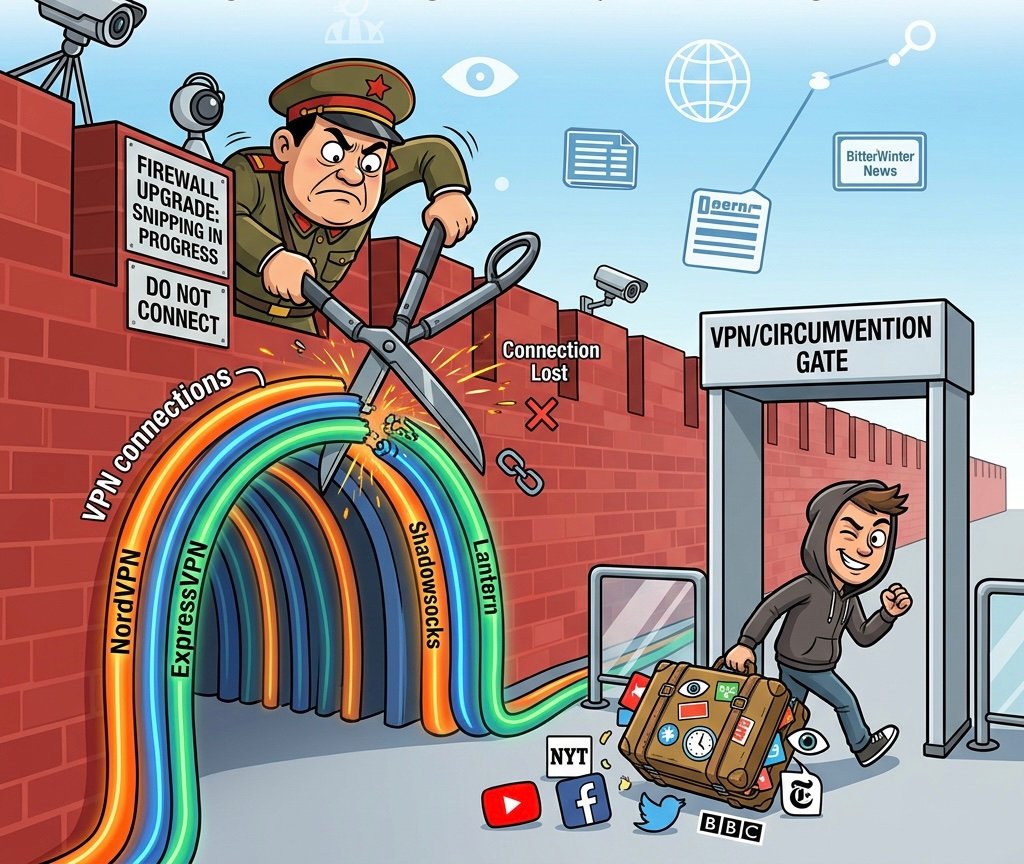
Virtual Private Networks, commonly known as VPNs, and the so-called “airports” that many Chinese internet users depend on are not sophisticated hacking tools. They are straightforward services that let regular users connect to the broader internet instead of the limited area controlled by China’s censors. A VPN sets up an encrypted tunnel to a server outside the country, while an “airport” is a black-market service that offers access to these tunnels in an easy-to-use format.
Many Chinese users use them to watch international entertainment services, but their true importance goes beyond that. Without these tools, it becomes impossible to read uncensored news, access foreign academic resources, or visit websites blocked by the Great Firewall, including “Bitter Winter.” VPNs and airports are the only ladders people can use to see beyond the “official” Internet.
Recently, a series of internal notices shared online and collected by “China Digital Times” has raised concerns that these ladders might soon be forcibly removed. One document from a regional content-delivery provider shares instructions from its upstream telecom partner requiring that all international connections be terminated for business clients. The wording is broad: every IP address under their control must block traffic to any location outside mainland China. The same notice directs customers to remove any signs of VPNs, proxies, or other tools used to bypass restrictions. Those who do not comply will face immediate disconnection, data loss, and no refunds.
The memo seems to be part of a broader trend, not just an isolated overreaction by one company. Other providers have reported issuing similar warnings. Additionally, a separate document—allegedly from the Ministry of Industry and Information Technology—invites major state telecom companies to a meeting focused on tightening control over unauthorized cross-border data connections. The emphasis on “dedicated lines” might sound technical, but it refers to any method that allows information to flow beyond the Great Firewall without official approval. When the ministry calls for a special meeting on such matters, it typically indicates that an organized effort to enforce compliance is underway.
Another document, an invitation to a seminar at the Cyberspace Administration of China, does not mention VPNs at all. However, it encourages officials to explore Xi Jinping’s “key thoughts on national cyber power,” a phrase that has come to signify the ideological basis for China’s increasingly interventionist policy in the digital realm. Attendees are asked to leave their phones in lockers and stay in the meeting room for the entire session—a small but significant hint of the environment in which these policies are formed.

The renewed focus on “airports” is no accident. These services have thrived due to widespread demand for uncensored access. Researchers have found that airport providers operate in a competitive, low-profit market, offering affordable monthly plans and a variety of foreign servers. Some serve thousands of customers, many of whom have little understanding of the technology involved. They buy a small device online, connect it to their home router, and access foreign websites almost instantly. For many, this is not a political statement but a basic necessity: they want to watch a foreign show, read an international newspaper, or access a blocked academic article. Yet the normality of this behavior is what troubles the authorities. A tool that makes it easy to bypass censorship is inherently a threat to a system that relies on that censorship.
Legal experts have long pointed out that China’s rules on VPNs exist in a gray area. Creating or selling tools to bypass restrictions has always carried risks, and there have been occasional crackdowns on service providers. However, ordinary users have usually faced little more than occasional fines. The new draft Cybercrime Law, currently under discussion, raises concerns that this gray area may tighten further. Some analysts believe that the draft includes provisions regarding unauthorized international connections, which could be interpreted in ways that increase pressure on both providers and users. Whether this suggests a shift toward full criminalization remains unclear, but the timing of recent corporate and governmental notices suggests enforcement could become stricter even without new laws.
For Chinese internet users relying on VPNs and airports to access the outside world, the consequences are significant. Losing access to foreign entertainment would be a nuisance. Losing access to uncensored information would be much worse. Bypass tools enable citizens to compare sources, verify information, and understand how the world views their country. They allow scholars, journalists, and everyday readers to access materials that would otherwise remain blocked. They help those interested in religious freedom, human rights, or social issues read reports that domestic platforms would never publish.
If fully enforced, the new wave of restrictions would further expand the Great Firewall, which makes the Chinese Internet an enclosed garden. As always, the initial victims of such measures are not criminals or extremists, but ordinary people who want more than government-approved information allows. Whether the current notices signal the start of a sustained effort or a temporary display of strength remains to be seen. At any rate, in the battle between control and connectivity, the authorities are again signaling that control must come first.
In China, simply reading a foreign website becomes a subtle declaration of intellectual independence. The tools that facilitate this—VPNs, airports, and other circumvention methods—are crucial because they support the freedom to access information. This is precisely why they are under threat, and why the world needs to pay attention.

Uses a pseudonym for security reasons.