The story of the vigil at the Middlewich Detention Centre.
by Susan J. Palmer
The story of the April 29, 2026, military-style raid on the Ahmadi Religion of Peace and Light (AROPL) has been told and retold in the “Guardian,” BBC News, the “Daily Mail,” and by human rights activists in “Bitter Winter” magazine and Human Rights Without Frontiers (HRWF). But the story about the believers who held a protest demonstration outside the Middlewich Detention Centre, where their leader, Aba Al-Sadiq, was being held—this story has not yet been told.
The Cheshire Constabulary reported the April 29 arrests. Apart from those charged with more serious crimes, 25 people were charged with relatively minor public offenses: obstructing or assaulting a constable or assaulting an emergency worker. The report published their names, ages, nationalities, and addresses.
Five months later, on September 28, the Crown Prosecution Service (CPS) dropped the charges against 14 of these defendants. It is still unclear why, since the other 11 are still waiting for their trial dates.
The Cheshire Constabulary report, despite its meticulous details that invade the privacy of individuals presumed innocent, offers little information on how and why these 25 believers were arrested at Webb House during the raid.
I arrived at Webb House in Crewe in May, two weeks after the April 29 raid, where my two colleagues, Stuart Wright and Holly Folk, and I interviewed AROPL members (who refer to themselves as “believers”) about their experiences of the raid. Several of my informants had also participated in the demonstration outside the Middlewich Detention Centre.
They described that fateful day: how they were awakened by 500 police officers wearing Kevlar helmets and masks and carrying shields. Most were still in pajamas and in a state of shock, so they put up little resistance. By the afternoon, after being herded into crowded rooms and separated from their families, they were each interviewed—and then abruptly ordered to vacate the premises. By this time, the believers were angry, having witnessed hours of bullying and harsh treatment of AROPL women and children by the police. They were indignant at the manhandling of their revered Mahdi, Aba Al-Sadiq. Several had watched the police arrest and handcuff him, and they spread the news. One believer said, “They lied, they broke their promise to treat him with respect, they snatched off his black beanie, handcuffed him, pushed him to the ground, shoved boots in his face, and sprayed him with pepper spray.”
The rumor spread that Aba Al-Sadiq had been arrested and dragged off to the police station. One brother (members call each other brother and sister), after he was questioned and released, called an Uber with his friends and headed for the Crewe police station, where he had heard Aba Al-Sadiq and his core group were being held. They were soon joined by other believers who had avoided the raid because they lived in private apartments in Crewe: “We just got the message that Base [‘Base’ is slang for Webb House] had been raided and that Aba Al-Sadiq was in handcuffs without his hat!”
It turned out they had the wrong address. The right place was the Middlewich Detention Centre in an industrial area on the outskirts of Crewe. When the group arrived, they found around fifty believers, men and women, gathered in the police parking lot. They pressed the call button, demanding to speak to their leaders, but the constable who answered told them, “No, they’re being questioned.” They kept pressing the button until a police squadron showed up behind them and shouted, “You are not allowed to protest in the parking lot!”
The demonstrators shouted back: “But you just raided our property!” and “This is a peaceful protest!” More believers were arriving and joining the protest. Then the police warned: “If you don’t leave, we will use force!”
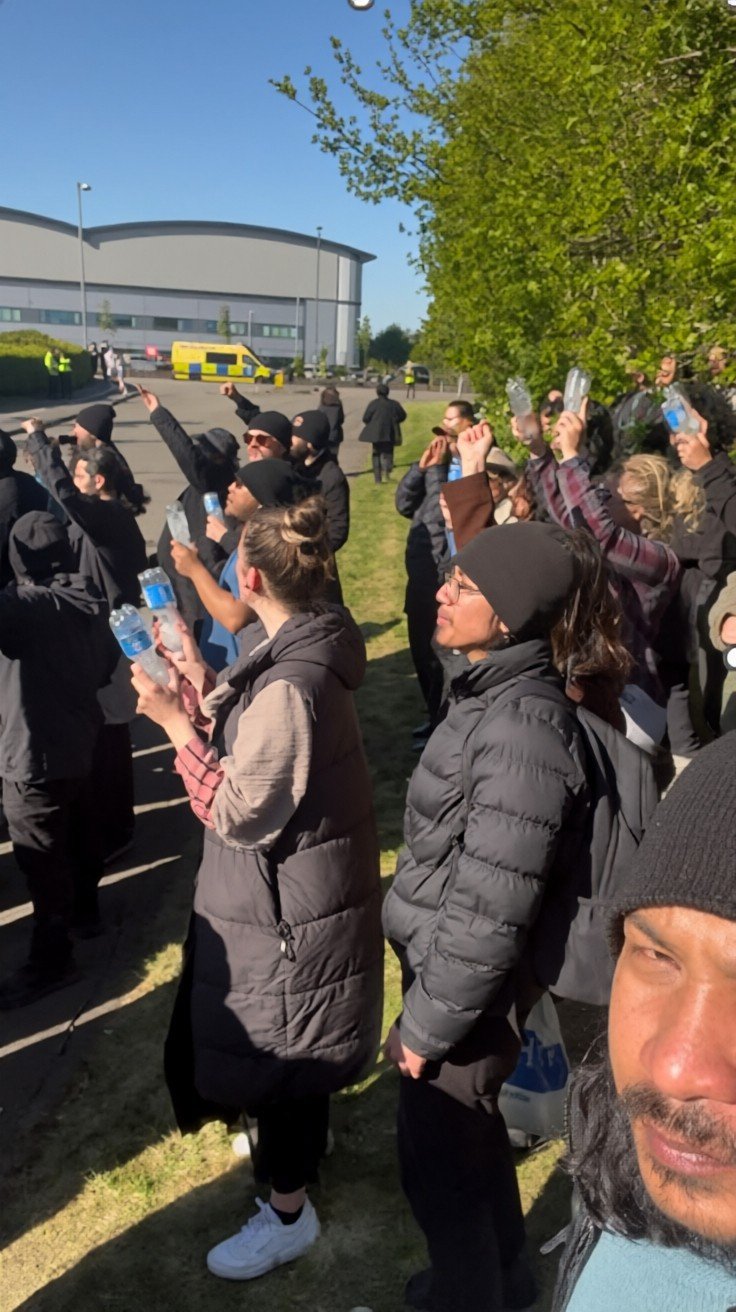
One believer described the escalation of conflict: “Then they started to get aggravated. One of the higher-ups (with red stripes) came out and told us he had called for reinforcements. ‘Attention! Attention!’ he said. ‘This is your final warning. If you don’t leave, we will have to use appropriate force!’ Then they set up a barricade of policemen, shoulder to shoulder. There was a pause, then the barricade advanced and the police kicked and punched, they marched forward, pushing us back. They began to kick and punch.”
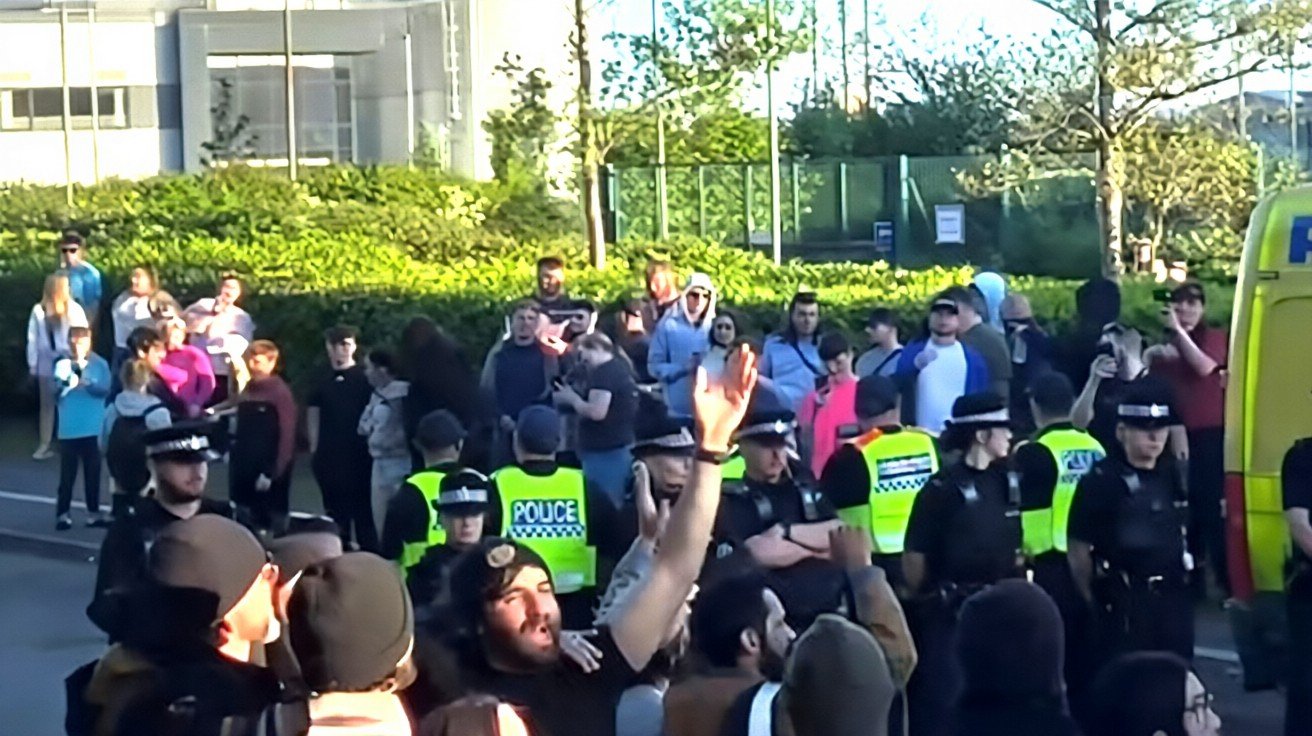
One brother witnessed the police shoving a pregnant woman forcefully. He noted, “They arrested around 20 of us for obstructing justice!”
Brother Z. reports how he was pepper-sprayed: “It left me blind for fifteen minutes. My eyelids swelled up and I couldn’t open my eyes. After ten minutes I was able to see but it was blurry.”
By 9 p.m. the police had retreated into their station. It was getting dark, so the demonstrators retired to a large grass verge opposite the police station. Brother J. reported, “It was very cold that night, some of us had chattering teeth, our bodies were shaking, but our people sent blankets, duvets and pillows to help us stay warm.”
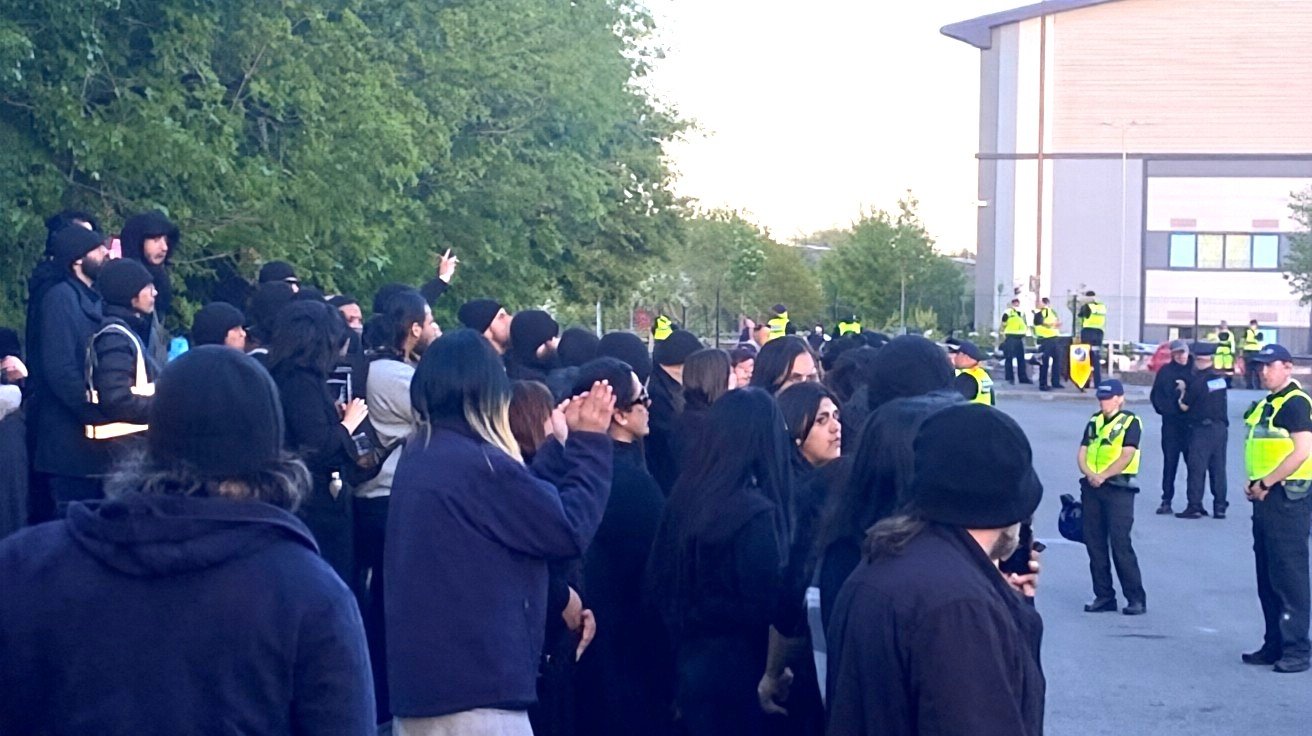
There were no shops or restaurants in this industrial area, but as it grew dark, one of the brothers who worked in a restaurant sent out a big delivery of hot chicken and fries for the demonstrators huddled in the park, which helped them sleep.
The demonstration was resumed the next day, on April 30, and the believers spent another night sleeping in the park. Then, soon after midnight on Friday morning, May 1, Joe McGowan, one of the leader’s close companions, was released from the police station with a message for the demonstrators: “The police have said they won’t release Aba Al-Sadiq until all the protesters have left.”
So the demonstrators disbanded. But there was a delay, according to Brother Z.: “Aba Al-Sadiq had been detained for around 36 hours. They arrested him early Wednesday afternoon [April 29], and they released him on Friday morning [May 1] around 1 a.m.”
Sister K., who participated in the demonstration, commented: “They had a two-tiered police force, and they used disproportionate force. There were unclear instructions about the zones in which protests were permitted, and there was a lack of clarity concerning Aba Al-Sadiq’s whereabouts and time of release.”
By Sunday, May 3, the police had released the 14 AROPL members who were suspects in the three criminal cases. They were not charged, but were exiled from Webb House and Cheshire County, and placed under bail conditions in the neighboring county. By that day, the police had also completed their search of Webb House, so some of the 100-odd residents were able to return to their apartments at Webb House, although many families were still being held in Booth Hall with their children. Those who returned encountered chaos and desecration.
The floors were littered with debris. Bananas were strewn throughout the mansion, a symbol of racial hate. “The Goal of the Wise,” their holy book, was used as a doorstop in multiple locations, and the sacred statue of Imam Al-Hassan in the Hall of Mysteries was incongruously holding a paintbrush.
What stands out in this story is the staunch loyalty of the believers to their leader, to their faith, and to their community.
Shortly after the raid, I was speaking to a fellow scholar who predicted: “We should warn Abdullah [Aba Al-Sadiq] to expect ‘death by a thousand cuts.’ All it takes is one or two members to crack and tell the police what they want to hear—and with that pressure, who can blame them?”
I protested, “But what’s the point in warning him? He has no control over potential defectors, betrayals or schisms.” (I had witnessed arrested spiritual leaders being “thrown under the bus” by weak disciples before.) But, in fact, six months later, not one AROPL member has broken ranks, complained, or reinforced the criminal allegations. This is remarkable.
It is ironic that, while their leaders were being detained as suspects in the crime of modern slavery, these (presumably enslaved) followers, temporarily deprived of leadership, were independently, spontaneously organizing a protest demonstration.
The police regard AROPL members as “brainwashed” victims of a “cult.” This became clear at the open hearing held on October 22 at the Chester Magistrates’ Court, which I attended. In the role of the witness was DI Eleanor Atkinson, the Senior Investigator in the raid. When asked by AROPL’s lawyer, “When you went to Webb House, did you expect to find anyone enslaved?” she replied, “Not really, but I did expect to find people indoctrinated and controlled psychologically.”
During this questioning, the witness also described AROPL as “a highly dangerous cult.”
Although it became obvious during the open hearing that, after a six-month investigation, all the police could produce as “evidence” of rape or forced marriage was double hearsay or anonymous online sources, the witness triumphantly proclaimed finding evidence of modern slavery.
In their search of the Webb House offices, the police had found boxes of bank cards and NHS cards with members’ names on them, and slips so that mothers could request milk and baby diapers. (The witness mentioned “milk and baby diapers” several times in an effort to drive home the image of AROPL’s leader as an arrogant, patriarchal “cult” leader who holds his people captive and has to be begged for the bare necessities of life while mothers and hungry, soiled babies are suffering.)
But then AROPL’s lawyer pointed out that in their search of the Webb House apartments the police had established that every family had at least one cellphone, plus credit cards and passports. Moreover, it became clear that the police had not bothered to ask any AROPL members why their bank cards were kept in the office. When I asked an AROPL administrator, she explained, “The cards are kept in the office so that our drivers, when they are going into town, can pick up items from the grocery or the pharmacy for our members if they are too busy to shop or if there is a shortage of cars.”
This makes sense. After all, AROPL is a commune. The question is, why did the “investigating” police not ask this question? Was it to avoid exculpatory evidence?
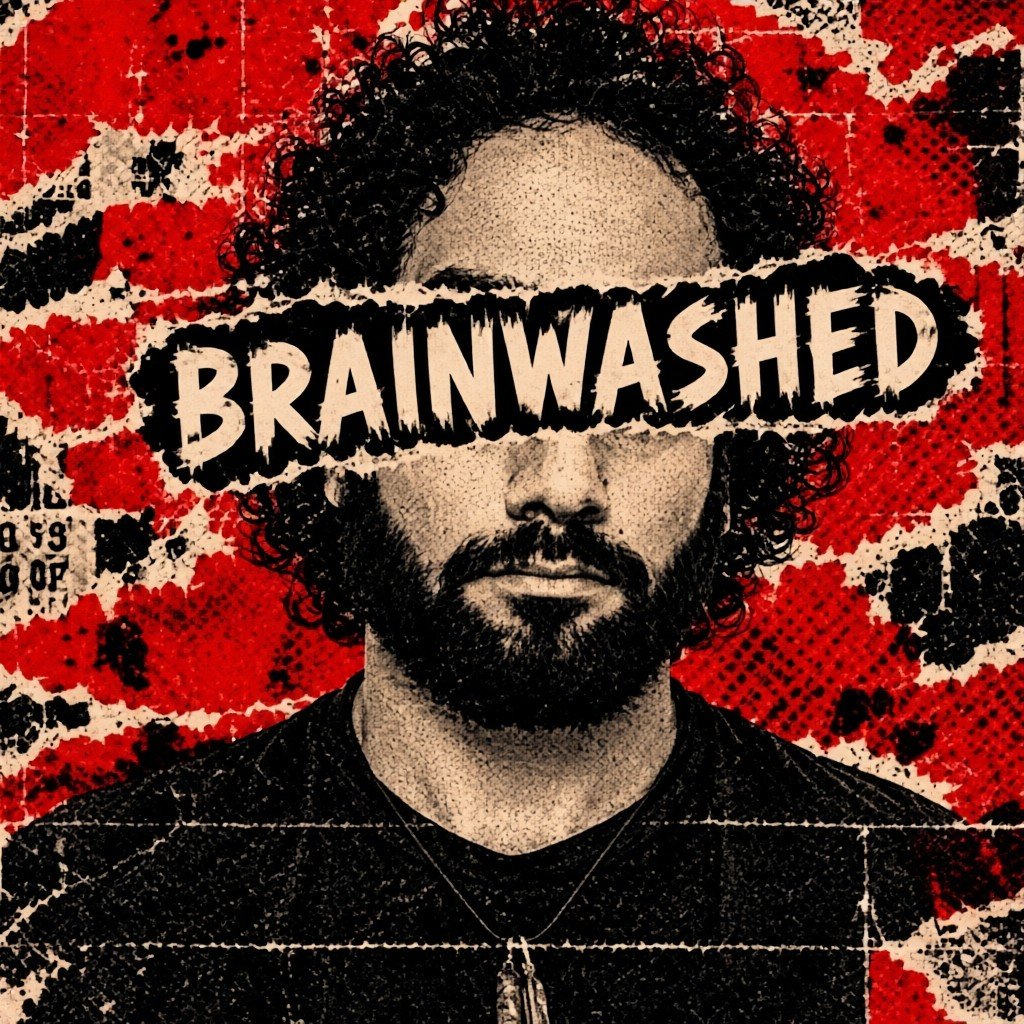
Now that the judge in the hearing has granted the police an additional six months for their investigation, and the gag order on the October 22 proceedings has been lifted, AROPL’s youth have been expressing their own points of view in a plethora of eloquent, humorous videos posted on TikTok and Facebook. Nasar Hashem has branded his Facebook photo with “brainwashed” emblazoned across his face. Nasoha performs a witty satirical skit on British justice in his TikTok video, “Great News for UK Citizens.” Sarah Batul (SarahBatul2 on TikTok) crafts a compelling argument that deconstructs the popular notion that AROPL believers are “brainwashed” victims trapped in modern slavery:
“I’ve been seeing TikTok videos about AROPL members being portrayed as dangerous or as helpless victims… and honestly, I think there is one rather important thing missing from that conversation—and that’s our own voices…. We’re not stereotypes, and we’re not characters in someone else’s story. We are people living our lives, living communally, trying to get through what we believe to be a period of persecution…. The Cheshire Constabulary, they look at my way of life and decide that it cannot possibly be good for me… that I must be brainwashed, that I cannot possibly have chosen it for myself. It’s very highly offensive… you assume I am a victim or a slave simply because I live differently than you do? You don’t know my mind better than I do.”

Sarah Batul quotes John Stuart Mill: “The only freedom which deserves the name is that of pursuing our own good in our own way.”
Susan J. Palmer is an Affiliate Professor in the Religions and Cultures Department at Concordia University in Montreal. She has directed the Children on Sectarian Religions and State Control project at McGill University, supported by the Social Sciences and the Humanities Research Council of Canada (SSHRC). She is the author of fourteen books, notably The New Heretics of France (Oxford University Press, 2012).