True believers in Satanic ritual abuse still exist and may even persuade legislators to pass laws. Many more apply Kent’s flawed logic to “cults.”
by Massimo Introvigne
Article 4 of 4. Read article 1, article 2, and article 3.
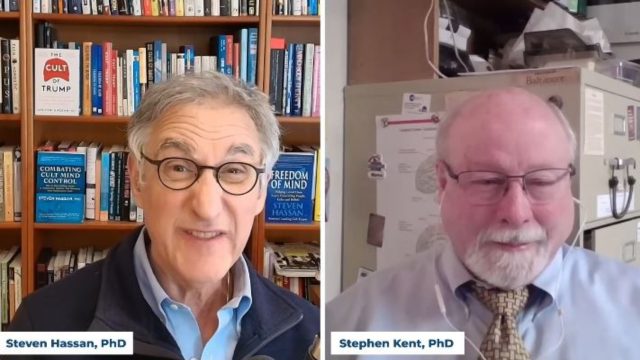
In the world of moral panics, few ideas have proven as resilient—and as corrosive—as the belief in vast, secret networks of Satanic ritual abusers. Though thoroughly debunked by scholars, government commissions, and the passage of time, the myth persists, mutating with each new cultural anxiety. Parts of this enduring narrative derive from Stephen Kent, whose academic work helped shape—and sustain—the paranoia.
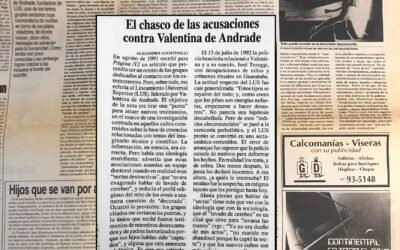
As leading American scholar Anson Shupe wrote in a book he co-authored with Susan Darnell, notwithstanding his fiascos in leading Canadian police to vainly dig for corpses, “Kent has continued to promote a paranoia about secret societies and conspiracies.” Eventually, his promotion of a “bizarre set of accounts” about Satanism earned Kent “a reputation as something of an eccentric on the matter of cults and NRMs [new religious movements]” (“Agents of Discord: Deprogramming, Pseudo-Science, and the American Anticult Movement,” New Brunswick, NJ: Transaction Publishers, 2006, p. 135).
Indeed, Kent’s theories were not merely speculative. They were deployed in courtrooms, cited by law enforcement, and used to justify investigations that led to wrongful convictions. But beyond the immediate damage, Kent’s legacy raises a deeper question: How do we distinguish between real crimes and imagined conspiracies? And what happens when scholars blur that line?
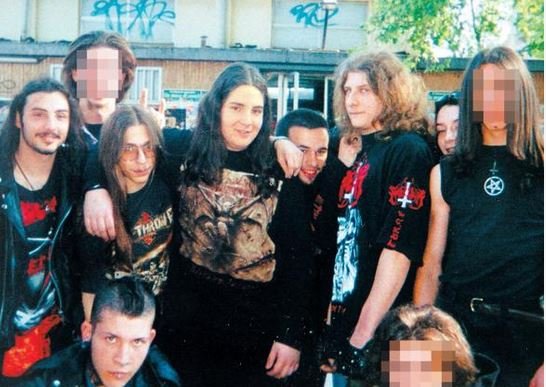
Let me be clear: I do not deny the existence of crimes committed by self-styled Satanists or occult groups. In Italy, the “Beasts of Satan” were young people who committed horrific acts—including murder—under the belief that they were serving dark spiritual forces. These were real crimes, with real victims, and they deserved legal redress. In fact, I have served as an expert witness for the prosecution in Italy in suspected ritual crime cases.
But these incidents are not evidence of a transhistorical, generational Satanic conspiracy. They are isolated eruptions of pathology, not proof of a global network. The leap from individual criminality to systemic ideology is precisely what Kent’s work encourages—and what serious scholarship must resist.
Kent’s writings often conflate these categories. He draws on survivor testimonies, religious texts, and historical anecdotes to construct a theory of ritual abuse that spans centuries and institutions. He suggests that sacred scriptures or spiritual and philosophical textbooks—whether the Bible, the Book of Mormon, or Masonic texts—can be interpreted (or misinterpreted) to justify abuse. And he portrays several religious groups not as diverse communities but as potential incubators of violence.
This approach is not just flawed—it is dangerous. It legitimizes suspicion of religious minorities, fuels legislative overreach, and persists, despite decades of debunking.
Consider the recent legislation passed in Utah in 2025: a statute targeting “ritual abuse,” despite the absence of credible evidence that such abuse exists in any organized or systemic form. The law was inspired by survivor accounts that echo the same themes Kent popularized—secret ceremonies, generational cults, and scriptural justifications for violence. Critics rightly point out that the law risks criminalizing unconventional religious practices and reviving a panic that has already done immense harm.
This is not an isolated incident. The resurgence of ritual abuse rhetoric reflects a broader cultural trend: the return of anti-cult conspiracy thinking in a time of uncertainty. And Kent’s work, with its blend of anecdote and ideology, provides a scholarly veneer for these fears.
What makes this especially troubling is Kent’s continued prominence in anti-religious and anti-cult circles. As “Bitter Winter” has documented, Kent has evolved from a critic of specific groups to a crusader against religion itself. He portrays sacred texts as inherently dangerous, religious leaders as manipulative and mentally ill, and spiritual communities as breeding grounds for abuse. His reliance on apostate ex-members of groups such as Scientology or the Unification Church and uncorroborated testimonies mirrors his earlier work on Satanism—and raises the same concerns.

Kent’s problem is not that he critiques religion. The problem is how he does it. He constructs a sensational and simplistic narrative by privileging anecdote over evidence and ideology over nuance. He treats religious belief as pathology, ritual as camouflage, and dissent as proof. This is not sociology—it is polemic.
And it has consequences. Kent’s theories have been used to justify surveillance of religious groups, to support prosecutions based on dubious evidence, and to stigmatize communities that deviate from mainstream norms. His work has contributed to a climate of suspicion, where difference is equated with danger and belief with abuse.
This is why revisiting the Satanism scare—and Kent’s role in it—is not merely an academic exercise. We must remember how easily fear can masquerade as scholarship, and how quickly ideology can distort inquiry. We must distinguish between critique and condemnation, between analysis and accusation.
The myth of generational Satanic abuse, long confined to tabloids and talk shows, now finds new life in legislation and media. It is repackaged as concern for victims, reframed as protection of children, and rebranded as justice. But beneath the rhetoric lies the same paranoia—a belief in hidden evil, secret networks, and ritual conspiracies.
Kent’s legacy is a cautionary tale. It reminds us that scholars have a responsibility not only to seek truth but to avoid harm. When we abandon rigor for rhetoric, we do more than misinform—we may become complicit in injustice.
In closing, let me return to the figure of Léo Taxil, whose hoax convinced much of Europe that Freemasonry was a front for Satanic worship. Taxil fabricated testimonies, forged documents, and invented characters—all in the name of ideology. Kent, of course, is no Taxil. He is an academic, not a provocateur. But the parallels are instructive.
Both constructed narratives of hidden evil, relied on unverified accounts, and contributed to moral panics that stigmatized minority groups. The difference is that Taxil eventually confessed.
As scholars, we must do better. We must ground our work in evidence, acknowledge complexity, and resist the seduction of simple stories. We must remember that real crimes deserve real investigation—and that imagined conspiracies deserve real skepticism.
Stephen Kent’s theories, while provocative, have failed the test of time. They have been challenged by scholars, discredited by investigations, and contradicted by evidence. Yet they persist, not because they are true, but because they are useful—to those who seek to criminalize unpopular movements as “cults,” pathologize religion, justify surveillance, and sustain fear.
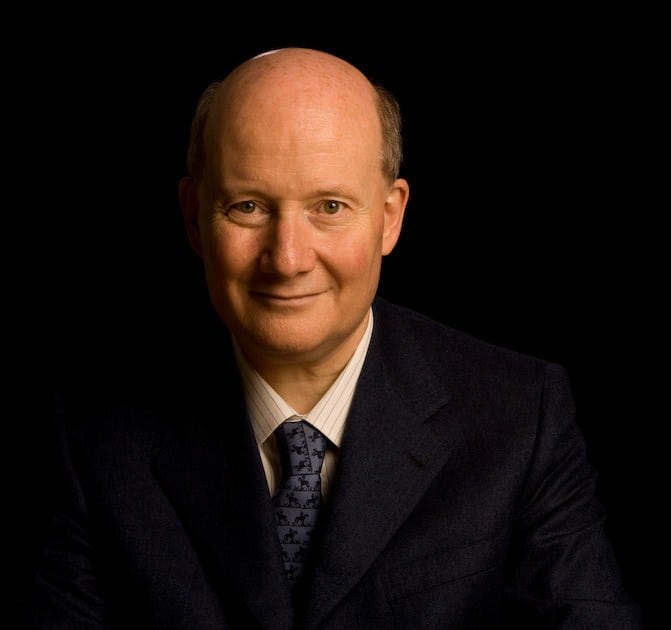
Massimo Introvigne (born June 14, 1955 in Rome) is an Italian sociologist of religions. He is the founder and managing director of the Center for Studies on New Religions (CESNUR), an international network of scholars who study new religious movements. Introvigne is the author of some 70 books and more than 100 articles in the field of sociology of religion. He was the main author of the Enciclopedia delle religioni in Italia (Encyclopedia of Religions in Italy). He is a member of the editorial board for the Interdisciplinary Journal of Research on Religion and of the executive board of University of Pennsylvania Press’ Nova Religio. From January 5 to December 31, 2011, he has served as the “Representative on combating racism, xenophobia and discrimination, with a special focus on discrimination against Christians and members of other religions” of the Organization for Security and Co-operation in Europe (OSCE). From 2012 to 2015 he served as chairperson of the Observatory of Religious Liberty, instituted by the Italian Ministry of Foreign Affairs in order to monitor problems of religious liberty on a worldwide scale.