The anti-cult sociologist really believed that Satanic “human sacrifices” happened in Canada. But he admitted that he “never once came across a body.”
by Massimo Introvigne
Article 2 of 4. Read article 1.
In the annals of moral panics, few episodes rival the Satanism scare that gripped North America in the 1980s and 1990s. Fueled by tabloid headlines, talk show hysteria, and a troubling alliance between pseudoscience and law enforcement, the panic led to wrongful convictions, ruined lives, and a lingering distrust of minority religious groups. Canada, often seen as a bastion of moderation, was not immune. And among the voices that amplified the alarm was Stephen Kent.
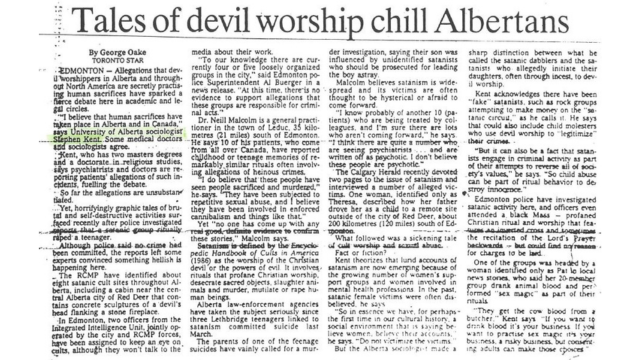
Kent’s career as the academic face of anti-cultism emerged in tandem with the crescendo of the Satanic ritual abuse (SRA) hysteria. While many scholars were working to debunk the scare, Kent positioned himself as a commentator who gave credence to the most lurid claims. In a 1990 interview with the “Toronto Star” (“Tales of Devil Worship Chill Alberteans,” November 12), Kent declared, “I believe that human sacrifices have taken place in Alberta and Canada.” He urged to “not victimize the victims,” referring to women who claimed to have been ritually abused by Satanic cults—often based on memories recovered through hypnosis or suggestive therapy.
This was not a fringe opinion. Kent’s statements were published in mainstream media and cited by law enforcement. His views helped legitimize a wave of investigations that relied not on physical evidence but anecdotal recollections—many of which were later proven false. The Royal Canadian Mounted Police (RCMP) dug up fields in search of buried bodies. None were found. Kent later admitted, “I’ve never once come across a body. I’ve never been able to confirm major aspects of these people’s stories” (“Reports Hard to Substantiate,” “Calgary Herald,” March 26, 1993).
Yet the damage was done. Innocent people went to prison, some for years, based on allegations that Kent and others had helped to validate. The panic was not limited to Canada. In the United States, similar cases unfolded, often with Kent’s writings cited as supporting evidence. His ritual abuse project consisted of interviewing a handful of women, listening to them for hours as they recounted memories of abuse. These memories, often recovered under questionable therapeutic conditions, became the foundation for Kent’s broader theories.
As mentioned in the previous article, what distinguished Kent’s approach was his attempt to root Satanic abuse in religious texts. This interpretive leap was not merely speculative—it was ideological. Kent’s antipathy toward religion colored his analysis, leading him to see sacred texts less as complex cultural artifacts than as potential blueprints for abuse.
Kent expanded his scope to include Mormonism. He cited historical sources, survivor testimonies, and the controversial Pace memorandum—a 1990 internal memo by LDS Bishop Glenn L. Pace, which claimed that dozens of victims had reported ritual abuse within the Church of Jesus Christ of Latter-day Saints.
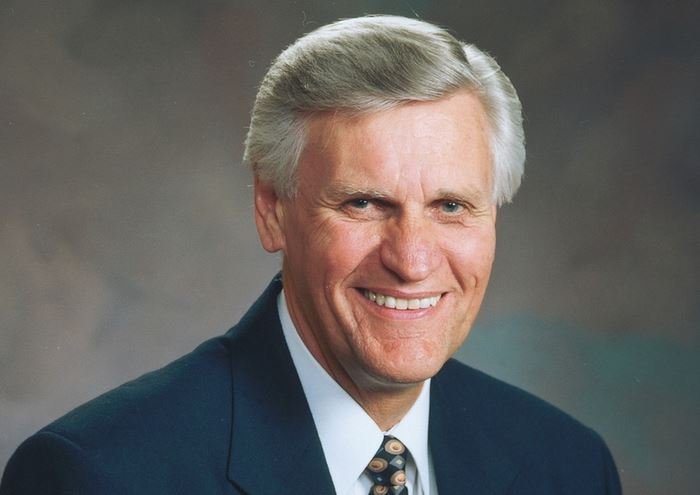
Kent endorsed the Pace memo as “the strongest (but not definitive) evidence that satanic rituals are being conducted in the context of deviant Mormonism.” However, subsequent investigations found no corroborating evidence. The Utah legislature appropriated $250,000 to investigate the claims. Hundreds of alleged victims were interviewed. No charges were filed. In 1995, Utah Attorney General Jan Graham formally closed the case, stating: “Investigators were unable to substantiate with physical evidence the incidents reported to them.”
Kent’s willingness to accept unverified claims extended to his views on Freemasonry. In an interview with the anti-Masonic “Freemasonry Watch,” he speculated about Masonic ritual abuse, drawing tenuous connections between esoteric rites and Satanic practices. His theories echoed Léo Taxil, whose 19th-century hoax linked Freemasonry to Luciferian conspiracies. While Kent did not fabricate evidence as Taxil did, his interpretive methods—relying on survivor anecdotes and speculative readings of ritual texts—raised similar concerns.
Not a scholar of Aleister Crowley, Kent also took literally references by the British magus to “sacrifices of children” that virtually all academic interpreters have understood as referring not to murder but to masturbation.
More troubling was Kent’s collaboration with law enforcement. He provided “expert assessments” of Satanic abuse allegations, including one published on his own website. Similar assessments, based on anecdotal evidence and ideological assumptions, were used to justify investigations that led to wrongful convictions. The consequences were devastating. Families were torn apart. Careers were destroyed. And the credibility of scholars was undermined.
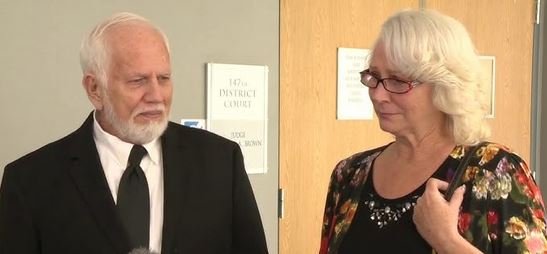
One of the most egregious cases Kent referenced (although admitting it was “controversial”) was that of Fran and Dan Keller in Oak Hill, Texas. Accused of sadistically abusing children in their daycare center, the Kellers were convicted and sentenced to 48 years in prison. The allegations included serving blood-laced Kool-Aid, forcing children to participate in videotaped sex acts, and conducting ritual killings. No physical evidence was ever found. In 2013, the Kellers were released based on prosecutorial misconduct. In 2017, they were declared innocent and awarded $3.4 million in compensation.
Kent’s theories also influenced Royal Canadian Mounted Police (RCMP) investigations. In a March 26, 1993, article in the “Calgary Herald,” RCMP Cpl. Reed Leary admitted that none of the reports received by his agency had led to charges. One supposed murder victim was found alive. Yet Leary refused to concede that the panic was unfounded, asking, “Even if the police were total losers, can’t they get lucky once?” Kent, for his part, continued to rely on “less formal” bodies of evidence—stories that were often the product of suggestive interviewing and therapeutic manipulation.
In an interview with Wayne Morris on Radio CKLN FM 88, where he continued to accuse Freemasons (with some caution to avoid being sued), Kent recounted a case where a woman claimed a pickled fetus was buried in a shed. Kent and a local reporter dug up the shed—on videotape, no less—and found nothing. They even flew the woman to the site to dig with them. Still, nothing. Yet Kent remained undeterred, continuing to promote previously discredited theories.
Kent was not alone. The Satanism scare was a collective failure, involving journalists, therapists, police, and some anti-cult activists (although other anti-cultists were not persuaded that Satanic ritual abuse existed). However, Kent’s role was unique in providing a scholarly veneer to claims lacking empirical support. His writings lent legitimacy to a panic that ruined lives and distorted public understanding of religion and ritual.
When scholars abandon rigor for rhetoric, they do more than misinform—they become complicit in injustice. Kent’s legacy in the Satanism scare is not one of discovery but of distortion. His theories, built on anecdote and ideology, contributed to a moral panic that has since been thoroughly debunked. Yet the echoes of that panic remain, resurfacing in new forms and contexts. Kent, despite the absence of evidence, continues to dig for demons.
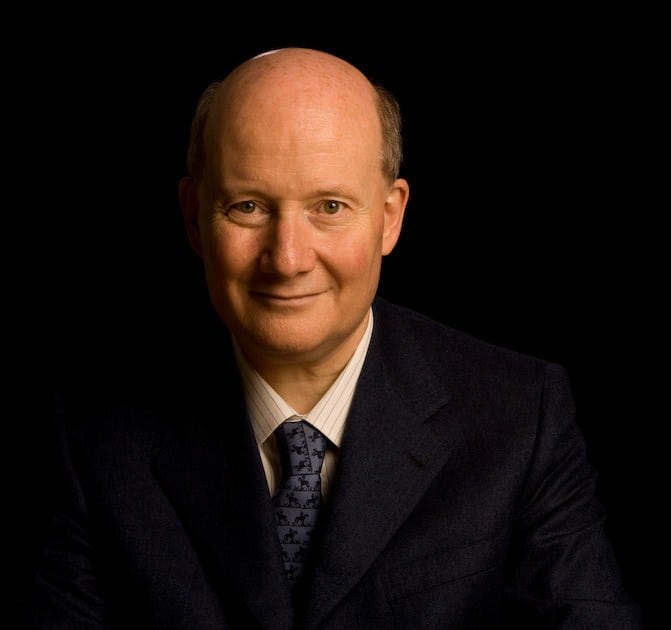
Massimo Introvigne (born June 14, 1955 in Rome) is an Italian sociologist of religions. He is the founder and managing director of the Center for Studies on New Religions (CESNUR), an international network of scholars who study new religious movements. Introvigne is the author of some 70 books and more than 100 articles in the field of sociology of religion. He was the main author of the Enciclopedia delle religioni in Italia (Encyclopedia of Religions in Italy). He is a member of the editorial board for the Interdisciplinary Journal of Research on Religion and of the executive board of University of Pennsylvania Press’ Nova Religio. From January 5 to December 31, 2011, he has served as the “Representative on combating racism, xenophobia and discrimination, with a special focus on discrimination against Christians and members of other religions” of the Organization for Security and Co-operation in Europe (OSCE). From 2012 to 2015 he served as chairperson of the Observatory of Religious Liberty, instituted by the Italian Ministry of Foreign Affairs in order to monitor problems of religious liberty on a worldwide scale.