Washington licensed 45,000 advanced NVIDIA chips for a Central Asian data center. Could China tap their computing power?
By Nazigul Maksutkhan

A major artificial intelligence infrastructure project based on NVIDIA technologies is under development in Kazakhstan. The initiative could advance the country’s digital economy and establish it as a data center hub for Central Asia.
However, the project’s geographical location and technological scale raise an important issue for U.S. export controls. Will the advanced NVIDIA chips supplied to Kazakhstan remain exclusively under the control of authorized users, or could their computing capabilities become accessible to China, directly or indirectly?
This question is particularly significant given the close economic ties between Kazakhstan and China, their joint technology projects, and the activities of Chinese companies in the region.
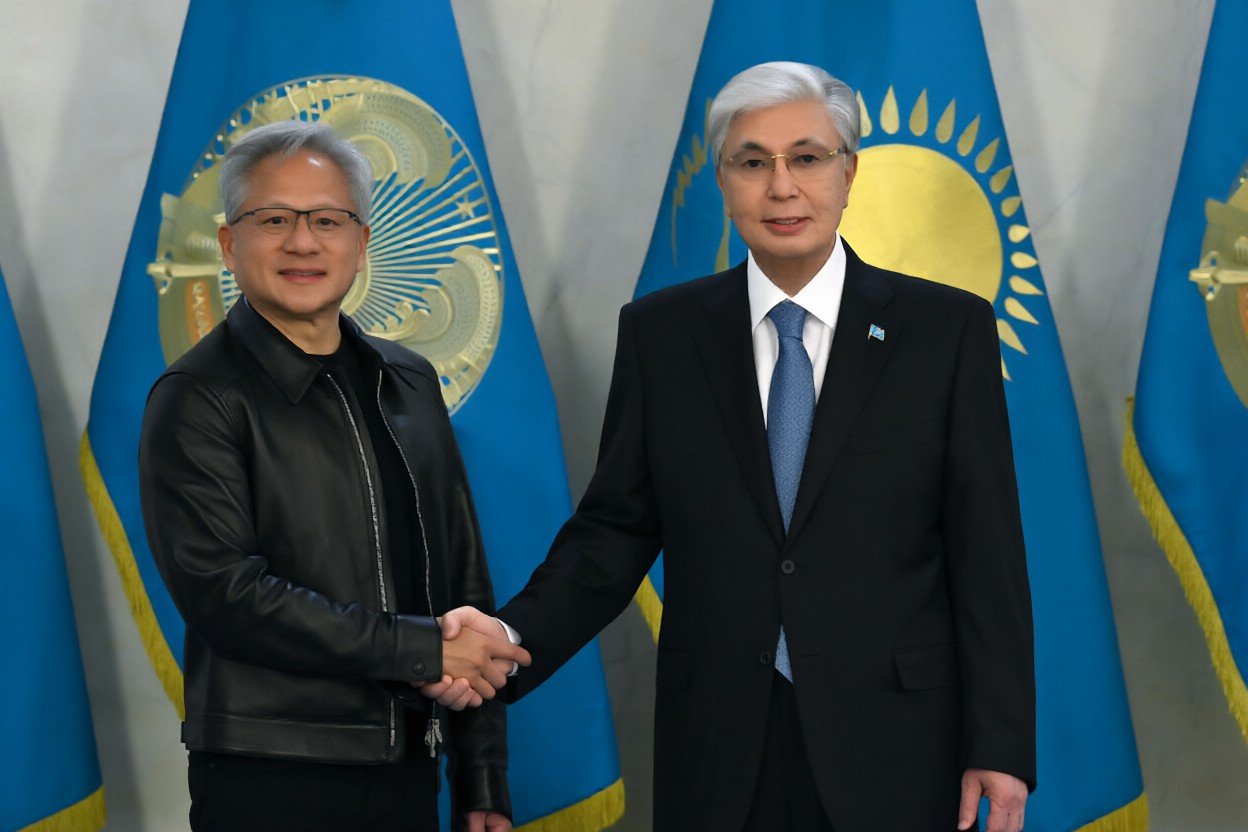
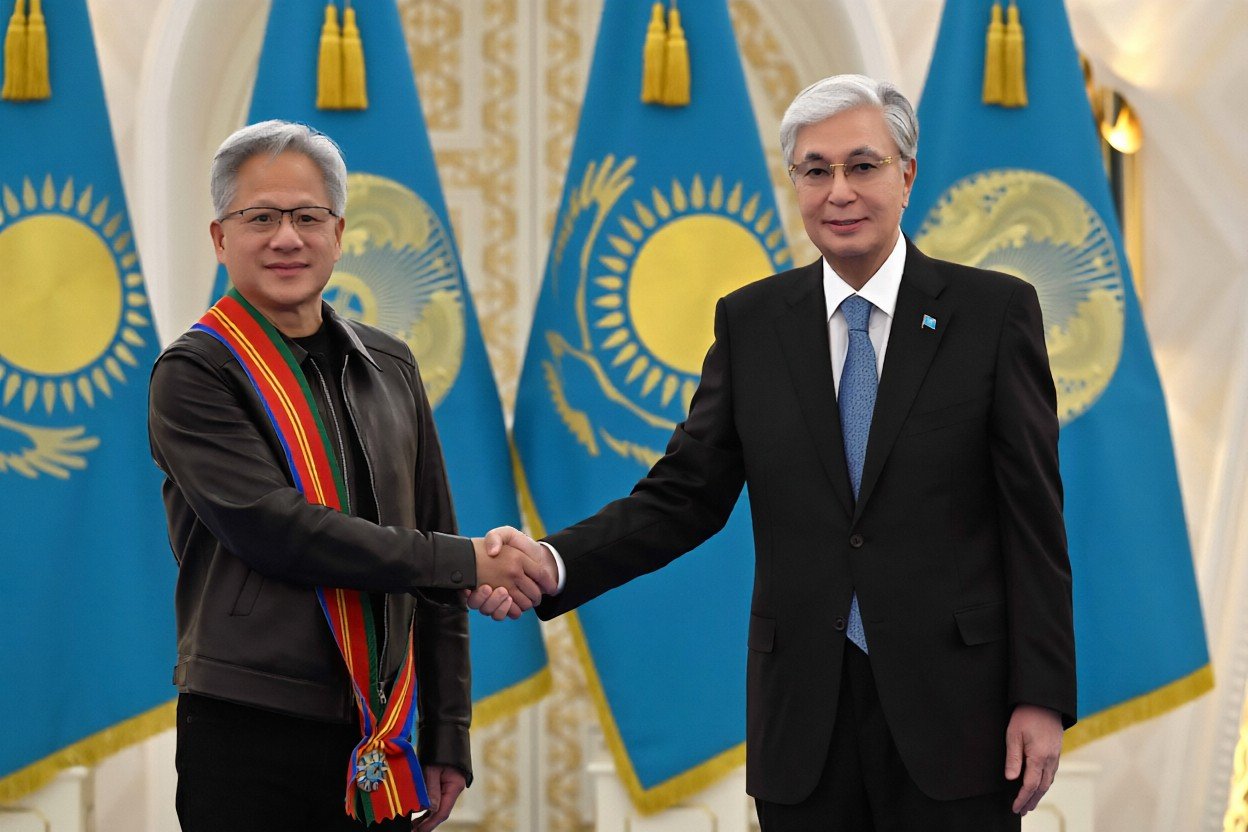
During the visit of NVIDIA chief Jensen Huang to Kazakhstan in October 2026, discussions covered cooperation in artificial intelligence, energy, robotics, and physical AI.
According to a statement issued by Firebird on October 24, 2026, the company obtained a U.S. export license to supply 45,000 NVIDIA Grace Blackwell GPUs for the first phase of its AI Factory project in Kazakhstan.
The project will be implemented jointly with Kazakhtelecom at Data Center Valley in Ekibastuz. Commercial operations are scheduled to begin in the third quarter of 2027.
According to the company, an investment of approximately US$5 billion is planned for the first phase. The infrastructure is expected to have a power capacity of up to 109 MW and to accommodate more than 45,000 GB300 GPUs. Firebird states that at least 10 percent of the computing capacity will be allocated to Kazakhstani companies and government institutions. Subsequent phases could raise the project’s total capacity to approximately 500 MW. These figures are plans announced by the company.
The delivery of more than 45,000 advanced GPUs to a single country is a significant development from an export control perspective. Computing capacity on this scale must be assessed by asking where the hardware is physically located, who controls it, who uses it, and for what purposes.
NVIDIA’s advanced computing chips are subject to U.S. export controls. Washington has sought to restrict the transfer of such technologies to China, whether directly or through intermediaries. High-performance GPUs play an important role in training artificial intelligence models and in developing military and dual-use technologies.
On November 16, 2026, Reuters reported on new U.S. export requirements intended to regulate Chinese companies’ access to advanced AI computing capacity through overseas data centers. Under the new rules, certain operators serving China-based companies through foreign data centers may be required to obtain a U.S. license.
These developments raise an important question about the Firebird project in Kazakhstan. The fact that chips are not physically shipped to China does not necessarily mean that Chinese companies cannot use their computing capacity.
Two distinct risks must be considered.
The first is the physical re-export of chips. There is a possibility that NVIDIA hardware, once delivered to Kazakhstan, could be transferred to a third country, including China, unlawfully or through intermediaries.
The second is remote access to computing capacity. Even if the chips remain in a data center in Kazakhstan, companies based in China could potentially use their processing power through cloud services, server rentals, or intermediary organizations.
The second scenario is particularly complex from an export control perspective, since the hardware and its actual users may be located in different countries.
Transparency is therefore essential on the following questions. Who are the actual owners and operators of the GPUs? Which companies purchase or lease the computing capacity? Will companies registered in China, or their subsidiaries, be permitted to receive services? How will remote access, cloud services, and intermediary platforms be monitored? Is there a system for verifying end users and identifying the ownership structures of clients? How will compliance with the conditions of the U.S. export license be verified?
These questions do not imply that chips delivered to Kazakhstan have been transferred to China. Their purpose is to identify potential channels through which such access or transfers might occur.
Economic ties between Kazakhstan and China have expanded in recent years. China is one of Kazakhstan’s largest trading partners and a significant investor in its energy, industrial, transport, logistics, agricultural, and technology sectors.
According to official figures for 2025, the joint investment portfolio of the two countries comprised more than 224 projects, with a total value of approximately US$66.5 billion.
In July 2026, Samruk-Kazyna signed 19 agreements with Chinese companies, worth a combined US$4.29 billion. They covered telecommunications, energy, transport, digitalization, and data centers. Technological cooperation with Huawei and agreements between Kazakhtelecom and Hengtong Group concerning the Data Center Valley project were also listed among these arrangements.
Kazakhstan and China maintain several joint institutions and mechanisms for coordinating bilateral cooperation. They include the Kazakhstan–China Cooperation Committee, the Kazakhstan–China Business Council, and joint bodies covering trade, investment, transport, and logistics. The two countries also cooperate within the Shanghai Cooperation Organization, the Conference on Interaction and Confidence Building Measures in Asia, and the Central Asia–China framework.
These ties illustrate the scale of Chinese corporate participation in Kazakhstan’s economy. Partnerships in telecommunications, digital infrastructure, and data processing, in particular, reinforce the need to identify the actual clients and technology partners of any infrastructure using NVIDIA chips.
The existence of joint projects with China does not establish that chips are being transferred to China. Nevertheless, the participation of Chinese companies in Kazakhstan’s digital infrastructure, and their potential access to its computing capacity, require separate scrutiny.
President Kassym-Jomart Tokayev has consistently presented the deepening of Kazakhstan’s comprehensive strategic partnership with China as an important priority of the country’s foreign economic policy.
Following a meeting with Xi Jinping in June 2025, Tokayev described China as Kazakhstan’s close friend and reliable partner, and expressed his willingness to expand bilateral cooperation. This was an official expression of the political closeness and strategic ties between the leaders of the two countries.
The statement “We oppose turning Kazakhstan into a country hostile to China” has also been attributed to Tokayev in public discussion. Its original source could not be verified, however, and it is not presented here as a direct quotation from the President.
The central issue for this article is the extent of Kazakhstan’s economic and technological ties with China. In this context, an unambiguous answer is needed on whether Chinese companies could use data centers and computing infrastructure located in Kazakhstan.
Governance transparency and corruption risks must also be considered in assessing this issue. In Transparency International’s 2025 Corruption Perceptions Index, Kazakhstan ranked 96th out of 182 countries, with a score of 38 out of 100.
This ranking does not establish wrongdoing in any particular transaction in Kazakhstan. It does, however, indicate that major investment projects call for careful scrutiny of contract transparency, beneficial ownership, the justification for government decisions, and controls over access to technological infrastructure.
Several factors may have influenced the selection of Kazakhstan for the Firebird project: energy resources, land availability, government support, geographical location, and access to the Central Asian market.
However, the availability of electricity alone is insufficient to support a data center. Such infrastructure also requires a reliable power supply, cooling systems, high-speed international internet connections, redundant communications links, and qualified engineers.
An analysis by the Carnegie Endowment identifies energy, international connectivity, and government policy as decisive factors in the development of Central Asia’s digital infrastructure. The fact that a substantial proportion of Kazakhstan’s international internet traffic passes through Russia also shows how much the diversification of communications routes matters.
This raises a further question. Who will control the international communications links serving Kazakhstan’s data centers, and what technical and legal arrangements will govern foreign clients’ access to the servers?
An expert discussion published by Vlast raised questions about the actual customers of the Data Center Valley project, its funding sources, and the eventual users of its computing capacity. According to the experts, although China and Russia are geographically close potential markets, U.S. export restrictions prevent companies in those countries from using NVIDIA’s advanced chips.
A precise list of the project’s principal clients and purchasers of computing capacity is therefore important in assessing its economic model.
In November 2026, Reuters and other international media published reports about a personal relationship between NVIDIA chief Jensen Huang and Alice Huang, a former executive of Megaspeed International.
Although Reuters reported that U.S. authorities had suspected Alice Huang of potentially engaging in espionage on China’s behalf, the agency emphasized that it could not independently verify any connection between her and the Chinese government or any involvement in espionage. China also denied the allegations. NVIDIA’s board of directors reportedly opened an investigation in connection with these reports. Huang resigned as chief executive on November 12, 2026, and the board reinstated him on November 23.
This information does not constitute evidence of unlawful conduct involving the Firebird project or its partners in Kazakhstan. It nevertheless illustrates the importance of corporate governance, partner due diligence, end-user identification, and information security in international supply chains for advanced chips and artificial intelligence technologies.
In major projects using NVIDIA chips, an examination of corporate ownership structures, intermediaries, clients, and arrangements governing access to technology should form an essential part of export control compliance.
Kazakhstan’s strategic and economic cooperation with the United States extends beyond artificial intelligence. Rare and strategic minerals are another important area of bilateral engagement.
In a statement dated June 27, 2026, U.S. Senator Jon Ossoff criticized potential conflicts of interest and issues of government financing associated with a tungsten project in Kazakhstan. He questioned the relationship between Kazakhstan’s negotiations with the United States, ownership interests held by members of the Trump family in the company, and potential U.S. financing of up to US$1.6 billion. This is the senator’s political assessment, and no court has established unlawful conduct.
According to a Reuters report published on November 10, 2026, the Export-Import Bank of the United States and the U.S. International Development Finance Corporation were not, at that time, planning to approve US$1.6 billion in financing for the project. Earlier letters expressing interest in financing did not constitute binding financial commitments. The project remained at a preliminary assessment stage.
Although the tungsten project is separate from the NVIDIA–Firebird initiative, it illustrates Kazakhstan’s growing importance in the strategic competition between the United States and China over technologies and minerals.
The NVIDIA–Firebird project in Kazakhstan envisages the installation of more than 45,000 advanced GPUs. Information about the actual users and recipients of the services supported by computing capacity on this scale should be a central element of the project’s disclosures.
Kazakhstan’s close trade and economic ties with China, joint investment projects, and technological partnerships make this issue particularly relevant. However, the existence of these ties does not establish that NVIDIA chips have been transferred to China.
The principal issue requiring attention is the possibility of remote access to computing capacity, alongside the physical movement of chips. Could Chinese companies use servers located in Kazakhstan, either directly or through intermediaries? If so, would such services comply with the conditions of the U.S. license?
Answering these questions requires precise information on the Firebird project’s clients, end users, computing capacity rental terms, remote access arrangements, and system for ensuring compliance with export controls.
The central question is who will actually use the computing capacity of the NVIDIA chips delivered to Kazakhstan, and whether that capacity could become accessible to China’s technological ecosystem.

Nazigul Maksutkhan is a Kazakhstani lawyer, human rights defender, and activist with the unregistered Atajurt (Naghyz Atazhurt) movement. Following a peaceful protest on November 13, 2025, in Qalzhat near the Kazakhstan–China border—where demonstrators denounced repression in Xinjiang and demanded the release of detained Kazakhstani citizen Alimnur Turganbay—the authorities brought criminal charges against her under Article 174(2) (“inciting ethnic or national discord”). Maksutkhan was seven months pregnant at the time of the protest and was placed under house arrest with electronic monitoring. She gave birth by cesarean section on February 19, 2026, while the proceedings were underway. On April 13, 2026, a court in Taldykorgan convicted all 19 Atajurt defendants. Maksutkhan received a sentence of four years and eight months, which was deferred and converted into a non-custodial “restriction of freedom” sentence so that she could care for her child, together with a three-year ban on public or political activities after completing the sentence. An appeals court upheld the convictions on June 9, 2026.