Beijing’s autumn gathering of the Central Committee promised cadres tighter discipline, endless study sessions, and lifelong scrutiny, while purges emptied a quarter of the seats.
by Hu Zimo
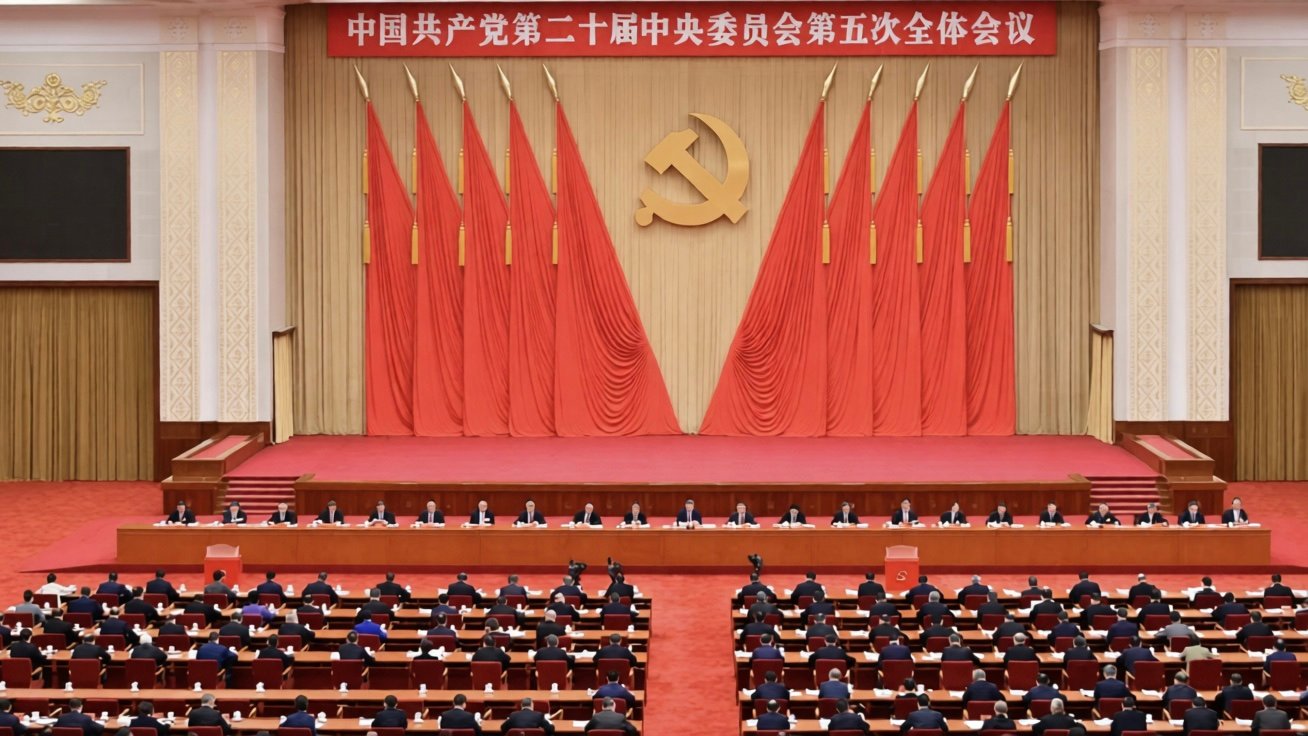
Somewhere in China, a mid-level official is reading the communiqué of the Fifth Plenary Session of the 20th Central Committee of the Chinese Communist Party, released on October 29, 2026, and reaching for something to settle the stomach. The four-day meeting in Beijing produced a document whose title alone, “Resolution of the Central Committee of the Communist Party of China on Certain Major Issues Concerning Persevering with Full and Rigorous Party Self-Governance,” could fill a short lunch break. Stripped of its liturgy, the message is not subtle. Belonging to a Party of roughly 100 million members was already a demanding career choice. It is about to become a more demanding one.
The first hint came from the attendance sheet. The 20th Party Congress in 2022 elected 205 full members and 171 alternate members of the Central Committee. Only 162 and 117 took their seats this week. Bill Bishop, in his China newsletter “Sinocism,” reported that no plenum with published attendance figures had seen such a low turnout since 1968. That was the high season of the Cultural Revolution, which emptied meeting halls with considerably less paperwork.
The empty chairs have names. The plenum confirmed the expulsion from the Party of 33 senior figures, 17 civilians and 16 military officers. The military list is headed by Zhang Youxia, until recently the senior Vice Chairman of the Central Military Commission and once regarded as the most trusted general in Xi Jinping’s circle. Among the civilians are Ma Xingrui, the former Party Secretary of Xinjiang, whose years in Urumqi readers of “Bitter Winter” will remember for the wrong reasons; Liu Jianchao, the former head of the International Liaison Department, at one time tipped as a future foreign minister; Jin Zhuanglong, a former Minister of Industry and Information Technology; and Yi Huiman, the former chief securities regulator. Li Yunze, until recently in charge of the National Financial Regulatory Administration, lost his Party posts while keeping his Party card, which in the current climate qualifies as a lucky escape. Membership in the Central Committee has become a club whose members check the guest list each morning to see whether they are still on it.
Somebody, of course, has to fill the seats. Ten alternate members were promoted to full membership, while five alternates who ranked above them in the official order were quietly skipped. Zhang Shengmin, a Vice Chairman of the Central Military Commission, was added to the Political Bureau, the first time a plenum has enlarged the Politburo since Huang Ju joined it in 1994. The queue moves, in other words, according to rules nobody bothers to write down. This detail acquires a certain irony a few pages later, where the communiqué promises to eradicate the “hidden rules” of Party life.
The document offers an official history that will be familiar to anyone who has followed Chinese politics since 2012. Before Xi, the communiqué explains, Party leadership had grown “weak, hollow, and watered-down,” self-supervision was lax and superficial, and the Party harbored problems it calls “startling.” The Central Committee led by Xi then applied “the most stringent measures,” curbed tendencies that had long gone unchecked, and removed “serious dangers hidden within the Party, the state, and the military.” The problem, readers learn, has been solved at its root. In the very next breath they learn that the “four tests” and “four dangers” facing the Party remain “protracted, complicated, and serious.” This kind of logic guarantees discipline inspectors lifetime employment.
For the uninitiated, the four tests concern governing, reform and opening up, the market economy, and the external environment. The four dangers are complacency, incompetence, detachment from the masses, and corruption. Each could serve as the title of a self-help manual for cadres, and several probably already do.
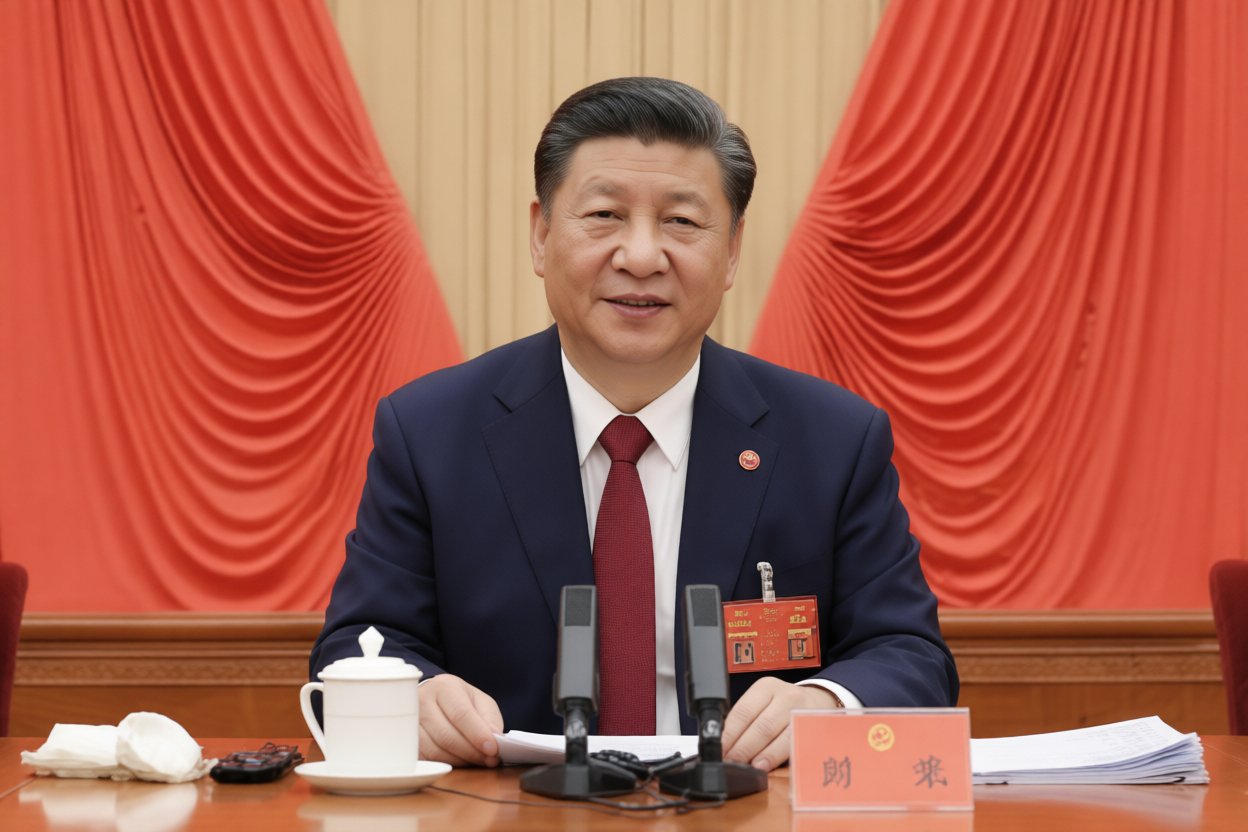
What does the Party now ask of its members? The resolution organizes its demands around nine areas, and each one adds something to the cadre’s backpack. Members must treat the cultivation of “Party spirit” as a lifelong commitment, accompanied by loyalty education and periodic “Party spirit appraisal,” a phrase suggesting that the soul of a Communist will be graded much like a quarterly report. Democratic centralism will be enforced more strictly, with new limits on how the “number one” leader of each unit exercises power. Officials will be selected, trained, and monitored under tighter standards, and the eight-point rules on frugal conduct introduced in 2012 will be applied with renewed zeal. Banquets, it seems, will remain a hazardous activity.
The anti-corruption chapter deserves a prize for ambition. Officials should lack the audacity, the opportunity, and the desire to engage in corruption. Put more plainly, cadres must be too frightened to steal, too closely watched to steal, and too ideologically pure to want to. Discipline inspectors have plenty of experience with the first two goals. The third has defeated moralists of every age and civilization, and the Party now proposes to reach it through study sessions.
Study sessions there will be. The communiqué calls the study of the plenum’s principles a major political task for the entire Party in the coming period. A separate campaign on “establishing and practicing the correct view of performance” continues, with special training for the new heads of leadership teams emerging from the next round of local elections. The communiqué also enshrines “Xi Jinping Thought on Party Building” as a component of the broader Xi Jinping Thought and as the guide for implementing the resolution. The 21st Party Congress, set for the second half of 2027, will provide a further occasion for collective study.
For readers of “Bitter Winter,” one aspect of this exercise deserves attention beyond the palace intrigue. Party rules require members to be atheists, and the communiqué’s insistence on “strengthening ideals and convictions,” on nurturing Party spirit with the Party’s own traditions, and on appraising that spirit throughout a member’s career leaves less and less space for the private religious life some members have quietly preserved. The resolution also calls for extending Party building into “emerging sectors,” the new economy and the private firms where many Chinese now work. Every new rule for members tends to become, at one remove, a rule for the society they supervise.
For the ordinary cadre, the plenum’s guidance can be summarized in a formula the communiqué does not use: keep your head down, your notebook open, and your Marxist conscience spotless. And at the next meeting, count the chairs.

Uses a pseudonym for security reasons.