After CESNUR 2026, some thirty academics toured a ruined villa near Taipei and met disciples in a forum on a case that refuses to close.
by Massimo Introvigne
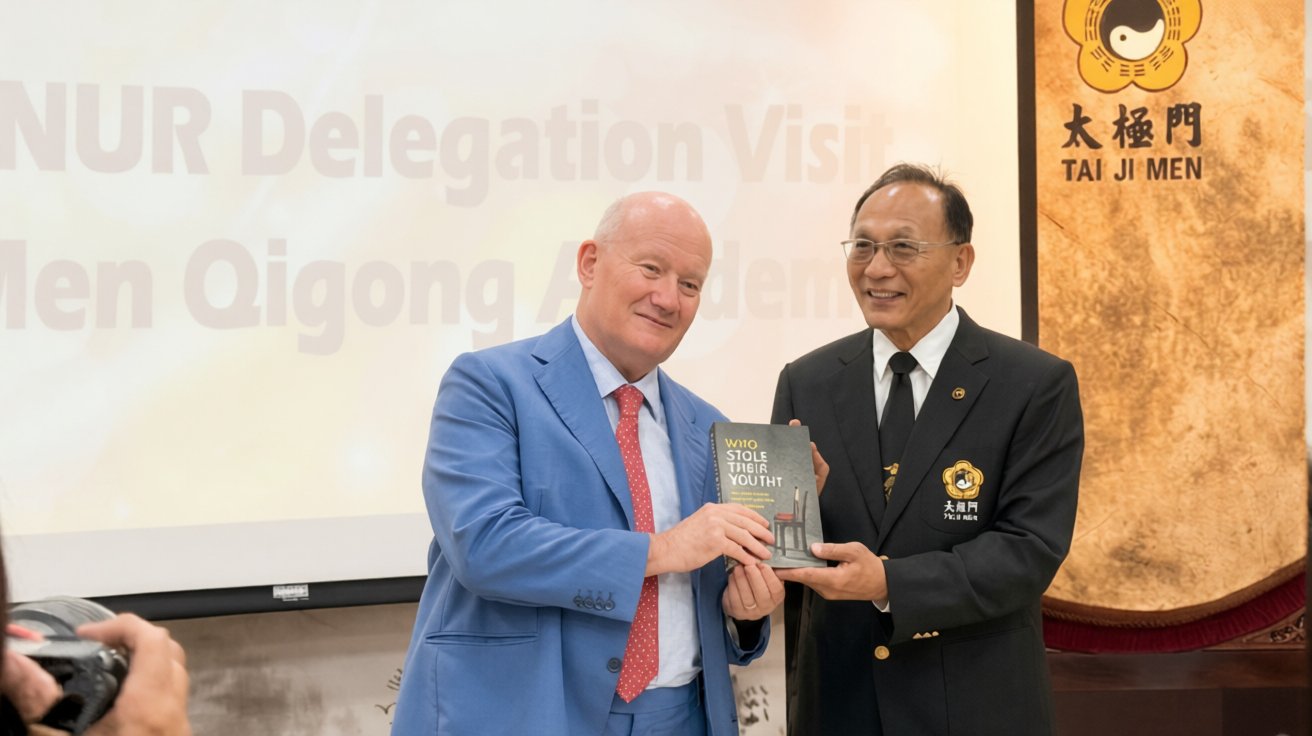
The CESNUR 2026 international conference ended in Taichung on October 12, but for many participants the Taiwanese journey continued. On October 15, a delegation of some thirty scholars from several continents traveled north to visit two places connected with Tai Ji Men and its thirty-year-old case: the Swiss Mountain Villa in Xizhi, on the outskirts of Taipei, and the Tai Ji Men Qigong Academy in the capital itself. On the way, our bus passed close to the land in Miaoli that Tai Ji Men regards as sacred, nationalized by the state in 2020 after a failed auction.
The Swiss Mountain Villa is a residential community in the green hills near Yangmingshan National Park. In 1995, Dr. Hong Tao-Tze, the Shifu (Grand Master) of Tai Ji Men, bought several properties there, planning to turn them into a self-cultivation and learning center for his dizi (disciples) and a guesthouse for those coming from abroad. One year later, Prosecutor Hou Kuan-jen launched his crackdown on Tai Ji Men, arresting Dr. Hong, his wife, and two disciples. In 1997, their assets were frozen, and the National Taxation Bureau placed a restraint on the villa properties as part of the tax case born from the criminal one. The Supreme Court acquitted all defendants of all charges in 2007, yet the properties remained blocked; in 2019, the National Enforcement Agency seized them to enforce the fabricated 1992 tax bill. They were returned only in 2020, after the Miaoli land had been taken in their place and more than twenty-three years had passed. During all that time, Dr. Hong could neither use nor sell the buildings, although he still had to pay property taxes on them. Abandoned, they slowly fell into ruin, and current building regulations make both rebuilding and restoration practically impossible.
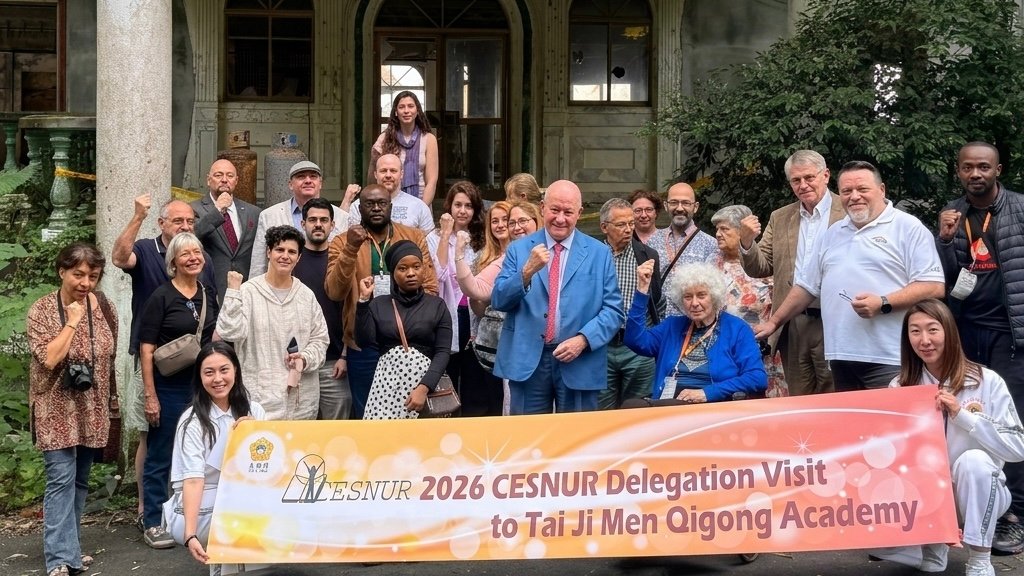
Walking through the site produces a mixture of admiration and sadness. The mountains are beautiful, the houses were obviously designed with care, and the decay is everywhere. Dizi guided the delegation through the buildings, explaining what each was meant to become. The disciples now treat the place as a site of memory as much as a property.
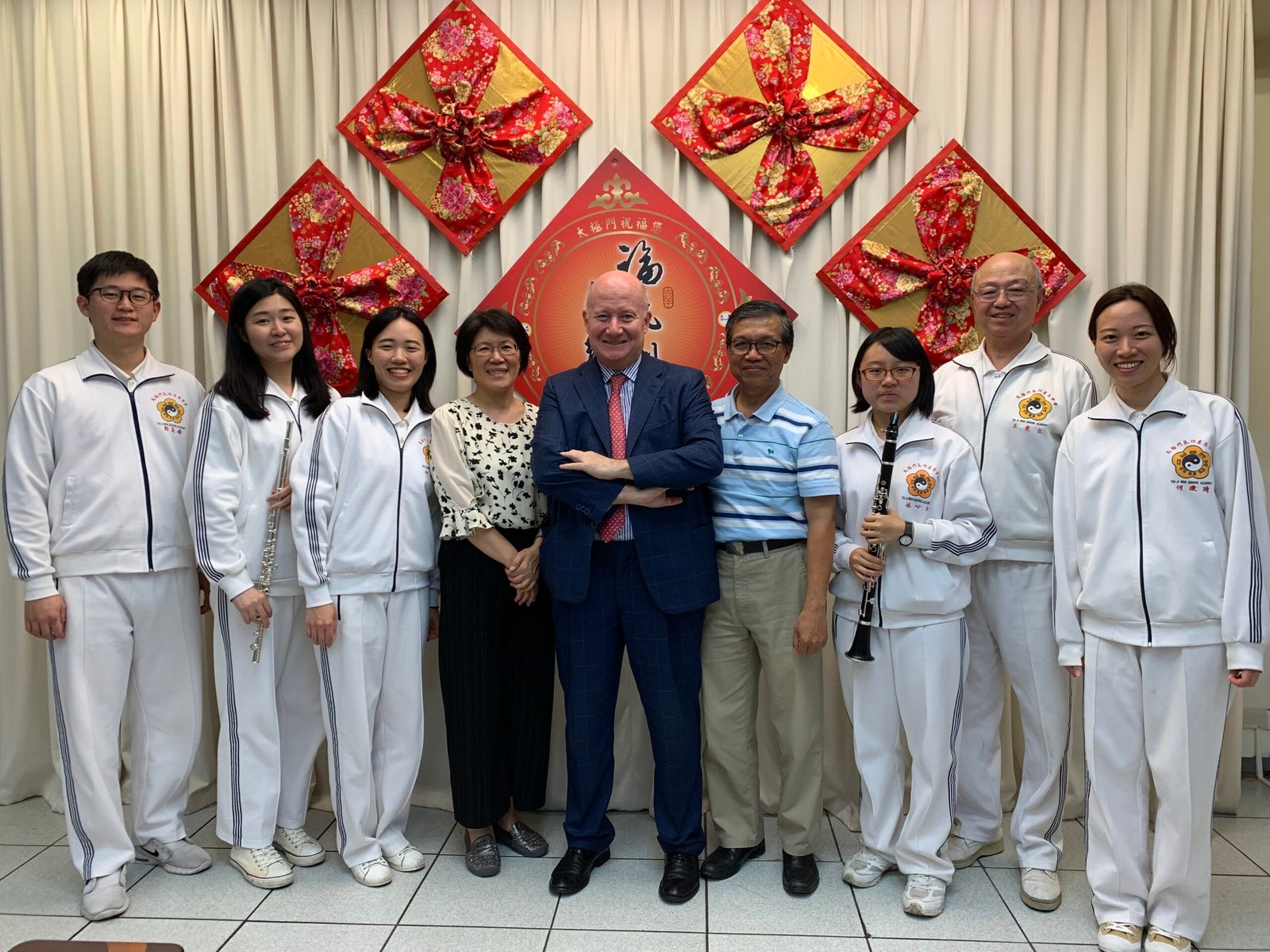
Later in the day, the delegation reached the Tai Ji Men Qigong Academy in Taipei, founded in 1966 and celebrating its sixtieth anniversary this year. Dizi led the scholars through its rooms, introducing them to the history of Tai Ji Men, an ancient menpai (similar to a school) of qigong, martial arts, and self-cultivation, and to the international activities through which its members have carried Taiwanese culture and a message of conscience to more than 120 countries. The tour included the Bell of World Peace and Love, kept inside the Academy, which Tai Ji Men has invited world leaders to ring in many countries.
The visit was followed by a forum titled “Perspectives and Dialogue on the Tai Ji Men Case,” co-organized by CESNUR and Human Rights Without Frontiers, which I had the privilege to introduce. I recalled that my own involvement started in March 2019, when Rosita Šorytė and I attended the International Religious Freedom Summit in Taipei as a “Bitter Winter” delegation. Leaving the venue, we met two dizi distributing flyers about their case and, the following evening, came to this very Academy to learn about a story we knew almost nothing about. Since little had been written about it, we started writing and organizing events in different countries (later in the year, Dr. Hong came to Torino, CESNUR’s home), international conferences, and then, during the COVID-19 pandemic, the periodic webinars that still continue. Seven years later, I suggested two lessons.
Correcting a bureaucracy’s decisions, as we know in Italy too, is extremely difficult, though hope should never be abandoned, especially in the presence of a movement whose Shifu inspired the United Nations to proclaim both the International Day of Conscience, celebrated on April 5, and the International Day of Hope, celebrated on July 12. And victory may lie in the process itself. Through thirty years of entirely peaceful protest, the dizi have made friends with scholars and activists on all continents, discovered similar cases elsewhere, and, cooperating with others, secured a reform of taxpayers’ rights in Taiwan.
After my introduction, the first speaker was Márk Nemes, a Hungarian historian and scholar of religions who works as a researcher at the Hungarian Academy of Arts’ Research Institute of Art Theory and Methodology and serves as Deputy Director of CESNUR. Nemes offered a historical hypothesis on the origins of the tax accusations.
He suggested that treating disciples’ gifts as taxable income echoes the cram schools of imperial China, where many candidates paid to make it easier to obtain degrees that opened the door to administrative positions. Taiwanese authorities forced that old intellectual model onto a different reality, he argued, since Tai Ji Men’s red envelopes belong to a culture of gift-giving and have nothing to do with exam preparation.
Nemes then invited scholars of esotericism to look closely at the Bell of World Peace and Love the delegation had just seen. Bells of this type, called “tsurigane” in Japanese, are divided into three sections, and the upper one typically carries sacred texts, symbols, and mythical animals. In Tai Ji Men’s bell, he said, that upper section brings the teaching’s esoteric dimension to the surface, confirming that esotericism is a global phenomenon and that an “Eastern esotericism” deserves its own field of study. Apart from preliminary work by Pierluigi Zoccatelli, the late Italian scholar who preceded Nemes as deputy director of CESNUR, the field remains almost unexplored. The same is true, Nemes added, of Tai Ji Men’s dances, whose Taoist esoteric references require a specialized competence that few scholars possess.
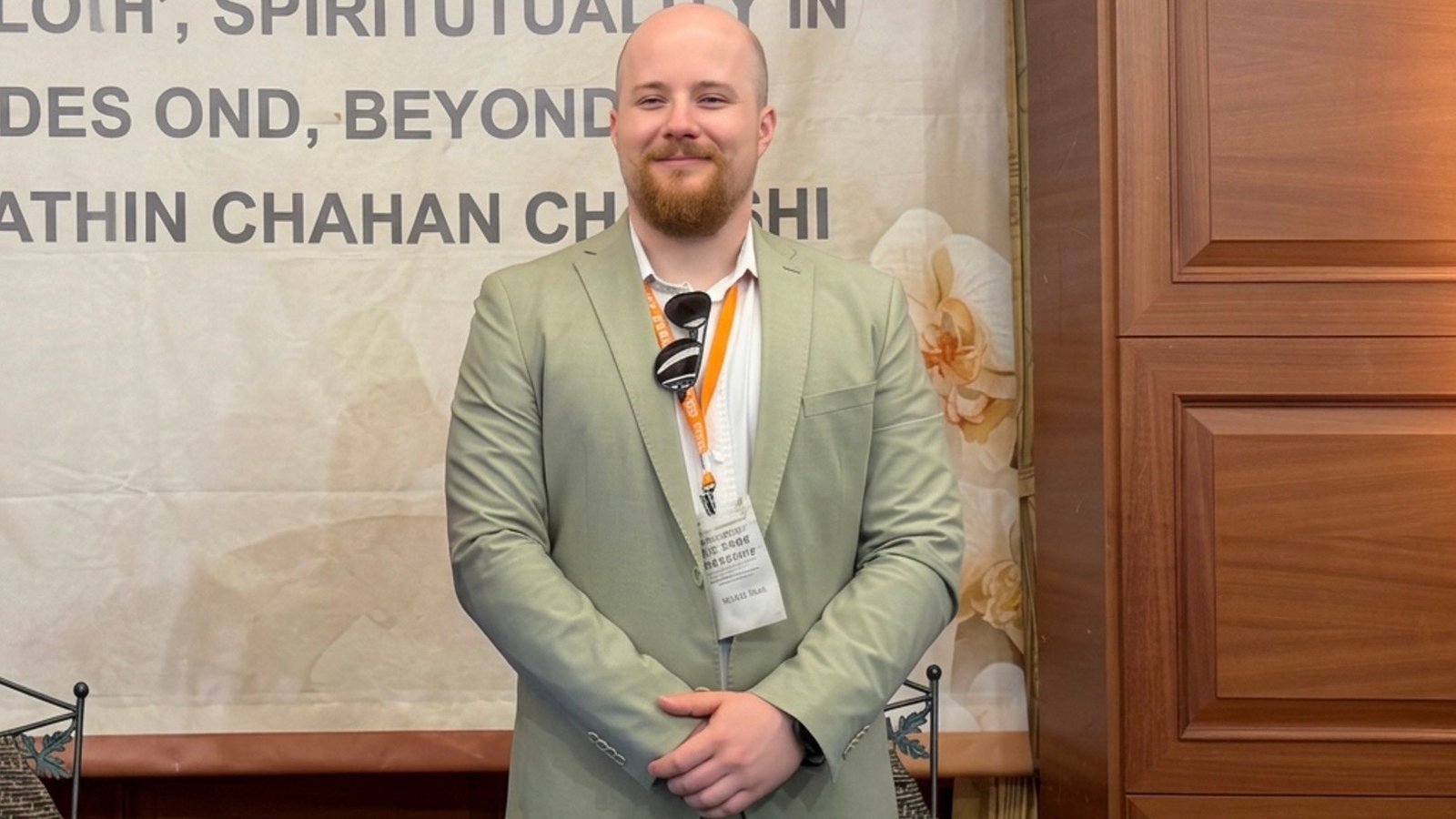
He also said the webinars on the case have been broadcast on YouTube since 2021 and reported in “Bitter Winter” and on the website TaiJiMenCase.org, offering scholars and activists rich material to study.
Hans Noot, deputy director of Human Rights Without Frontiers and president of the Dutch Gerard Noodt Foundation for Freedom of Religion or Belief, built his remarks around a simple definition. Frustration measures the distance between expectation and reality, and once that distance becomes too great, frustration turns into despair. Walking that morning through the Swiss Mountain Villa, he said, everyone in the delegation had probably imagined living in one of those houses before meeting the reality of their condition. He imagined the enthusiasm of the dizi in 1995, as Dr. Hong announced the purchase and they began dreaming of ponds, waterfalls, and buildings, followed by long years of disappointment.

Noot said he sees the same pattern worldwide, as small religious and spiritual movements clash with administrative policies, and between their dreams of peace and the harsh reality of government action stands media propaganda. That is precisely where Human Rights Without Frontiers concentrates its efforts. He commended Tai Ji Men for turning the villa into a place that preserves the memory of the case and encouraged the dizi to continue, since life cannot be reduced to frustration with a government. Their strength, he said, comes from what they had described during the day, the source of their “chi.”
With time running short, María Vardé, an anthropologist and researcher at the Institute of Anthropological Sciences of the University of Buenos Aires, offered brief remarks from Argentina, which will host the CESNUR conference in 2027. Vardé explained that her research looks beyond the legal and tax dispute to a broader question: how state institutions interpret religious and spiritual traditions, and what happens when those interpretations fail to describe the realities in front of them. In the Tai Ji Men case, a menpai’s relationships were filtered through administrative categories that did not fit, and gifts to the Shifu became taxable tuition for an imaginary cram school. Classifications like this, she said, can take on a life of their own and survive even after courts and administrative bodies have challenged the assumptions behind them.
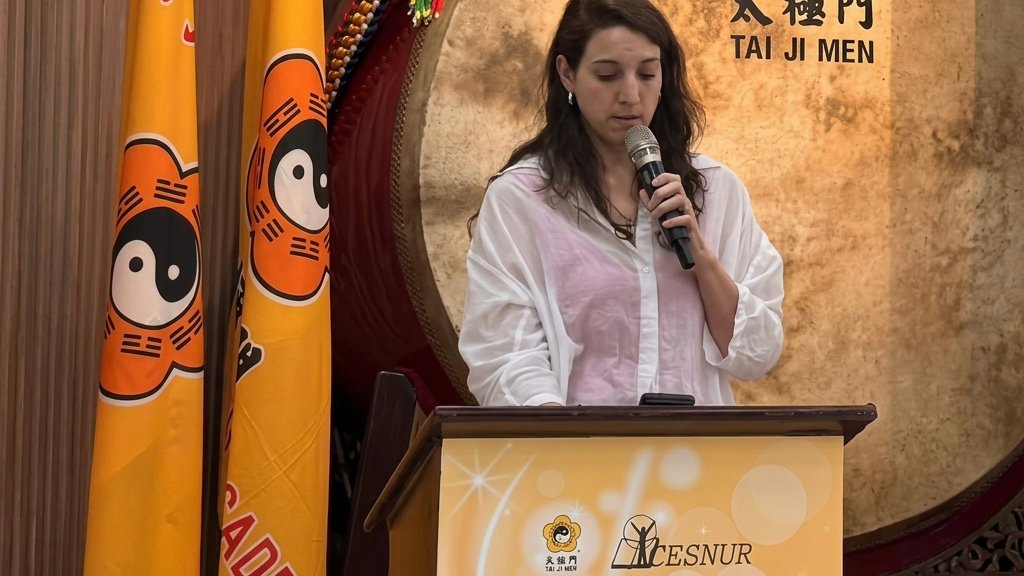
Religious freedom, Vardé argued, requires more than formal recognition. It needs institutions capable of understanding forms of spiritual life that do not match familiar models. Applying identical categories to everyone does not automatically produce equal treatment, especially once those categories were built around specific ideas of religion, education, or economic exchange. Spiritual communities may face legal scrutiny, she added, as long as it rests on evidence and accurate knowledge of their practices. She also warned that a long controversy risks becoming the only lens through which the public sees a community, whereas Tai Ji Men has a history, a philosophy, and a social life far richer than its legal troubles.
Karolina Maria Kotkowska, Assistant Professor at the Center for Comparative Studies of Civilizations at Jagiellonian University in Kraków, Poland, who has followed the case through the webinars for about five years, described her emotions after visiting a Tai Ji Men academy for the first time. She analyzed the case through the lens of epistemic injustice and repeated one point. Negative labels attach to spiritual groups partly because of a gap in public knowledge. People are familiar with simplistic notions of “cults,” much less with complex esoteric ideas or with what a menpai is, and the simpler notions are easier to judge, sometimes with consequences for fundamental rights. This is why even theoretical scholarship has a practical side, as it can help bridge that gap, provided people are willing to listen. Kotkowska also saw a kinship between the dizi and the scholars. Both proceed step by step, action by action; both pursue truth, and while Tai Ji Men speaks of conscience, scholars speak of freedom, human rights, and diversity, including the diversity of ideas. These are two paths, she concluded, toward a world richer in understanding and balance.
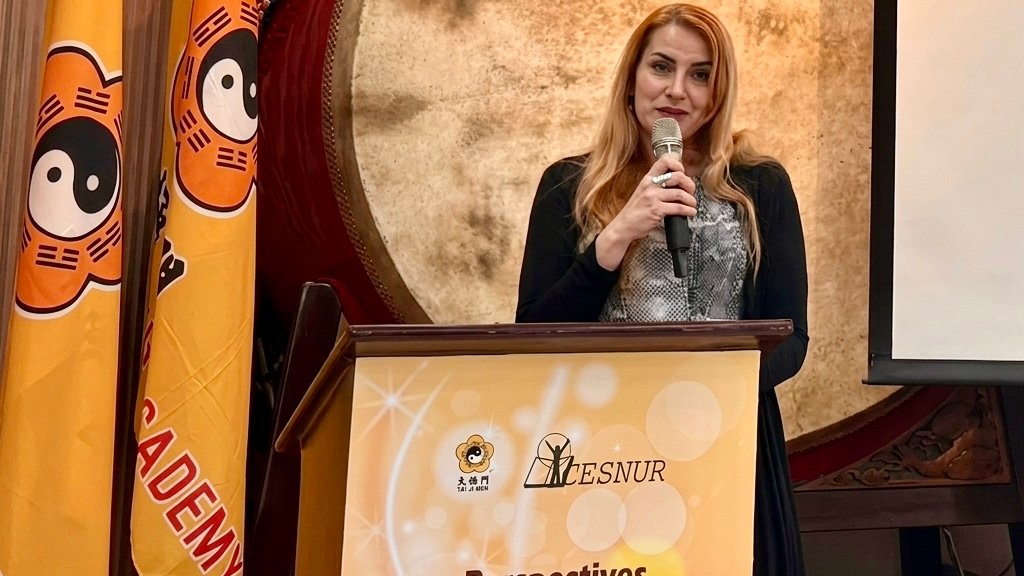
The last word went to Eileen Barker, professor emerita of sociology at the London School of Economics, whom I presented as the mother of all scholars of new religious movements. Barker began by listing, with her trademark humor, her disappointments. No children had sung a welcome song at her arrival, as it had happened in previous visits; her “adopted grandson” among the dizi was in California; and Dr. Hong was absent, depriving her of the energetic slap on the back that had once sent her chi soaring as she prepared to climb a flight of steps. Worse still, the dizi kept asking her for videos and texts, and the latest request, received the previous morning, was to read a whole book and write a foreword “by the day before.”
She had spent the long bus trip from Taichung to Mount Zion, the headquarters of a Christian new religious movement the CESNUR delegation had visited the previous day, reading the book and drawing two lessons. The first is that Tai Ji Men is a family. The book tells the personal stories of people whose lives were affected for thirty years, including many who felt their childhood had been taken away by the case, stories too often lost when the matter is told in distant legal terms. Second, beyond resolving their own case, the dizi are on a mission to make the world better.
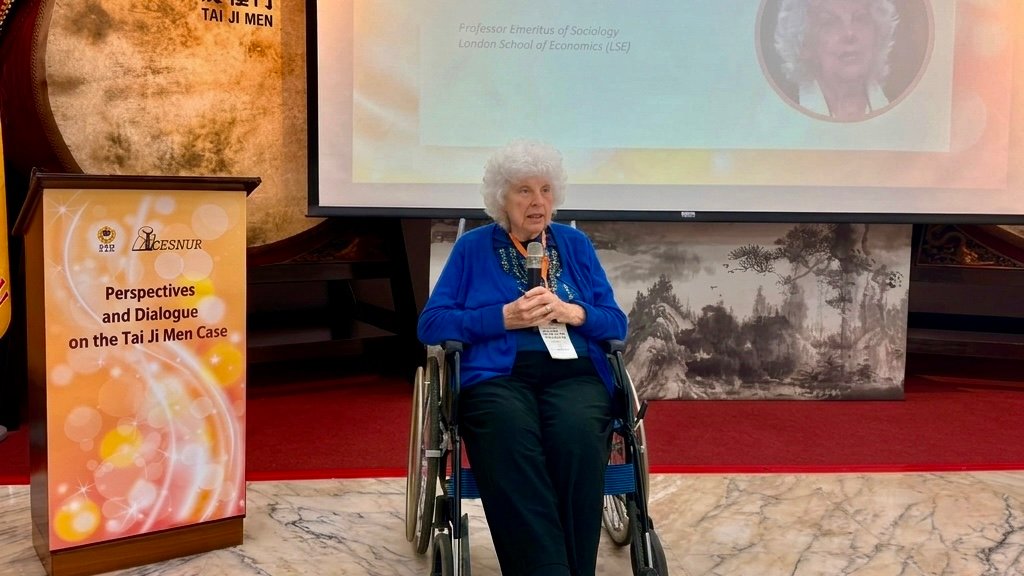
Barker recalled her first visit to Taiwan and her surprise at seeing a public billboard advertising Falun Gong, a movement banned as a “xie jiao” in mainland China. She took it as evidence of religious liberty in Taiwan. Learning that a case like this had occurred in such a free country was a real disappointment, she said. Others might have given up long ago, content with having won most of the legal battles. Dr. Hong, she said with affection, is “bloody-minded,” determined to keep fighting for something far larger than Tai Ji Men. She thanked him for continuing.
The scholars left Taiwan carrying images of a ruined villa and of a community that refuses to let ruin have the last word. The forum ended, but the fight for freedom and justice continues.

Massimo Introvigne (born June 14, 1955 in Rome) is an Italian sociologist of religions. He is the founder and managing director of the Center for Studies on New Religions (CESNUR), an international network of scholars who study new religious movements. Introvigne is the author of some 70 books and more than 100 articles in the field of sociology of religion. He was the main author of the Enciclopedia delle religioni in Italia (Encyclopedia of Religions in Italy). He is a member of the editorial board for the Interdisciplinary Journal of Research on Religion and of the executive board of University of Pennsylvania Press’ Nova Religio. From January 5 to December 31, 2011, he has served as the “Representative on combating racism, xenophobia and discrimination, with a special focus on discrimination against Christians and members of other religions” of the Organization for Security and Co-operation in Europe (OSCE). From 2012 to 2015 he served as chairperson of the Observatory of Religious Liberty, instituted by the Italian Ministry of Foreign Affairs in order to monitor problems of religious liberty on a worldwide scale.