Shaped by Einar Jónsson, William Blake, Theosophy, and the esoteric circles of London, Copenhagen, and Reykjavík, his nation’s best-loved artist filled moss and rock with hidden presences.
by Massimo Introvigne
Visitors to Kjarvalsstaðir, the Reykjavík museum named after Jóhannes Sveinsson Kjarval (1885–1972), met an unfamiliar version of the painter in 2025. Opened on May 24, the exhibition “Dreamland” was devoted to his fantasy works, with their religious themes, divine or enigmatic beings, symbols, and mystical references, and it placed several works by Einar Jónsson (1874–1954), lent by the Einar Jónsson Sculpture Museum, beside them. One small watercolor came from an unusual lender. The caption identified it as the property of Lífspekifélagið, the Icelandic Theosophical Society. For a series on art and Theosophy, that loan is a fitting place to begin.
Kjarval was born as Jóhannes Sveinsson on the south coast of Iceland, at the farm Efri-Ey in the Meðalland district, and raised by relatives on the east coast at Geitavík in Borgarfjörður Eystri. In his early twenties, he adopted the “royal Irish name” Kjarval, which he kept for the rest of his life, and he left for Reykjavík in 1902. Iceland at the time had almost no painters, and the young man worked for a while as a fisherman to earn the money for studies abroad. In the capital, he took courses with Þórarinn B. Þorláksson (1867–1924), who had mounted the country’s first painting exhibition only two years earlier, and with Ásgrímur Jónsson (1876–1958). The visionary streak came early. His first exhibition, held in Reykjavík in 1908 when he was 22, already included fantasy works, before any journey to London or any formal training.
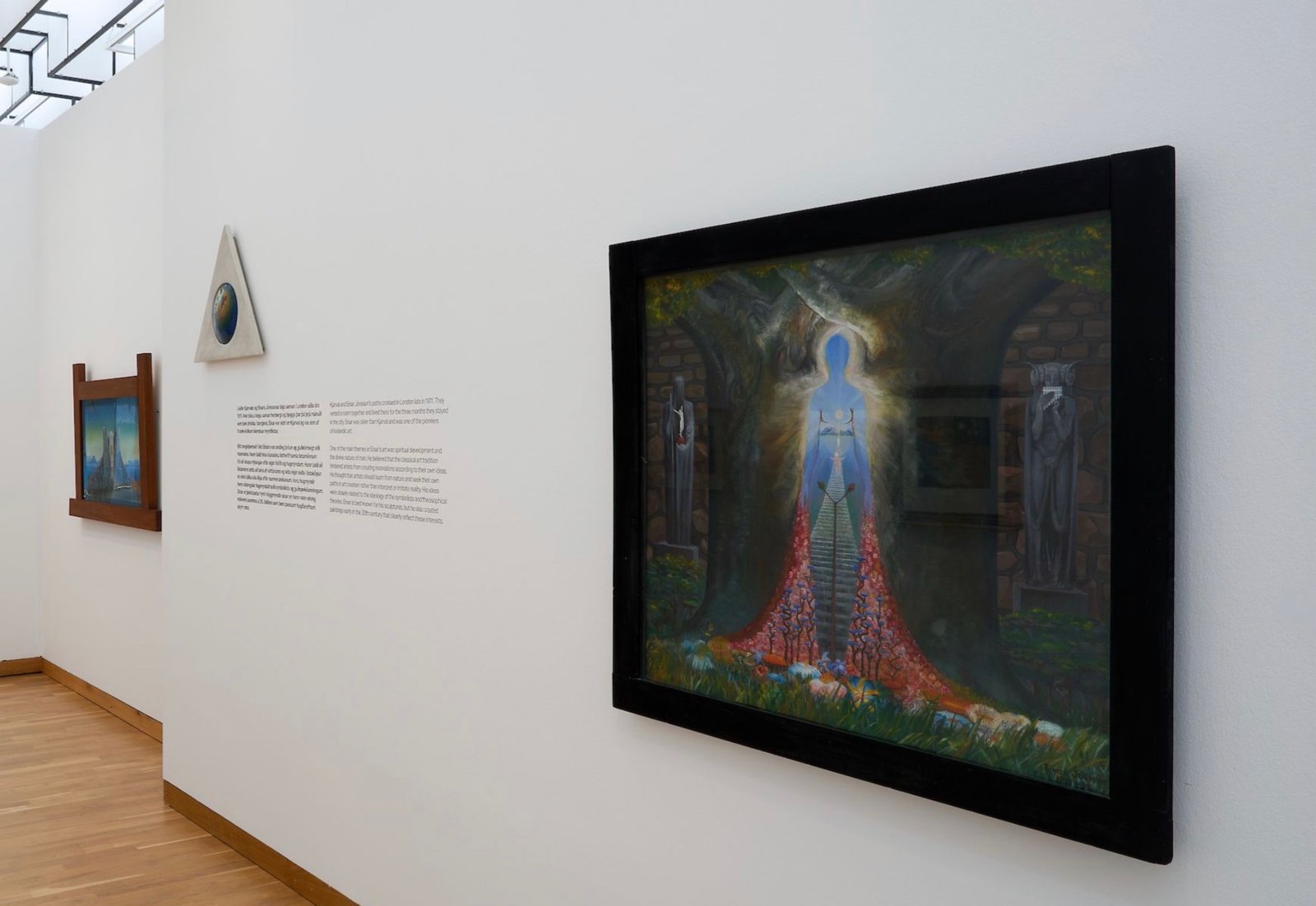
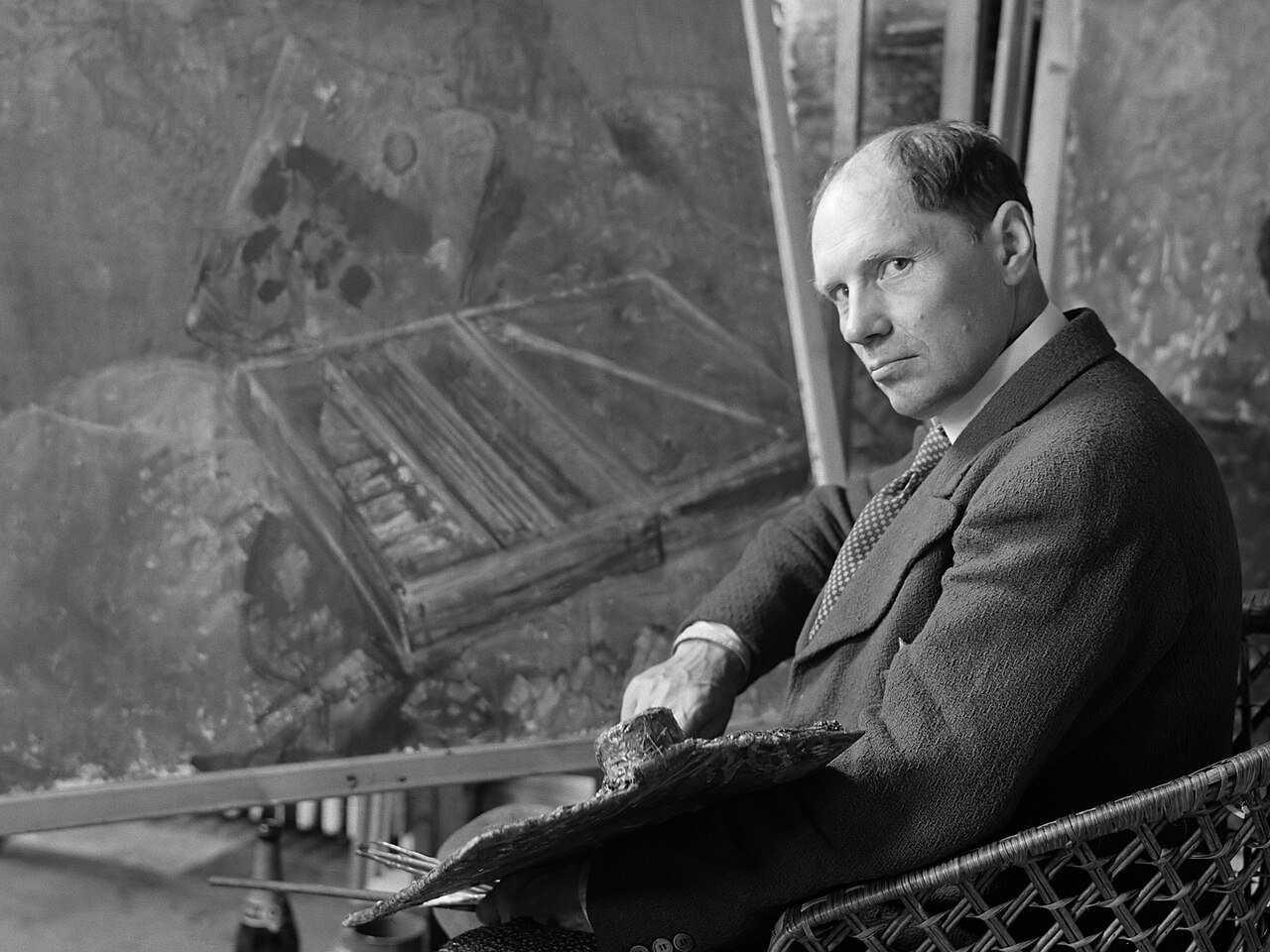
London changed him. He spent three months there in 1911 alongside Einar Jónsson, and the two became good friends. Eleven years older, Einar had already gone through his own spiritual revolution. After a stay in Rome in 1902–1903 he rejected naturalistic depiction and the weight of the classical tradition, developing a figurative language of interpretable symbols, personification and allegory related to German Symbolism, and his encounter with the ideas of Emanuel Swedenborg (1688-1772) in 1910 had a significant influence on his life and art. In the libraries and galleries of the metropolis, Kjarval also discovered William Blake (1767–1827), the English Romantic poet whose delicate, mystical drawings are dense with religious symbols and references. The curators of “Dreamland” insisted on the consequences. Spiritual themes had always occupied Kjarval’s mind, they wrote. Still, after London, his contact with international art and his insight into Theosophy and Symbolism shifted his emphasis and style in ways he developed throughout the rest of his career.
The Theosophy he met abroad also traveled home with him, by the same route. As historian of religion Pétur Pétursson explained in a 1984 study published in the journal “Saga,” Icelandic intellectuals encountered mysticism abroad, above all in Copenhagen, and Theosophy reached Iceland from the Danish capital. Kjarval lived in that city through the decisive years. He studied at the Royal Danish Academy of Fine Arts from 1913 to 1917 and remained mostly in Denmark until 1922.
Meanwhile, the movement put down roots on the island. A study group formed in Akureyri in 1909, and on November 17, 1912, seven prominent citizens met at the home of consul Ludvig Emil Kaaber (1878–1941) to found Reykjavík’s first lodge, under the Scandinavian Section, since Iceland was then still part of Denmark. The Icelandic Section followed on August 12, 1920, with seven lodges, and Annie Besant (1847–1933) signed its charter in January 1921. Its journal “Gangleri,” launched in 1926, took its name from the Eddas, a sign of how naturally Icelandic Theosophists wove Nordic mythology into the Ancient Wisdom. Pétursson placed this growth in a broader social frame. In his reading, psychic research, Theosophy and Freemasonry together served an ideological function for the new Reykjavík middle class, at a moment of rapid modernization while Iceland regained its independence from Denmark. Kjarval’s mystical canvases came of age in exactly this milieu, and the 2025 exhibition invited Pétursson himself to guide visitors through “Dreamland,” linking the works to the philosophical and religious ideas that molded Icelandic society.
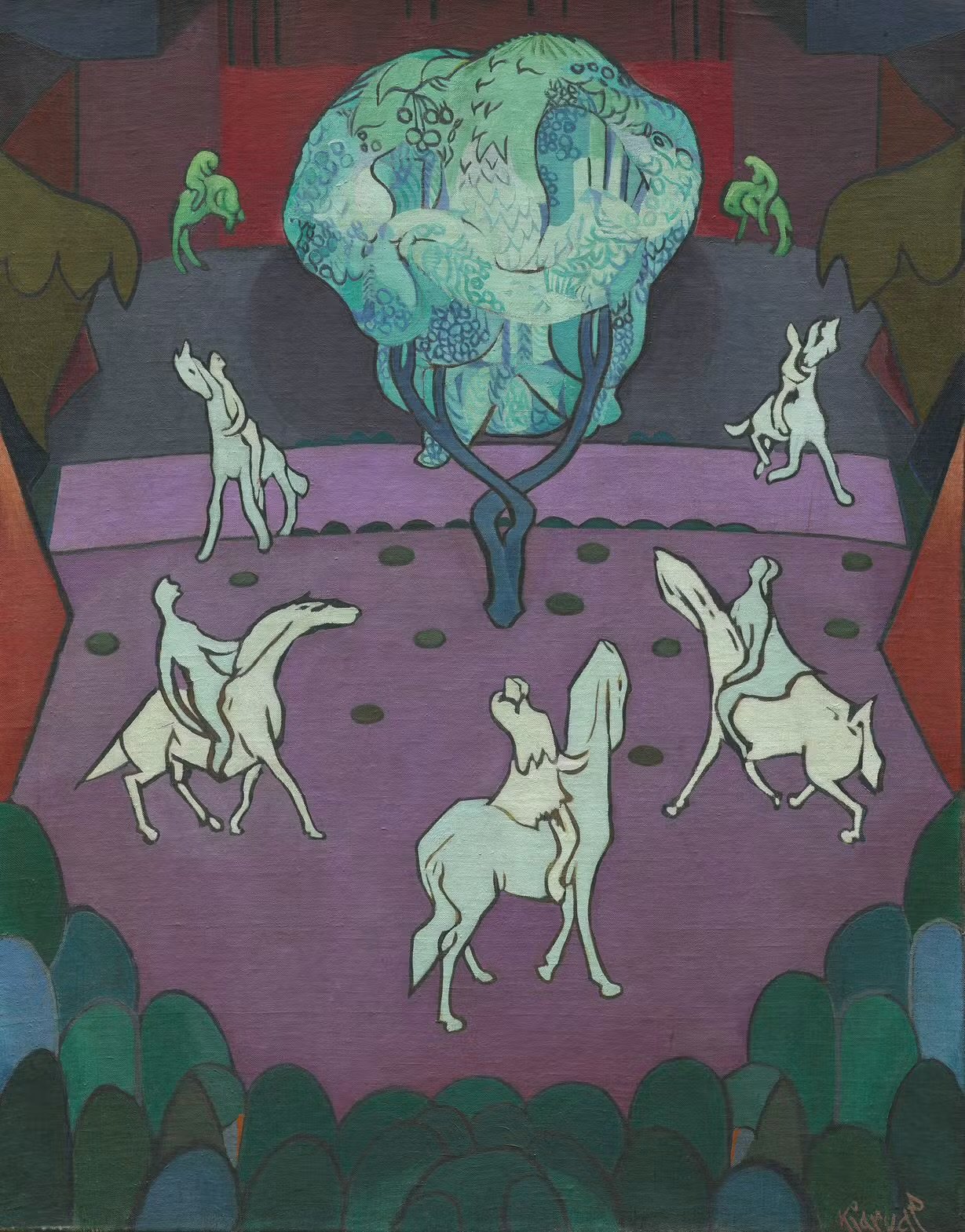
The paintings show how he absorbed these currents. A 1919 canvas known in English as “Icelandic Artists at the Tree of Knowledge” combines Symbolist and Cubist influences, showing from above a stage where pale riders on horses encircle a mysterious tree, and its Danish title, “Foran paradiset” (“In Front of Paradise”), points to biblical themes. “Hin heilaga skírn” (“The Holy Baptism”) followed in 1924. Completed in 1933 for his studio on Austurstræti, the large mural “Lífshlaupið” (“The Course of Life”) brings together landscape, working life and the fantastical element found throughout his oeuvre.
Most characteristic of all are the “hidden people,” the “huldufólk” of Icelandic lore. In his early pieces they travel in groups and live in rocks, and from the mid-1930s he linked them with the sea and with ships. In “Á Hulduströnd” (“On a Hidden Shore,” 1935), the cliff behind a woman is also a human profile, whose lips touch those of another profile in a kiss, while white light lifts the scene into a mystical register.
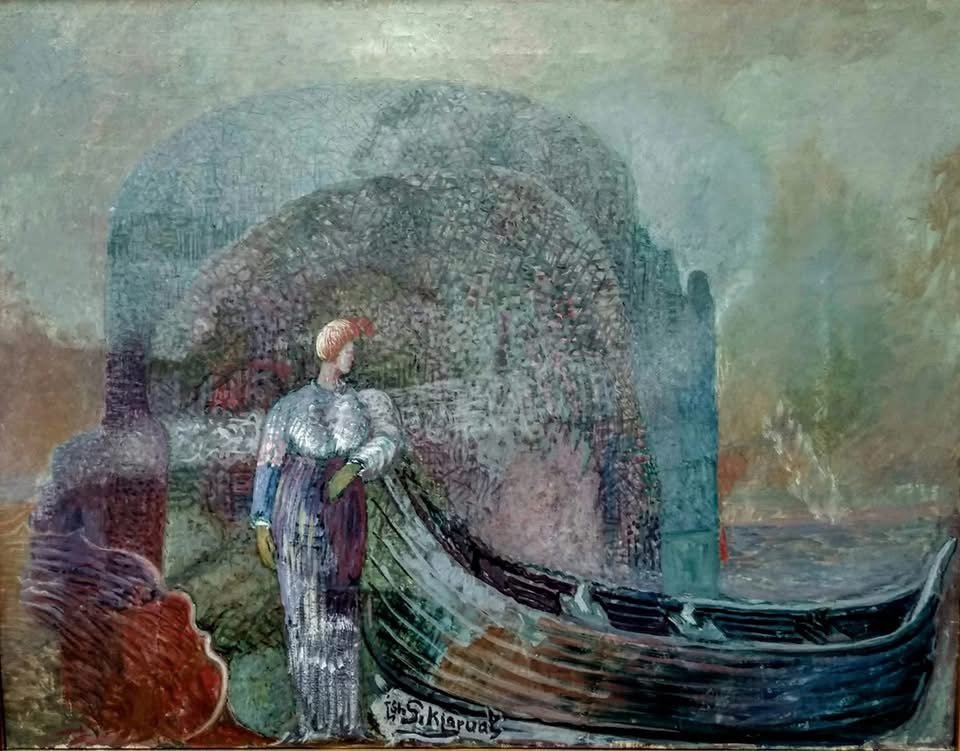
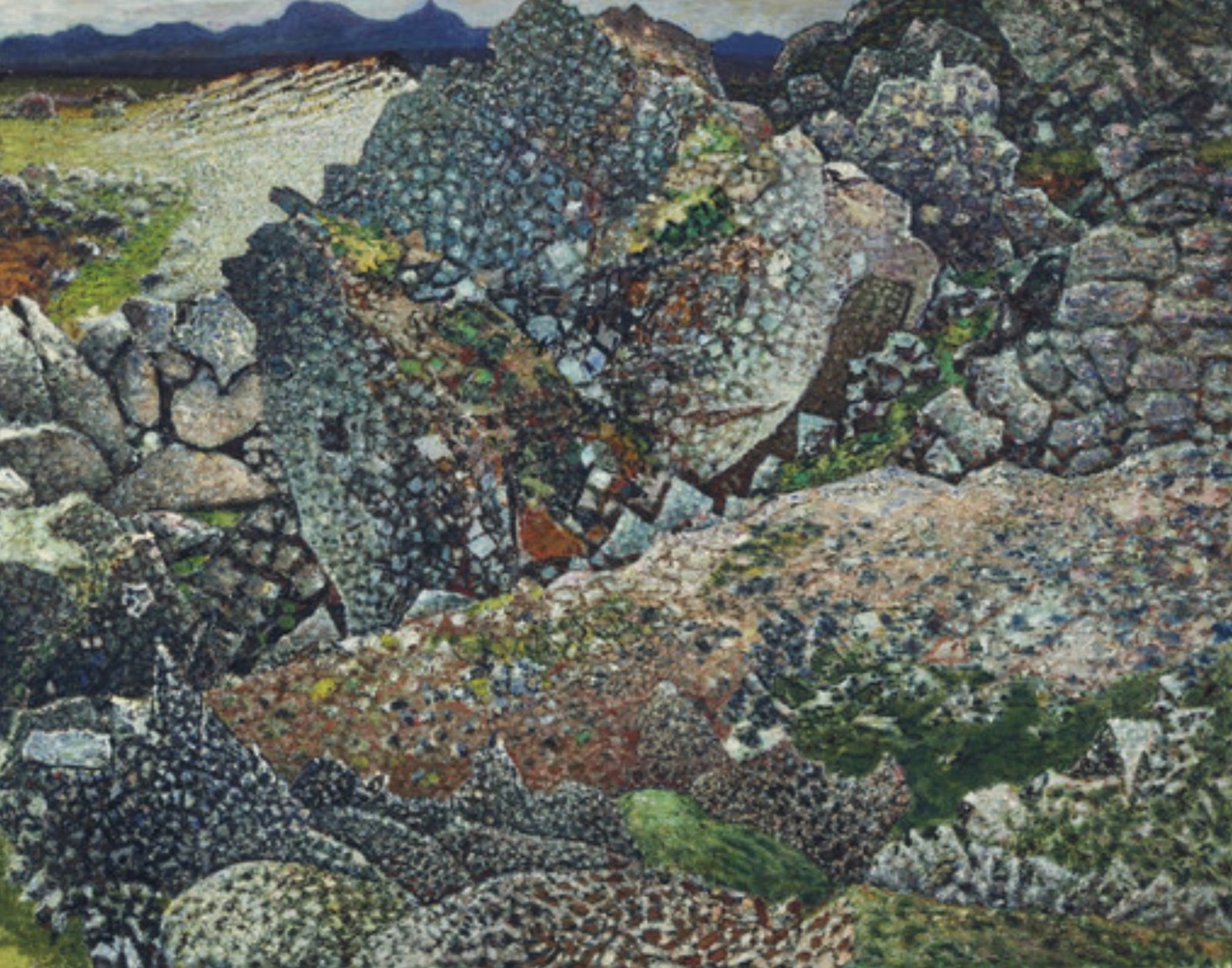
Here folklore and Theosophy meet. Blavatsky’s followers taught that nature is populated by invisible intelligences, nature spirits and devas working behind visible forms, and Icelanders had long believed that elves dwell inside stones and hills. Kjarval needed no doctrine to see faces in a cliff, yet the Theosophical vocabulary of a living, ensouled cosmos gave his intuition a modern and international language. His lifelong conviction can be expressed in one idea, that nature is alive, even as the emphases of his work changed over time. From 1929 he painted outdoors, often returning many times to the same spot to record the changing impressions of season, weather and light. His famous close-ups of the Þingvellir lava, broken into geometric masses on Cubist principles, can be read as portraits of that hidden life. A critic for “The Reykjavík Grapevine” observed that a milky veil of pale cobalt blue covers many of his oils, especially those inspired by the supernatural, as if the painter were rendering the subtle body of the land.
Honors arrived late and abundantly. Kjarval represented Iceland at the 1960 Venice Biennale together with sculptor Ásmundur Sveinsson (1993–1982). In 1968 he donated part of his works and personal effects to the city of Reykjavík, mostly drawings and sketches, and a selection appeared at the opening of Kjarvalsstaðir in 1973. He had died the year before, at 86, already a national legend, and many saw in him the archetype of the romantic bohemian artist. The watercolor lent by the Icelandic Theosophists to “Dreamland” recalls another identity, less celebrated and no less real: a fisherman’s son from the eastern fjords who learned in London and Copenhagen to call the spirits of his island by their Theosophical names.

Massimo Introvigne (born June 14, 1955 in Rome) is an Italian sociologist of religions. He is the founder and managing director of the Center for Studies on New Religions (CESNUR), an international network of scholars who study new religious movements. Introvigne is the author of some 70 books and more than 100 articles in the field of sociology of religion. He was the main author of the Enciclopedia delle religioni in Italia (Encyclopedia of Religions in Italy). He is a member of the editorial board for the Interdisciplinary Journal of Research on Religion and of the executive board of University of Pennsylvania Press’ Nova Religio. From January 5 to December 31, 2011, he has served as the “Representative on combating racism, xenophobia and discrimination, with a special focus on discrimination against Christians and members of other religions” of the Organization for Security and Co-operation in Europe (OSCE). From 2012 to 2015 he served as chairperson of the Observatory of Religious Liberty, instituted by the Italian Ministry of Foreign Affairs in order to monitor problems of religious liberty on a worldwide scale.