His paintings and writings fused esoteric experience, vitalist philosophy, and Mesoamerican symbolism into a spiritual search that continues to attract scholars.
by Massimo Introvigne
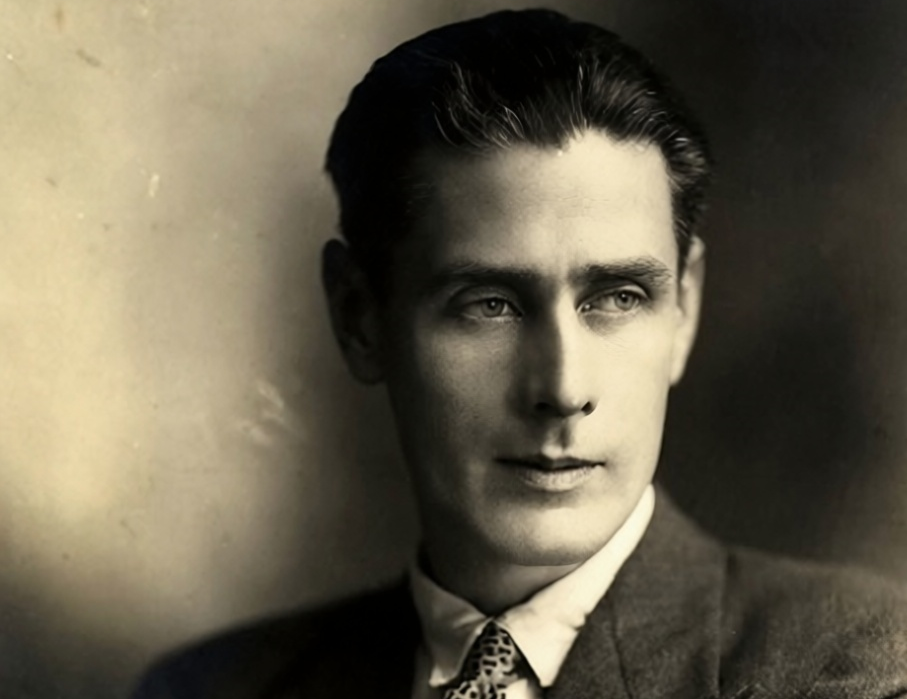
In 2025, Marta Sánchez-Salvà published a study in “Latin American and Latinx Visual Culture” (7[1]:68–84), titled “Vitalismo teosófico indoamericano en la pintura de Salarrué.” Her work renewed attention to the esoteric dimension of Luis Salvador Efraín Salazar Arrué, known as Salarrué. It offered a scholarly foundation for themes that had circulated for decades in cultural journalism and specialized commentary. The article examined the convergence of Theosophy, vitalism, and Mesoamerican “nahualismo” in his paintings and confirmed that his spiritual background was central to his creative identity.
Salarrué, born in 1899 and active until he died in 1975, was one of the most influential cultural figures of El Salvador. He was a painter, storyteller, poet, and public intellectual whose work shaped the country’s artistic imagination. His collection “Cuentos de barro” became a landmark of Central American literature, and his paintings developed an autochthonous visual language that combined rural life, mythic imagination, and spiritual symbolism. He lived in the United States, Mexico, and Europe, absorbing artistic currents while maintaining a strong connection to Salvadoran identity. His importance in the cultural history of El Salvador is comparable to that of major regionalist writers and painters across Latin America. Yet his esoteric dimension remained underexplored until recent years.
His relationship with Theosophy was complex. He frequently referred to Theosophical ideas, wrote in Theosophical magazines, and discussed the movement in interviews. There is no evidence that he joined the Theosophical Society, although his wife did, and newspapers often described him as a Theosophist. Scholars adopted the same label. His writings in the newspaper “Patria” and his unpublished manuscript “Almario” reveal a spiritual vocabulary aligned with Theosophical discourse. He wrote that humanity should seek to reject external paths to transcendence. He proposed an inward revolution that abandons categories such as religion, nation, and race, which he described as “grotesque totems erected by stupid conventionalism and superstition” (“Almario,” 8, quoted in Sánchez-Salvà, 72). His vision of awakening consciousness echoed the teachings of Jiddu Krishnamurti, whom he promoted in his articles.
In a text devoted to Krishnamurti in “Patria” (quoted in Sánchez-Salvà, 78), he affirmed that he endorsed what he considered the Indian sage’s main insight: “As I fix myself, the world fixes itself; because I am the world.”
His first contact with Theosophy came through Alberto Guerra Trigueros (1898–1950), a Nicaraguan poet and journalist who spent the last twenty-seven years of his life in El Salvador and became an influential literary figure. A Roman Catholic with a deep interest in Theosophy, Guerra Trigueros introduced Salarrué to Theosophical literature. Salarrué explained this moment in an interview given in the year of his death to novelist José Roberto Cea and published in 1976 (“Experiencias con Salarrué,” “Revista ABRA” 2 [1,9]:38–45). He recalled: “I did not know anything about Theosophy. My friend Alberto Guerra Trigueros, who was Catholic but knew a lot about it, had studied it and was somewhat Theosophist, took me to his house and read me a Theosophical book where they explained what the astral body was and all that. Right then I realized he was not lying, that it was true. I had verified it. So I entered those ideas not through books but through experience, which is a great advantage, because one admits that one may separate from himself.”
The reference is to a detailed account of his paranormal experiences, which predated his encounter with Theosophy, included in the same interview. He described episodes of conscious astral travel: “I always had a vocation for art, since childhood, and I developed there; later, when I was older, around thirty, then came the experiences I had, which made me know certain things like leaving my body and going out of it consciously and crossing solid layers with my astral body. I detached from my physical body, and among those things I went out consciously, first with much fear, later without fear, absolutely conscious. I was guided, and for reasons unknown to me, I was granted that grace. I could not go wherever I wanted, but I went to many places spontaneously. I went out from the patio of the house, through the wall or through the closed door, and from there I rose, because levitation is part of that, to enormous heights without vertigo. Over San Salvador, I knew the places perfectly and reached the edge of the sea. I saw the Estero de Jaltepec from above. When I was afraid, because ten minutes had passed, I closed my eyes and returned. I wanted to return, and I did immediately. I descended to the patio of my house and entered, and there was my body on my bed. I arrived and placed my hands on my chest. My eyes were somewhat blank, in a trance, and I lifted my astral hands at the moment of breathing. When I left my body, I wanted to know what the astral body was like and touched it to find out, and it was flesh.”
He added that Theosophical study gave him confidence in his experiences: “I continued studying those Theosophical books. That gives you great security about the matter. You grasp life and existence from another point. You know it is not very mistaken, and it gives you great security about life and death.”
Theosophy had a presence in El Salvador since the early twentieth century. The Theosophical Society established a branch in the country, the lodge Teotl, in 1910, originally affiliated with the Cuban branch, and its ideas circulated among intellectuals who sought cultural regeneration.
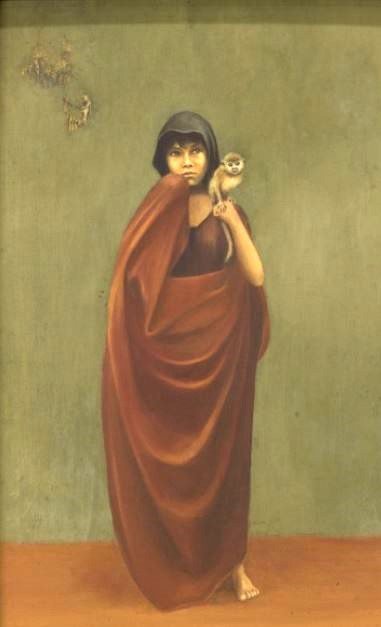
Sánchez-Salvà situates Salarrué within the regenerationist project that shaped early twentieth-century Central America. Intellectuals sought remedies for the region’s social and spiritual crisis, and Salarrué’s recurring image of the sad or sleeping “Indian” expressed this condition. The figure conveyed a sense of spiritual dormancy that had afflicted Central Americans since the arrival of European civilization.
His paintings often depicted characters with half-closed or sleepwalking eyes. These eyes in a state of “duermevela” suggested a meditative threshold through which spiritual penetration becomes possible. The viewer is invited to decipher the mystery of the image by shifting attention from the face to the extremities, where Salarrué placed vegetal or mineral transformations that destabilize inherited ways of seeing.
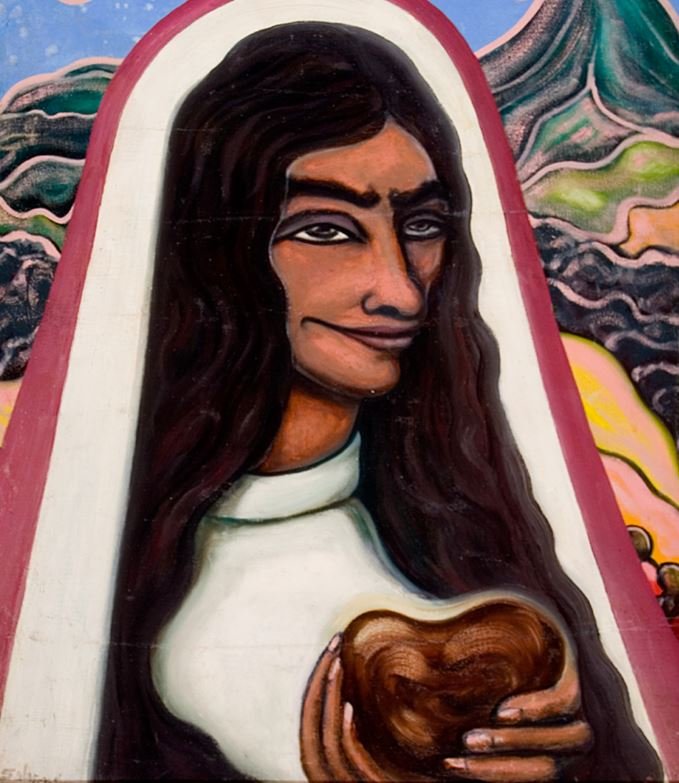
As noted by Sánchez-Salvà, his paintings incorporated specific Theosophical concepts. In “Emperor of Atlantis,” he depicted a figure associated with the red race of the Atlantean continent, drawing from Blavatsky’s theory of root races and from José Vasconcelos’s adaptation of Theosophical racial evolution in “La raza cósmica.”
The painting evokes the “sleeping” Atlantean race that Vasconcelos described as having once possessed immense knowledge and now appearing to have forgotten everything.
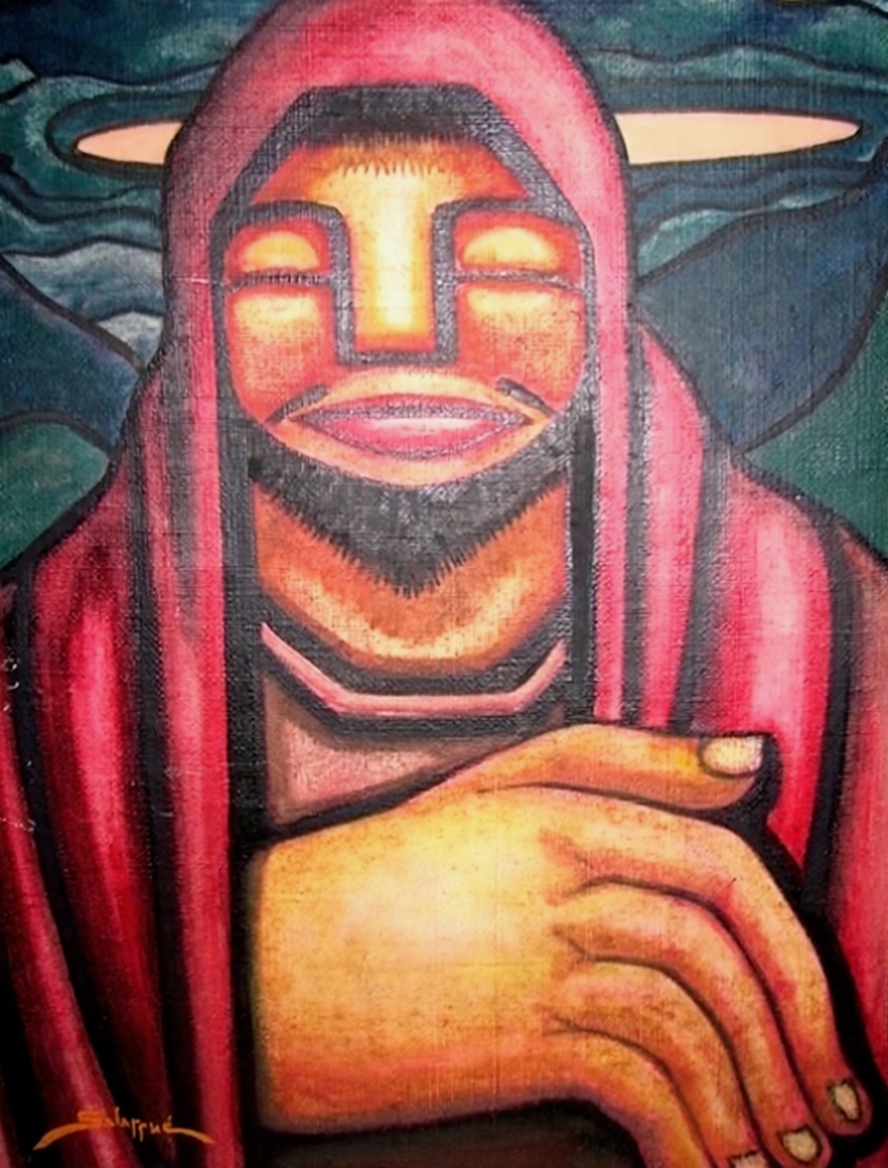
In “Sihuanahual,” an androgynous figure removes a mask while standing in a natural setting with a cave, a river, and an erupting volcano. A nipple placed in the center of the chest resembles a third eye, the organ of spiritual vision that Theosophy associated with early hermaphroditic species. The spiral composition can be read through Blavatsky’s evolutionary theory, beginning at the chesteye and ending in the figure’s contemplative gaze toward a future of spiritual splendor.
The volcanic eruption announces the emergence of a superior America, echoing Blavatsky’s warnings about volcanic conflagrations as signs of the end of the current Aryan root race.
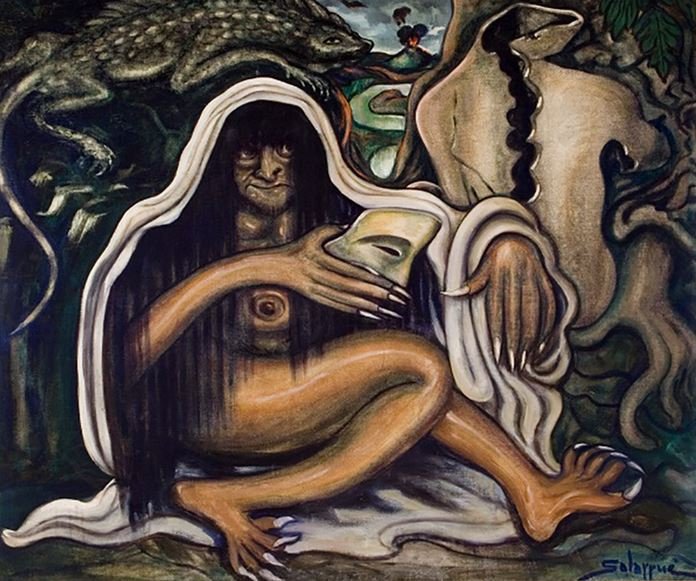
One of the best-known paintings by Salarrué is “The White Nun.” The artist reported that it was based on the apparition of a deceased nun, based on his “invocation” to creatures from the “astral world” (Salarrué, “La espada y otras narraciones” [1962], San Salvador: Dirección de Publicaciones e Impresos, 2010, 269–70).
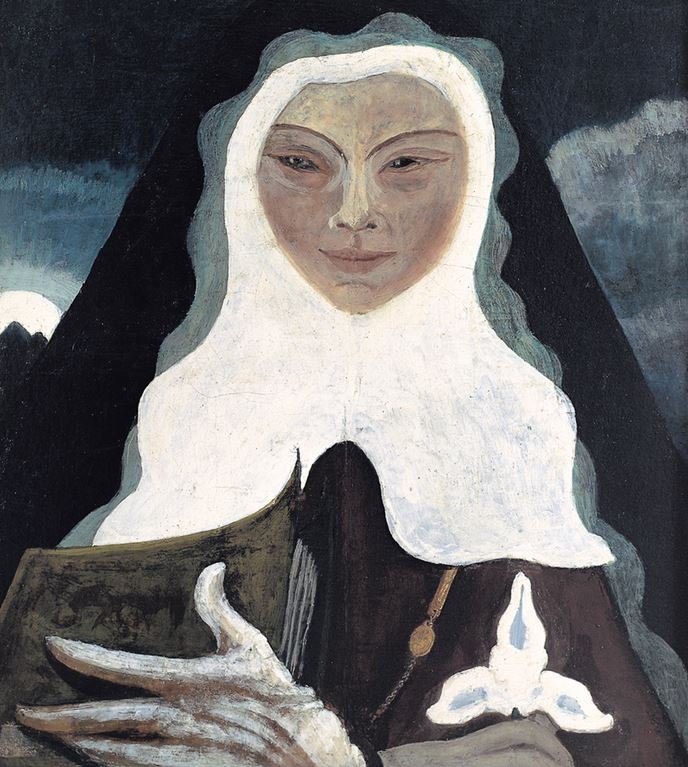
Salarrué believed the artist possessed “hierophantic powers to deliver the key” to a “necessarily symbolic art” (Salarrué, “Aspectos del arte moderno. El otro. La clave. Arte intemporal. El ojo mágico,” “Repertorio americano,” 1079, April 10, 1949, 57–8). His works were conceived as instruments for this awakening.
The new study by Sánchez-Salvà confirms that Salarrué’s autochthonous orientation was part of a broader reaction to the modern experience in Latin America and to the crisis of Western civilization. His paintings proposed an Indo-American vision of life without hierarchies between realms of existence. They invited viewers to abandon inherited ways of seeing and to embrace a vitalist consciousness accessible through intuition. His work continues to attract scholars who explore the convergence of Theosophy, Mesoamerican symbolism, and philosophical vitalism. Salarrué stands today as one of the most original figures of Central American art, and his spiritual imagination remains essential for understanding the cultural history of the region and the progress of Theosophy in Latin America.

Massimo Introvigne (born June 14, 1955 in Rome) is an Italian sociologist of religions. He is the founder and managing director of the Center for Studies on New Religions (CESNUR), an international network of scholars who study new religious movements. Introvigne is the author of some 70 books and more than 100 articles in the field of sociology of religion. He was the main author of the Enciclopedia delle religioni in Italia (Encyclopedia of Religions in Italy). He is a member of the editorial board for the Interdisciplinary Journal of Research on Religion and of the executive board of University of Pennsylvania Press’ Nova Religio. From January 5 to December 31, 2011, he has served as the “Representative on combating racism, xenophobia and discrimination, with a special focus on discrimination against Christians and members of other religions” of the Organization for Security and Co-operation in Europe (OSCE). From 2012 to 2015 he served as chairperson of the Observatory of Religious Liberty, instituted by the Italian Ministry of Foreign Affairs in order to monitor problems of religious liberty on a worldwide scale.