From Symbolism to abstraction: how a clairvoyant atlas shaped painters across continents.
by Massimo Introvigne*
*A paper presented at the 112th National Conference of the Italian Theosophical Society, “Thought-Forms as Architectures of the Soul,” Padova, May 30, 2026.
Article 2 of 4. Read article 1.
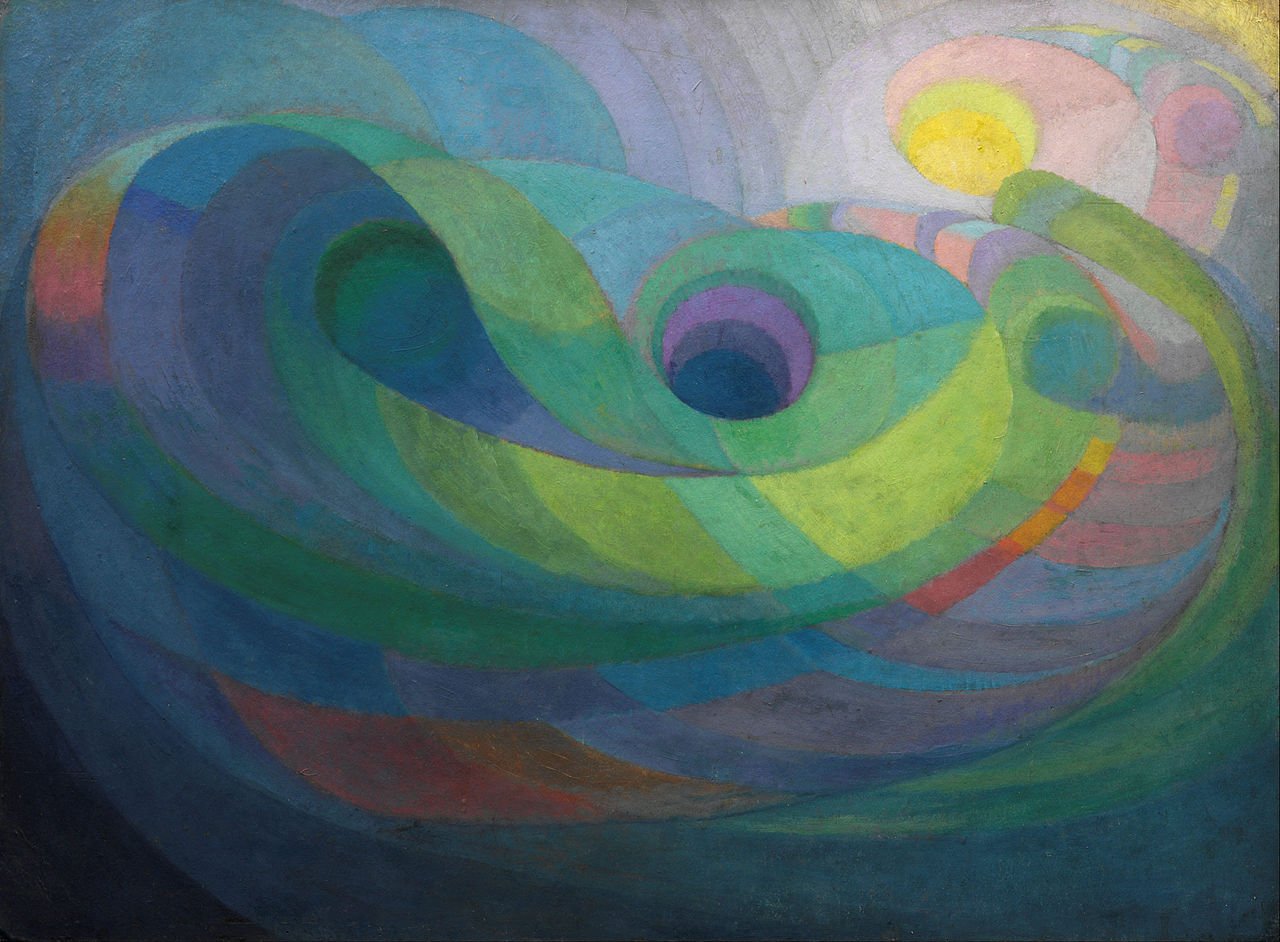
It is impossible to mention all the artists influenced by “Thought-Forms” and even only those who acknowledged the influence. I will limit myself to some examples, not necessarily in chronological order. The Australian modernist Roy De Maistre was one of the earliest artists to experiment with color-music analogies. He believed that colors corresponded to musical notes and that painting could evoke the same emotional resonance as music. De Maistre studied Theosophical literature, including “Thought-Forms,” and incorporated its ideas into his early abstract works. His color harmonies echo the diagrams in “Thought-Forms,” especially the plates depicting musical compositions.
Australian scholar Zoe Alderton studied the influence of “Thought-Forms” on De Maistre in a pioneering 2011 study (whose only problem was keeping the wrong date, 1901 rather than 1905, for the book). She traced it to De Maistre’s personal acquaintance with Leadbeater and showed how it extended to other Australian artists, such as Grace Cossington Smith. They found similar ideas in a popular book by Beatrice Irwin, “The New Science of Color,” published in 1916. Irwin is known as a Baháʼí. However, Alderton notes she was also “engaged with Theosophy until at least 1933.”
“Thought-Forms” also has its place in the history of Italian Futurism. When Futurism emerged in Milan in 1910, several of its leading figures were already familiar with Theosophy. Arnaldo Ginna and his brother Bruno Corra started writing about Theosophy in 1908. Ginna joined the Theosophical Society in 1913. Luigi Russolo, Umberto Boccioni, and Carlo Carrà all encountered Theosophical ideas and read “Thought-Forms,” which was available in both English and French editions.
Boccioni’s writings reveal an interest in translating emotions into colors, a theme central to “Thought-Forms.” Russolo’s “La musica” (1911) is an ambitious attempt to depict synesthetic correspondences between sound and color, echoing Leadbeater’s diagrams. Carrà’s theoretical writings also show traces of the book’s influence, though perhaps second-hand.
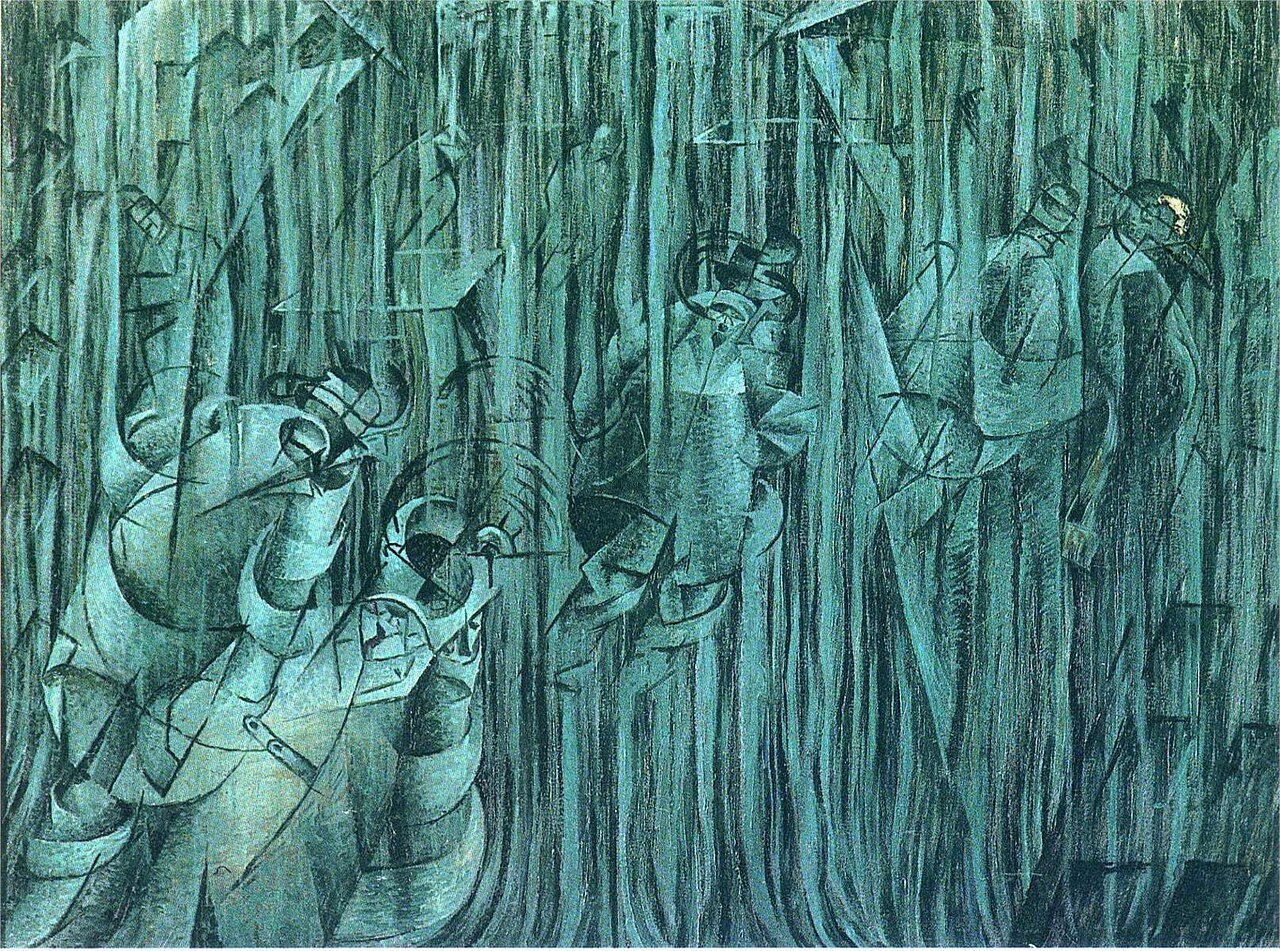
In a 1911 lecture, Boccioni traced a genealogy from the Rosicrucian symbolism of Gaetano Previati to modern “Spiritualist” research on forms and colors. He later removed these references from the printed version, likely to avoid association with Symbolism, but the original manuscript confirms his engagement with the book’s ideas.
In Canada, Lawren Harris, a founding member of the Group of Seven and the greatest painter his country produced, was an enthusiastic member of the Theosophical Society. Theosophical concepts shaped his transition from landscape painting to abstraction in the 1930s. Harris believed that art should reveal the spiritual essence of nature. His later abstract works, with their crystalline forms and radiant light, reflect the Theosophical notion that emotions and vibrations can be translated into color and form. Harris read Blavatsky extensively, but he also studied “Thought-Forms” and incorporated its ideas into his exploration of spiritualized color.
Kazimierz Stabrowski, founder of the first Theosophical lodge in Poland, served as director of the Warsaw School of Fine Arts from 1904 to 1909, where he mentored the Lithuanian painter and composer Mikalojus Konstantinas Čiurlionis. Stabrowski’s salon was a hub of esoteric discussion—Theosophy, Kabbalah, Indian philosophy, magic, and apocalyptic speculation. Both Stabrowski and Čiurlionis read Steiner’s “Theosophie” and “Thought-Forms,” and the Lithuanian artist’s synesthetic paintings reflect a worldview shaped by these ideas.
The Belgian symbolist painter Jean Delville was a leading Theosophist and head of the Belgian Theosophical Society for several years. The Russian composer Alexander Scriabin joined this circle and lived for a time in Delville’s home. Scriabin read “Thought-Forms” and “Man Visible and Invisible,” both texts very familiar to Delville, and their diagrams inspired his exploration of correspondences between sound and color.
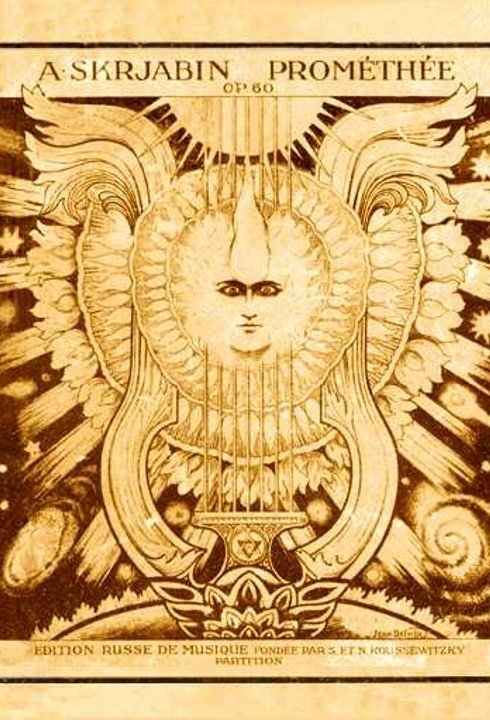
Delville’s painting “Promethée” (1907) inspired Scriabin’s “Prometheus: The Poem of Fire” (1910), a symphonic work with a part for “color organ.”The project expanded into a larger Theosophical collaboration, to which Delville and Scriabin invited several artists, including Čiurlionis, who died before he could join. Scriabin’s and Delville’s dream of a synesthetic, mystical Gesamtkunstwerk was deeply indebted to theories of “Thought-Forms” on vibration and color.
In England, Ethel Le Rossignol’s visionary paintings, produced mostly between 1920 and 1933, under the guidance of spirits, closely parallel the theories of “Thought-Forms.” She described spiritual beings constructing their surroundings through thought, echoing Besant and Leadbeater’s belief that thoughts produce radiating vibrations and floating forms. Her use of color to depict vibrating shapes reflects the Theosophical idea that emotions generate specific chromatic patterns. In Sweden, Hilma af Klint, who joined the Theosophical Society in 1904 (and left it in 1915 to follow Steiner into Anthroposophy), also stated that many of her abstract works were executed under the guidance of spiritual entities, and their biomorphic, radiant forms clearly reflect “Thought-Forms.”
Claude Bellegarde, active in mid-20th-century France, acknowledged the influence of Besant, Leadbeater, and Krishnamurti. His monochrome white paintings of the 1950s and later Chromagraph works explore aural energies and colors in ways reminiscent of “Thought-Forms.” He explicitly drew on Besant and Leadbeater’s diagrams of the human aura.
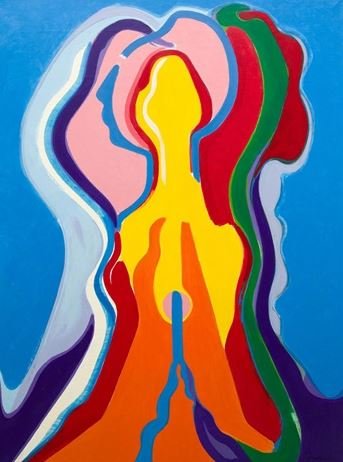
Piet Mondrian was an active and committed member of the Theosophical Society and read “Thought-Forms.” But he ultimately rejected the idea that Theosophical art should depict figurative images of thoughts and feelings. For many Dutch Theosophists, true Theosophical art meant illustrating thought-forms or using explicit symbols. Mondrian disagreed. For him, pure Theosophical art was Neo-Plasticism—an abstract language of verticals, horizontals, and primary colors that expressed universal spiritual laws. This put him at odds with the Dutch Theosophical establishment, but it also shows how “Thought-Forms” could interact with artists in very different ways.
Contemporary artists have continued to show a striking interest in “Thought-Forms,” a phenomenon that historian of esotericism Marco Pasi identifies as one of the most visible channels through which Theosophy has re-entered the language of twenty-first-century art. Among the most explicit examples is Paul Laffoley, who already in the 1990s incorporated Theosophical diagrams into works such as “A Maquette for a Thought Form,” and whose 1999 retrospective was tellingly titled “Architectonic Thought Forms.”
A younger generation has taken this interest further. Danish artist Lea Porsager has repeatedly engaged with thought forms, from her 2013 installation “How to Program and Use T F (Thought-Forms)” to her commission for the 14th Istanbul Biennale, where she was invited to “channel” new versions of Besant and Leadbeater’s original images. Christine Ödlund, from Sweden, has likewise produced installations directly inspired by “Thought-Forms,” including works modeled on the famous visualization of Charles Gounod’s music. They are not alone, and curators sustain the revival—most notably Carolyn Christov-Bakargiev, whose 2015 Istanbul Biennale was subtitled “A Theory of Thought Forms”—framing contemporary art within esoteric genealogies.
Massimo Introvigne (born June 14, 1955 in Rome) is an Italian sociologist of religions. He is the founder and managing director of the Center for Studies on New Religions (CESNUR), an international network of scholars who study new religious movements. Introvigne is the author of some 70 books and more than 100 articles in the field of sociology of religion. He was the main author of the Enciclopedia delle religioni in Italia (Encyclopedia of Religions in Italy). He is a member of the editorial board for the Interdisciplinary Journal of Research on Religion and of the executive board of University of Pennsylvania Press’ Nova Religio. From January 5 to December 31, 2011, he has served as the “Representative on combating racism, xenophobia and discrimination, with a special focus on discrimination against Christians and members of other religions” of the Organization for Security and Co-operation in Europe (OSCE). From 2012 to 2015 he served as chairperson of the Observatory of Religious Liberty, instituted by the Italian Ministry of Foreign Affairs in order to monitor problems of religious liberty on a worldwide scale.