Sixten Ringbom’s “dynamite”: how a young scholar’s archival shock reshaped the history of modern art.
by Massimo Introvigne*
*A paper presented at the 112th National Conference of the Italian Theosophical Society, “Thought-Forms as Architectures of the Soul,” Padova, May 30, 2026.
Article 1 of 4.
On February 3, 1965, a young Finnish scholar sat in the reading room of London’s Warburg Institute, surrounded by manuscripts, letters, and obscure publications from the early twentieth century. His name was Sixten Ringbom. That day, he wrote an excited letter to his wife, confessing that he had “DYNAMITE in my baggage” and was “in a manic state of mind.” He believed he had stumbled upon evidence that would radically revise the history of modern art. The “dynamite” was the discovery that Wassily Kandinsky—long celebrated as the rational pioneer of abstraction—had been deeply immersed in Theosophy, occultism, and esoteric speculation. This was not entirely unknown, but Ringbom believed he had found the key to understanding Kandinsky’s artistic revolution.
Ringbom’s excitement was understandable. In the 1960s, the dominant narrative in art history was shaped by formalism and secularism. Modernism was presented as a triumph of rationality, a movement that had shed the mystical baggage of the nineteenth century. The idea that the founders of abstraction were reading Helena Blavatsky, Annie Besant, Rudolf Steiner, and Charles Webster Leadbeater was, for many scholars, new and even embarrassing. It threatened to undermine the dignity of modern art by associating it with what they saw as irrationalism or pseudoscience.
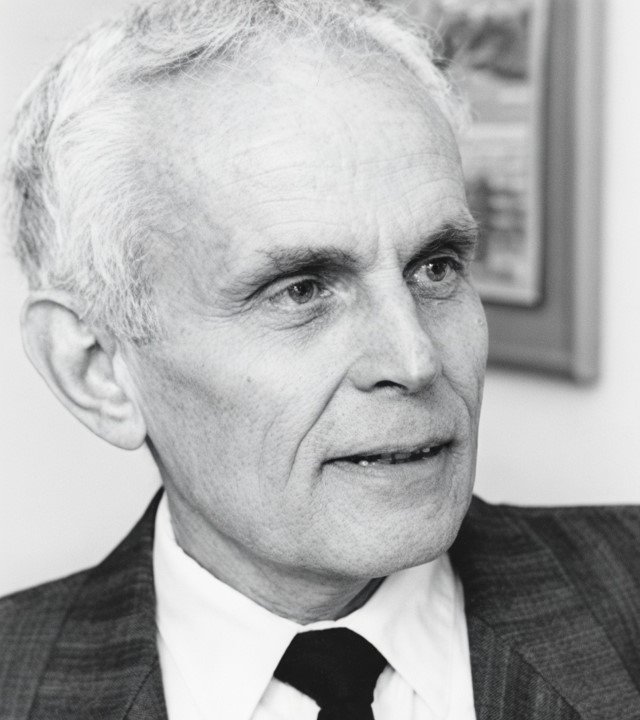
Yet Ringbom insisted that Kandinsky’s esoteric readings were not marginal curiosities but central to his artistic development. His first article on the subject, published in 1966 in “The Journal of Warburg and Courtauld Institutes,” argued that Kandinsky’s interest in Theosophy was not “some kind of personal hobby” but the very key to understanding his art. In 1970, he expanded this thesis into “The Sounding Cosmos,” a book that traced Kandinsky’s journey from Symbolism to abstraction through the lens of esoteric thought.
One of Ringbom’s key claims was that Kandinsky had been influenced by “Thought-Forms,” a book by Theosophical leaders Annie Besant and Charles Webster Leadbeater that presented clairvoyant images of thoughts and emotions. Ringbom believed the book had been published in 1901. In fact, it was published in 1905. The 1901 date is due to a typo in the 1925 edition, as definitively demonstrated by scholar John Crow in a 2012 article. This error matters because it affects the chronology of Kandinsky’s exposure to Theosophical ideas. Since “Thought-Forms” appeared only in 1905, it could not have influenced Kandinsky’s earliest steps toward abstraction. However, as we will see, Kandinsky was deeply influenced by Theosophical ideas.
To understand why “Thought-Forms” mattered so much to artists, we must first understand what it actually is: a clairvoyant atlas of the invisible.
“Thought-Forms” was published in 1905 by the Theosophical Publishing House in Adyar, India. Annie Besant, who wrote the foreword, explained that some of the material had first appeared in 1896 in “Lucifer” (later “The Theosophical Review”). Besant co-authored the book with Charles Webster Leadbeater, one of the most influential—and controversial—figures in the Theosophical Society. The book includes 58 color plates, many of them strikingly similar to later abstract art.
The illustrations were produced clairvoyantly. In the case of Leadbeater’s earlier book “Man Visible and Invisible” (1902), the main illustrator was Count Mauricy Prozor, a Lithuanian diplomat and Theosophist. Prozor later became chargé d’affaires of Lithuania in Rome through his friend Oscar Milosz, who was himself close to Parisian Theosophical circles. The clairvoyant origin of the images was part of their appeal: they were presented not as artistic inventions but as scientific diagrams of invisible realities.

As Tessel Bauduin has noted, Besant and Leadbeater did not consider these images “abstract.” For them, the forms were “figurative”: they depicted real objects, namely the contents of thoughts. But for artists, the images offered a new visual vocabulary—one that seemed to bypass the material world and express pure emotion, pure vibration, pure spirit. The book was not written for artists, yet it influenced several of them. Its impact was uneven, sometimes exaggerated, but undeniably present.
To understand why so many artists were influenced by it, we should explore what the book actually claims, how it organizes its images, what kind of “seeing” it presupposes, and why its plates looked so uncannily like abstract art decades before abstraction became a recognized movement. “Thought-Forms” did not simply offer artists a repertoire of shapes and colors. It offered them a visual grammar and a theory of perception that made non-figurative art intellectually and spiritually plausible.
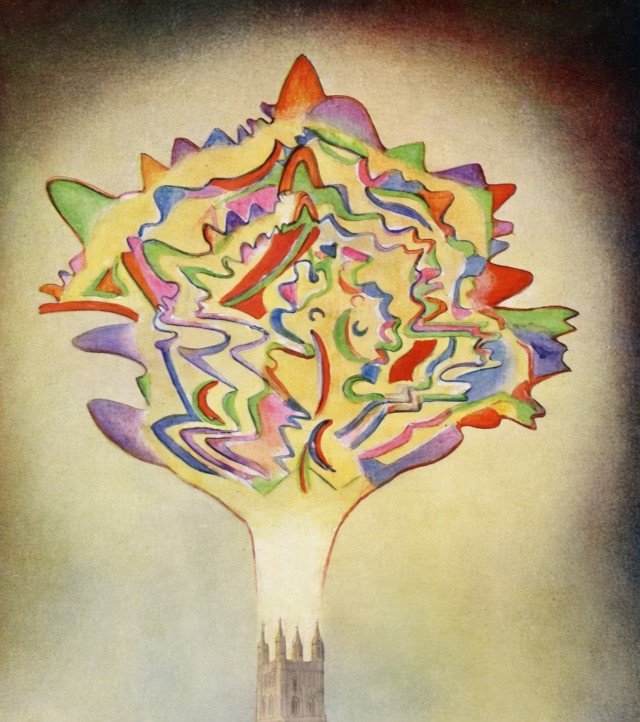
The central idea of “Thought-Forms” is simple yet radical: thoughts and emotions produce visible forms and colors in subtle matter that trained clairvoyants can perceive. These forms vary depending on the nature, intensity, and moral quality of the thought. Anger produces jagged red shapes; devotion produces upward-rising blue forms; music produces complex, luminous patterns. Besant and Leadbeater insist that this is not a metaphor. They are not saying that anger is like a red explosion or that devotion is like a blue flame. They are saying that anger literally “appears” as a jagged red form in the astral body, and devotion literally “appears” as an upward-rising blue shape.
The book presents itself as a kind of field guide to these forms. This objectification of inner life has profound implications. Thoughts and feelings are no longer private, ineffable states; they are visible, mappable phenomena. And if the true content of thought is non-representational—vibrations, colors, shapes—then an art that abandons external likeness in favor of inner form is not arbitrary. It is, in Theosophical terms, more realistic. For a painter struggling with the legitimacy of abstraction, this is indeed dynamite.
The structure of the book reinforces this argument. “Thought-Forms” is not a random collection of images but a carefully organized sequence designed to lead the reader from familiar emotional states to increasingly abstract visualizations. It begins with simple emotions such as affection, anger, fear, and devotion. Each emotion is associated with a characteristic color and shape. The forms are often symmetrical, sometimes radiating, sometimes jagged. The point is to show that even “simple” feelings have a definite, structured form.
The book then moves to more complex mental states such as intellectual concentration, religious aspiration, altruistic intention, and artistic inspiration. Here, the forms become more intricate, layered, and geometrically articulated. The more elevated the thought, the more harmonious and complex is its form.
Finally, the book presents the most visually elaborate plates, the “thought-forms” produced by music. These are associated with specific compositions by Wagner, Gounod, Mendelssohn, and others. The forms are swirling, multi-layered, and entirely non-figurative. They are not pictures of anything in the physical world. They are diagrams of vibration. This progression—from simple emotion to complex thoughts to music—has a rhetorical function. It leads the reader, step by step, from recognizable feelings to a realm where non-representational form is the only adequate language. By the time we reach the music plates, abstraction feels less like a rupture and more like a logical culmination.
One of the most striking aspects of “Thought-Forms” is its insistence on clairvoyance as a quasi-scientific method. Besant and Leadbeater present themselves as investigators, not fantasists. They repeatedly compare their work to microscopy: just as a microscope reveals bacteria invisible to the naked eye, clairvoyance reveals thought-forms invisible to ordinary perception. The plates are thus framed as data, not as artistic inventions. This epistemology legitimizes the images by presenting them as observations rather than creations. It stabilizes the forms by suggesting that different clairvoyants see the same emotion in the same way, making the forms part of the structure of the universe rather than subjective impressions. And it invites systematization. If thought-forms are lawful, they can be cataloged, compared, and perhaps even used as a basis for a new kind of visual language. For artists, this epistemology is crucial. It suggests that non-figurative forms can be grounded in a shared, objective reality—albeit a subtle one. Abstraction, in this view, is not arbitrary self-expression but participation in a cosmic order of vibrations.
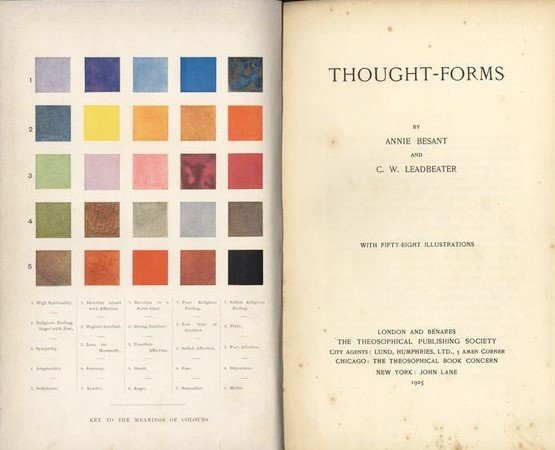
The book also offers a color theory, but one very different from conventional Symbolist or academic systems. In Symbolist painting, colors often function as poetic or psychological symbols: red for passion, blue for melancholy, and so on. In “Thought-Forms,” colors are not symbolic in that loose sense; they are diagnostic. A particular shade of red indicates a specific kind of anger; a particular blue indicates a specific kind of devotion. The book includes statements explaining that a certain tone of blue shows a devotional thought directed toward a personal deity, or that a muddy red indicates anger mixed with selfishness. This is not color as mood but color as code.
For an artist, this opens two possibilities. One is a disciplined use of color: if one accepts the system, one can use color to encode specific spiritual states. The other is a liberation from naturalism: if the “true” color of a thought is not the color of any physical object, then there is no reason to imitate nature. Color can be freed from representation and used to express inner states directly. Kandinsky’s own writings on color, especially in “Concerning the Spiritual in Art,” echo this logic. He speaks of colors as having inner sounds, inner temperatures, and inner movements.
The forms in “Thought-Forms” are equally structured. Many radiate outward from a center, suggesting expansion, influence, or emanation. Devotional or aspirational thoughts often take the form of upward rising shapes, sometimes like flames, sometimes like arrows. Harmonious thoughts tend to produce symmetrical forms, while disturbed or conflicted thoughts produce asymmetrical, jagged shapes. Some forms are enclosed within others, suggesting layered or nested states of consciousness. These formal features anticipate many of the compositional strategies of early abstract painting: central radiating forms, upward thrusts, layered transparencies, and dynamic asymmetries. Again, the point is not that artists copied these plates, nor that the book was intended for artists (it was not), but that “Thought-Forms” provided a visual vocabulary in which such structures were already meaningful.
This brings us to the question of why the plates look so much like abstract art. The resemblance arises because both “Thought-Forms” and early abstract art are trying to solve a similar problem: how to depict inner, non-material realities—emotions, spiritual states, musical vibrations—without relying on external likeness. Theosophists solved it by claiming clairvoyant access to subtle forms and then diagramming them. Artists solved it by experimenting with color, line, and composition until they found forms that felt adequate to their inner experience. The two projects are not identical, but they are parallel. In some cases, they intersect directly; in others, they share a common horizon. What “Thought-Forms” did, crucially and perhaps unwittingly, was to normalize the idea that non-figurative forms could be spiritually meaningful. It made it easier for artists to believe that abandoning representation did not mean abandoning content.
Before “Thought-Forms” appeared, the Theosophical Society had a complex relationship with the arts. Blavatsky herself had only a passing interest in painting, but she inspired a generation of Symbolists who saw art as a vehicle for spiritual revelation. By the early twentieth century, Theosophy had become a major force in European art. It offered artists a cosmology that united science, religion, and aesthetics. It provided a language of vibration, color, and form that resonated with the emerging interest in synesthesia and the fourth dimension.
In this context, “Thought-Forms” arrived at a perfect moment. It offered artists a visual grammar for depicting invisible realities. It suggested that art could reveal the inner essence of things rather than their outward appearance. It provided a bridge between Symbolism and abstraction.
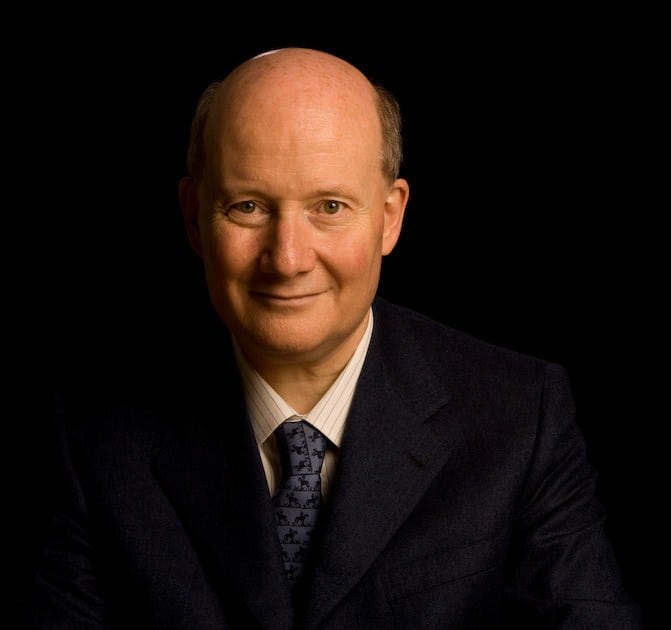
Massimo Introvigne (born June 14, 1955 in Rome) is an Italian sociologist of religions. He is the founder and managing director of the Center for Studies on New Religions (CESNUR), an international network of scholars who study new religious movements. Introvigne is the author of some 70 books and more than 100 articles in the field of sociology of religion. He was the main author of the Enciclopedia delle religioni in Italia (Encyclopedia of Religions in Italy). He is a member of the editorial board for the Interdisciplinary Journal of Research on Religion and of the executive board of University of Pennsylvania Press’ Nova Religio. From January 5 to December 31, 2011, he has served as the “Representative on combating racism, xenophobia and discrimination, with a special focus on discrimination against Christians and members of other religions” of the Organization for Security and Co-operation in Europe (OSCE). From 2012 to 2015 he served as chairperson of the Observatory of Religious Liberty, instituted by the Italian Ministry of Foreign Affairs in order to monitor problems of religious liberty on a worldwide scale.