Sacred eroticism and artistic creation have always been structurally intertwined. The journey starts in India and leads to contemporary spiritual movements.
by Massimo Introvigne*
*A paper presented at the 6th CEENASWE (The Central and Eastern European Network for the Academic Study of Western Esotericism) Conference, “Transcription of Visuality: From the Tradition of Esotericism to Traditional and Contemporary Artistic Practices,” University of Rijeka, Croatia, June 5, 2026.
Introduction
Whenever spirituality and eroticism meet, scholars become nervous, journalists become excited, and artists become—well, artists. Sacred eroticism has always lived in this unstable triangle, and the result is a history as rich as it is misunderstood.
This paper follows that history across five stations. We start in India, where Tantric traditions developed some of the world’s most sophisticated ways of turning bodies, images, and sensations into tools of enlightenment—long before Western translators reduced Tantra to a manual of exotic bedroom techniques. From there, we move to the West, where esoteric figures such as Aleister Crowley reinvented sacred eroticism with equal parts genius and scandal, leaving behind a body of art that critics still do not know whether to admire or fear.
Our third stop is contemporary: the artworks of YahRA (formerly Guru Jára), whose fusion of art and erotic spirituality has provoked both fascination and moral panic.
The fourth examines MISA, the Romanian neo‑Tantric movement that has elaborated a full‑fledged theory of “objective art,” complete with yantras, resonance, and a yoga of beauty.
Finally, we step back and ask the larger question: in a Tantric or neo‑Tantric worldview, is there even a boundary between art and eroticism? Or are they two names for the same alchemical process—using the material world not as an obstacle to transcendence but as its most powerful support?
Tantra and Art in India
Any exploration of sacred eroticism as art must begin with Indian Tantrism, not because Tantra is reducible to eroticism or because its artistic output is exclusively erotic, but because Tantric traditions developed a sophisticated understanding of how visual, performative, and ritual arts can function as vehicles of spiritual transformation.
Tantrism is a vast and internally diverse constellation of traditions, spanning Hindu, Buddhist, and Jain contexts, and ranging from ascetic lineages to highly ritualized temple cults. What unites these traditions is a shared conviction that the material world—including the body, sensory experience, and aesthetic form—is not an obstacle to liberation but a potential instrument of it. Art, in this context, is a technology of the sacred.
Classical Tantric sources describe the universe as a network of energies (śakti) that can be accessed, intensified, and redirected through ritual. Visual art, particularly in the form of yantras and mandalas, plays a central role in this process. These geometric diagrams are energetic maps, designed to resonate with specific deities and cosmic forces. The Śrī Yantra, perhaps the most famous of these diagrams, is understood as a visual condensation of the entire Tantric cosmos: its interlocking triangles represent the dynamic interplay of Śiva and Śakti, consciousness and energy, transcendence and immanence. Meditating on such a diagram is an embodied practice in which the practitioner’s consciousness is gradually aligned with the structure of the cosmos.
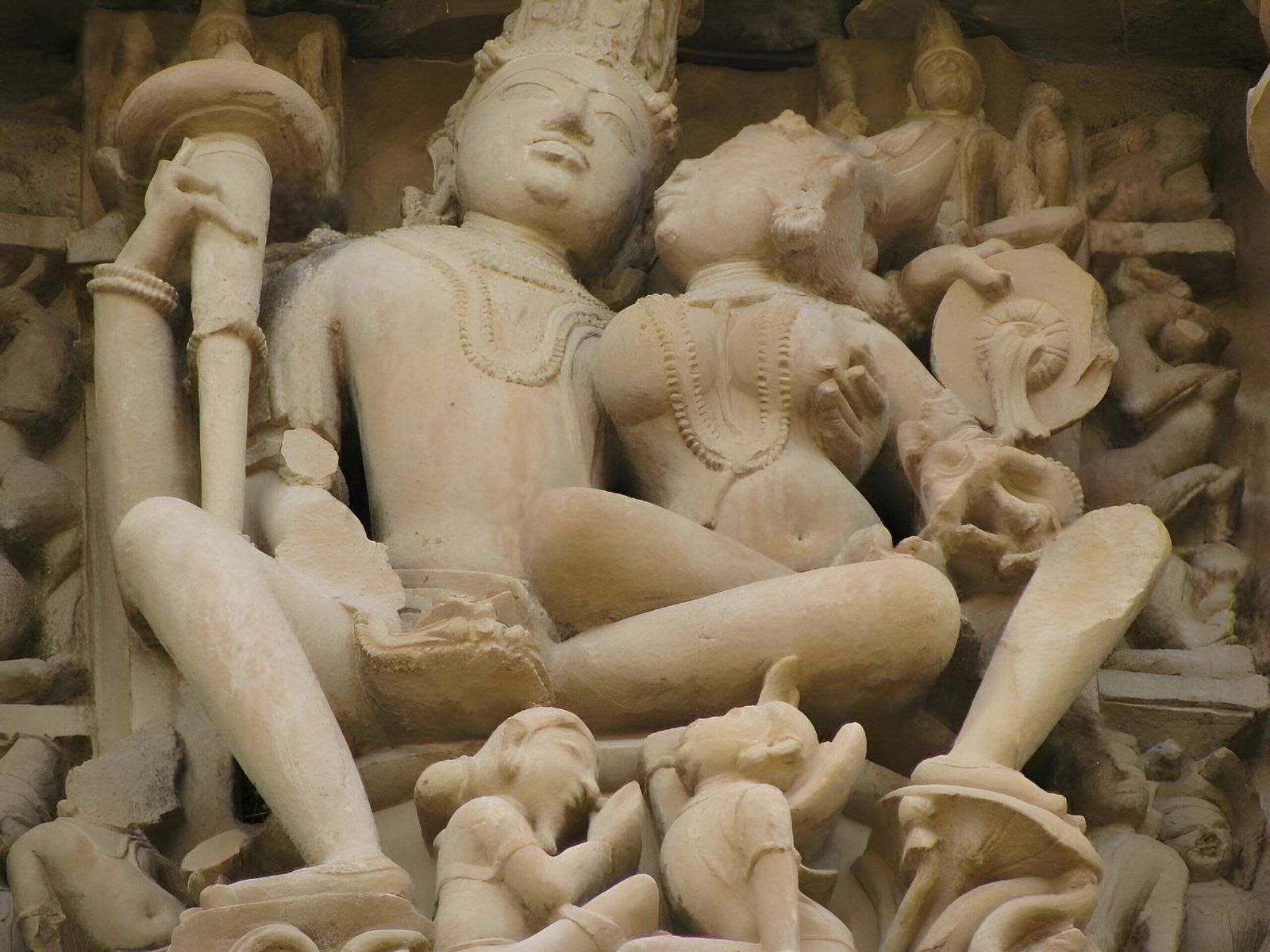
Alongside these geometric forms, Tantric art also includes anthropomorphic depictions of deities whose iconography often incorporates erotic elements. The maithuna couple—typically shown in a loving embrace—is one of the most recognizable motifs in Hindu Tantric art. Found on the walls of temples such as Khajuraho and Konark, these images have often been misinterpreted by outsiders as mere erotic decoration. In Tantric exegesis, however, maithuna represents the union of opposites, the fusion of dualities, and the realization of non-duality.
The temples of Khajuraho, built between the tenth and twelfth centuries, offer a particularly rich example of how erotic art functions within a Tantric worldview. The erotic sculptures that adorn their exterior walls are integrated into a larger iconographic program that includes deities, musicians, dancers, and ritual scenes.
Scholars such as Vidya Dehejia and David Gordon White have argued that these images should be understood within the context of Tantric ritual, where eroticism is one among many paths to awakening. The erotic figures, rather than isolated provocations, are part of a continuum of sacred imagery that affirms the sanctity of embodied experience.
Tantric Buddhist art, particularly in the Vajrayāna traditions of Nepal and Tibet, offers another dimension of sacred eroticism. Here, the yab-yum motif—depicting a male deity in union with his female consort—symbolizes the inseparability of wisdom (prajñā) and method (upāya). These images, often misunderstood by Western viewers, have a deep metaphysical meaning. The embrace represents the realization of emptiness and compassion as a single, non-dual awareness.
Eroticism is only one aspect of Tantric art, and not always the dominant one. Tantric traditions also produced vast bodies of non-erotic art: protective diagrams, ritual implements, temple architecture, and elaborate mandalas used in initiation ceremonies. Yet even when eroticism is absent, the underlying principle remains the same: art is a tool for awakening, a means of channeling divine energies.
This foundational insight—that aesthetic form can be a vehicle of spiritual transformation—will reappear, in transformed and sometimes distorted ways, in the Western esoteric reinterpretations of Tantra that emerged from the late nineteenth century onward.
Aleister Crowley and the Western Reinvention of Sacred Erotic Art
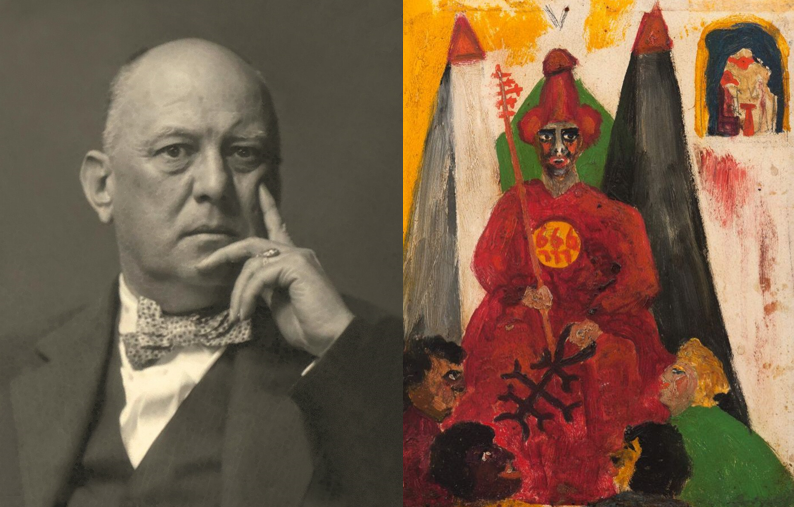
When sacred eroticism traveled from India to the West, it did not arrive intact. It was refracted through the lenses of occult revivalism, fin-de-siècle decadence, and the modernist hunger for new symbolic languages. Few figures embody this complex process more vividly than Aleister Crowley (1875–1947), whose reputation as a magician, libertine, and provocateur has long overshadowed his work as an artist. Yet Crowley’s paintings, drawings, and ritual performances form one of the earliest and most ambitious Western attempts to translate Tantric and quasi-Tantric ideas into a modern artistic idiom. Art is one of the primary media through which he articulated his esoteric system.
Crowley’s engagement with sacred eroticism was shaped by his encounters with both Eastern and Western esoteric traditions. His travels in India, Ceylon, and Burma exposed him to yogic and Tantric practices, though often through the distorted filters available to Western seekers of his time. At the same time, his involvement with the Hermetic Order of the Golden Dawn and later with the Ordo Templi Orientis provided a ritual framework in which sexuality could be understood as a sacramental force. For Crowley, erotic energy was a magical current capable of altering consciousness and reshaping reality. This conviction permeates his art.
Crowley’s paintings, produced primarily between 1920 and 1923 during his time at the Abbey of Thelema in Cefalù, Sicily, are often dismissed as crude or amateurish. Yet recent scholarship has begun to reassess them as early examples of visionary modernism. Their bold colors, distorted anatomies, and symbolic density reflect a deliberate attempt to bypass academic conventions and tap directly into what Crowley called the “astral light”—the imaginal realm where magical and psychological forces intersect. Many of these works depict deities, demons, and eroticized human figures engaged in ritualized gestures. The eroticism is integral to Crowley’s belief that the body is a gateway to spiritual illumination.
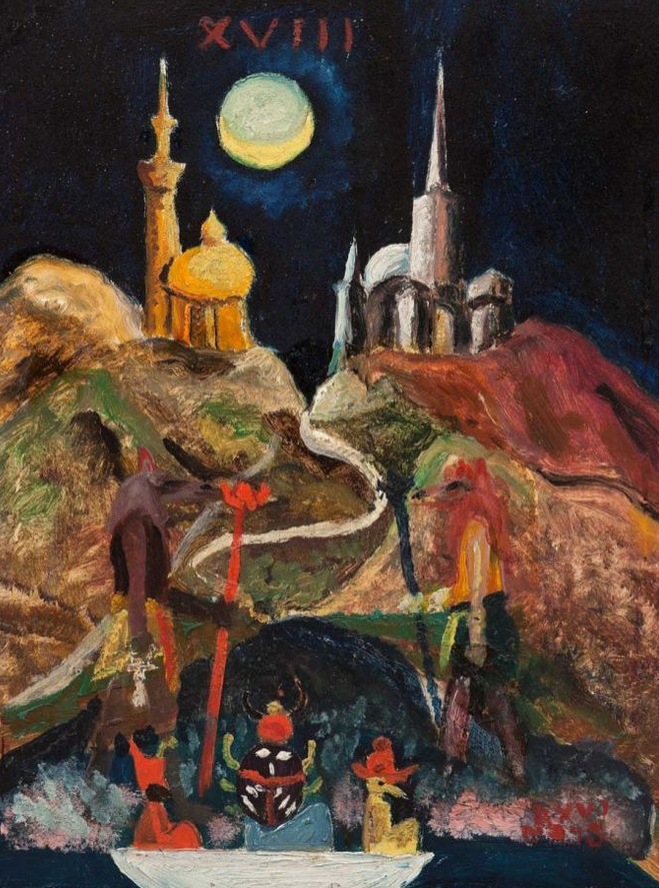
Crowley’s artistic practice integrated painting with ritual. He often created works in altered states of consciousness, induced through meditation, sexual magic, or the ingestion of psychoactive substances. The resulting images were talismans, condensations of magical intention. In this sense, Crowley’s art parallels the function of Tantric yantras: both are designed to embody and transmit specific energies.
Crowley’s reception as an artist has been as uneven as his reputation as an occultist. For many years, critics were unable—or unwilling—to separate the art from the artist’s scandalous persona. His erotic imagery, combined with his notoriety as a practitioner of sex magic, made him an easy target for sensationalist journalism. Even sympathetic observers struggled to evaluate his work on its own terms. It was only in the late twentieth and early twenty-first centuries, with the rise of academic interest in Western esotericism and outsider art, that Crowley’s paintings began to receive serious attention.
In fact, Crowley did not simply imitate Tantric models. He reimagined them through the prism of his own magical system, creating a hybrid form of esoteric erotic art that continues to influence contemporary practitioners and artists.
YahRa (Guru Jára): The Fusion of Sacred Eroticism and Contemporary Esoteric Art
If Aleister Crowley represents the early modern Western attempt to fuse sacred eroticism with artistic creation, YahRa (formerly Guru Jára) exemplifies a contemporary continuation of that lineage—one shaped by globalization, digital culture, and the hybridization of Eastern and Western esoteric forms. YahRa is known internationally as a neo-Tantric teacher whose teachings on sacred eroticism have generated both devoted followings and intense public controversy. Yet long before legal prosecution and media campaigns came to dominate his public image, YahRa had already developed a distinctive artistic practice—most notably his Astrofocus works—that sought to translate esoteric experience into visual form. His art, like his teachings, is grounded in the conviction that erotic energy is a subtle medium through which consciousness can be transformed.
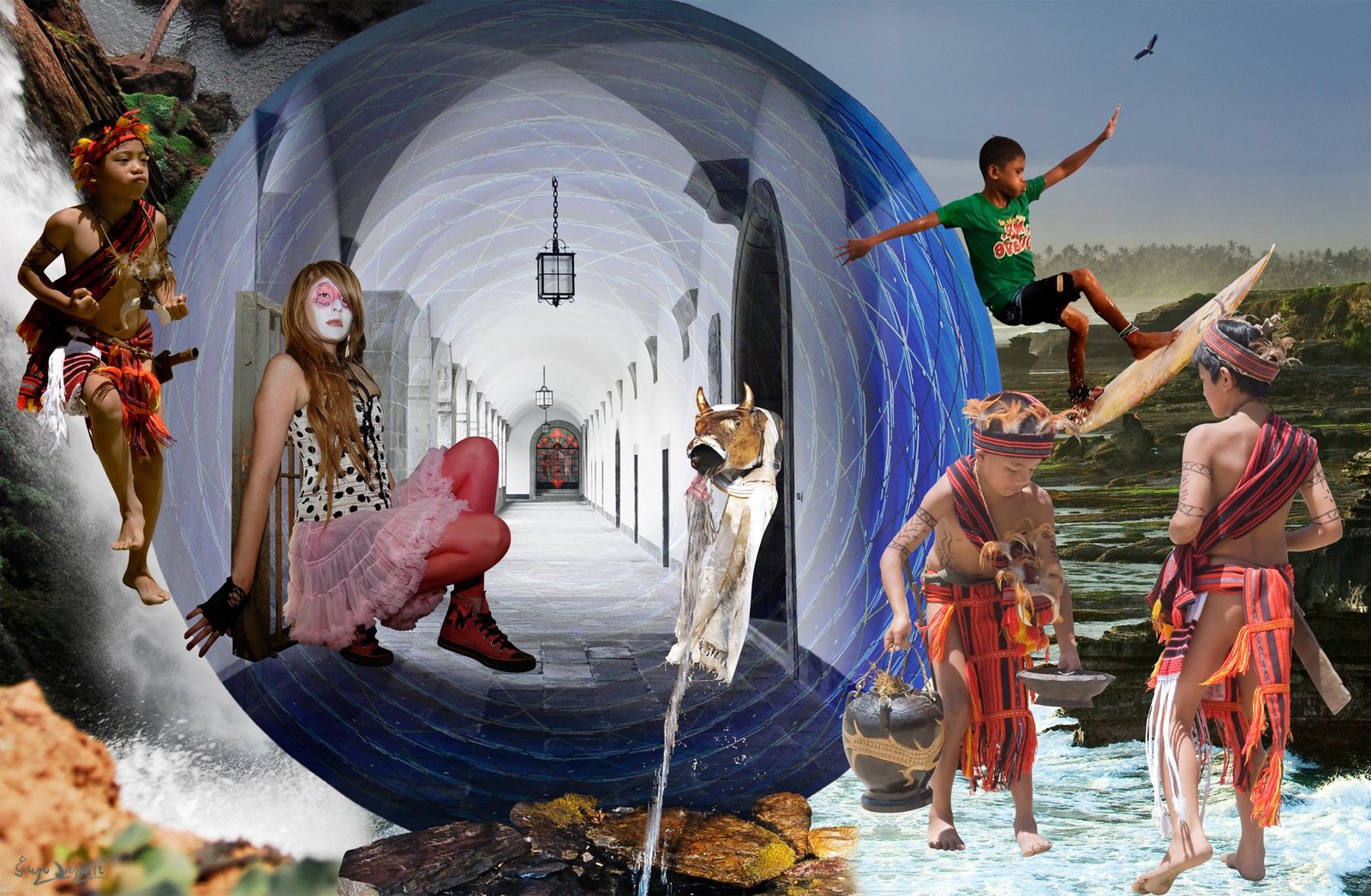
YahRa’s artistic production spans photography, collage, symbolic diagramming, and multimedia installations. His Astrofocus technique, which he developed in the early 2000s, is based on the idea that the “flow of life”—the energetic imprint of a person’s horoscope, emotional state, and spiritual trajectory—can be captured visually. The resulting works are energetic maps, intended to reveal the inner architecture of the portrayed subject’s consciousness. According to his students, each Astrofocus piece is created through a process that combines meditative attunement, symbolic interpretation, and intuitive composition. The artwork becomes a kind of yantra: a diagram that encodes specific energies and invites the viewer into resonance with them. Some works, such as “Astrofocus Tantric Mirror” (2012), directly allude to YahRa’s sacred erotic practices, in which women are liberated from the “hooks” left by previous unhappy sexual relations through ritual intercourse with the guru.
YahRa’s astrofocus art gained success mainly because of its perceived healing power, which spread informally by word of mouth. This concept involves nurturing kundalini energy to influence and refine a person’s life path, as depicted in their Astrofocus portrait. It is believed that this effect not only benefits the individual depicted but also affects others with similar astrological patterns, aligning their destinies through the mandala’s energetic field.
Astrofocus combines two interconnected elements. The first is astrology, in which the healing mandalas are based on the person’s horoscope, highlighting tense and strong aspects believed to influence kundalini flow and the development of energetic blockages. The second element is the focus or core, where the portrayed person becomes the energetic hub of the mandala. Around this center, planetary forces are metaphorically “set in motion,” depicted through YahRa’s photographic imagery. The mandala acts as a therapeutic tool, aiming to ease tense planetary aspects through symbolic links and the movement of mystical energetic currents that calm disharmonies between planets. It also helps to elevate stronger aspects into subtler, more spiritually refined vibrations. Practitioners describe this process as energetic rebalancing that merges symbolic, aesthetic, and esoteric elements.
A distinctive aspect of the Astrofocus system is its use of original photographic images collected personally by YahRa over many years and from various continents. For example, his students mention that the artwork “Melody of Existence” required an image representing crucifixion; consequently, YahRa traveled to the Philippines during Easter to photograph a real ritual crucifixion. On another occasion, he spent days in India observing a group of ashram monkeys from a rooftop until he captured the exact image of a mother and her infant needed for a different Astrofocus. Many such episodes—walking, climbing, flying, or trekking to find the perfect symbolic image—demonstrate how deeply the artist’s photography is intertwined with the Astrofocus system’s spiritual and healing goals.
This understanding of art as energetic transmission is central to YahRa’s worldview. His followers describe his work as “alive,” “timeless,” and “transformative,” emphasizing that its purpose is not to represent but to catalyze. In their view, YahRa’s art belongs to a lineage of photographs that includes figures such as Nobuyoshi Araki, Larry Clark, Jan Saudek, and František Drtikol—artists whose engagement with erotic themes provoked controversy but whose work is now recognized for its psychological and symbolic depth.
The settings of some of YahRa’s exhibitions are themselves significant. In 2010, YahRa’s photographs were shown at the Castle of Litomyšl, near the Portmoneum—the extraordinary house decorated by Czech esoteric artist Josef Váchal with murals depicting demons, Theosophical masters, and Christian imagery. In 2011, Astrofocus collages were exhibited at Duchcov Castle, where Giacomo Casanova spent the last years of his life. These venues situate YahRa’s work within a broader European tradition of esoteric and erotic art and literature, suggesting that his practice is part of a long cultural continuum.
MISA and the Objective Erotic Art
The Movement for Spiritual Integration into the Absolute (MISA), founded in Romania in 1990 by the neo-Tantric teacher Gregorian Bivolaru, represents one of the most ambitious contemporary attempts to systematize sacred eroticism within a comprehensive esoteric worldview. Bivolaru, currently jailed in France and awaiting judgment for sexual abuse, remains a polarizing figure, and the controversies surrounding him have inevitably shaped public perceptions of MISA. Yet, as with other neo-Tantric movements, the fixation on scandal has obscured the complexity of the group’s teachings and, in particular, its distinctive theory and practice of art. MISA insists that eroticism is only one component of a much broader Tantric path. Yet, it openly teaches erotic transmutation—especially the practice of orgasm without ejaculation—as a method for cultivating subtle energies and accelerating spiritual evolution. Within this framework, art becomes both an expression of these energies and a tool for awakening them.
MISA’s approach to art is rooted in what it calls “objective art,” a concept that draws on classical Tantric aesthetics, Western esotericism, and the teachings of Gurdjieff and Ouspensky. According to MISA, objective art is not the expression of an individual ego but the manifestation of universal laws. It channels divine energies through material forms—colors, proportions, rhythms, and symbolic structures—so that the artwork becomes a vehicle of resonance. Mihai Stoian, one of MISA’s leading yoga teachers (currently also jailed in France), describes art as “a direct method to awaken the soul,” emphasizing that true art works through resonance: the transmission of vibrations from the source to the receiver. For resonance to occur, there must be a degree of similarity between the two, which is why symmetrical figures and archetypal forms are considered particularly effective. This understanding echoes the Tantric principle that the microcosm mirrors the macrocosm, and that aesthetic form can serve as a bridge between them.
The most unusual artistic production of MISA is “The Feminine Astrological Typologies,” by French photographer Pierre Crié (2018). It is an elegant coffee table book, featuring full-page frontal black-and-white nude photographs of 144 different women. Although Crié is known for his reportages about life and religion in India and Tibet, here women do not do anything. They just stand and look at the camera. Such black-and-white images of naked women are not unusual. Helmut Newton (1920–2004), one of the most famous photographers of the 20th century, built a career around them. What is unusual, and unique, is that this is a book about astrology. The 144 women are each born under one of the twelve zodiac signs and with a different ascendant. The first woman is an Aries with Aries ascendant, the second an Aries with Taurus ascendant, and woman no. 144 is a Pisces with Pisces ascendant, so that all the 144 possible combinations are featured in the book. Essays accompanying the photographs explain that this astrological cartography of the female body offers a gallery of living mandalas.
Artists connected with MISA often produce yantras—geometric diagrams used in Tantric meditation—believing that audiences can easily resonate with these works. The mind, they argue, gradually takes on the shape of the yantra during contemplation, absorbing the specific energies encoded within it. In this sense, MISA’s art is designed to transform consciousness rather than depict external reality. Stoian contrasts this with what he calls “subjective art,” which he sees as an expression of the ego and therefore spiritually inert. Subjective art communicates personal impressions, no more significant than a résumé or passport. Objective art, by contrast, is vertical rather than horizontal; it initiates rather than entertains. It can be produced only by artists who have attained a certain level of consciousness, and it requires audiences who are prepared—through yoga, meditation, and ethical discipline—to receive its initiatory power.
MISA’s aesthetic theory is embodied in the movement’s ashrams, which are decorated with Tantric art produced by both amateur and increasingly professional artists. Among the latter is Ines Honfi, an Argentine-born painter. Born in Buenos Aires, Argentina, on September 23, 1973, to a Catholic family of Hungarian origin, Honfi enrolled at Buenos Aires’s Regina Pacis Art School at age 16 and graduated as an art teacher in 1993. She continued studying at the same school until 1995, when she (and many others) left in protest against the Catholic nuns’ decision to fire the school’s principal, artist Andrés Bestard Maggio. Honfi married in Argentina in 1993 and, in 1996, moved with her family to Hungary, where she joined MISA in 2003. Following her divorce in 2004, she moved to Copenhagen, Denmark, in 2006, where she began working as both a professional artist and a MISA yoga teacher.
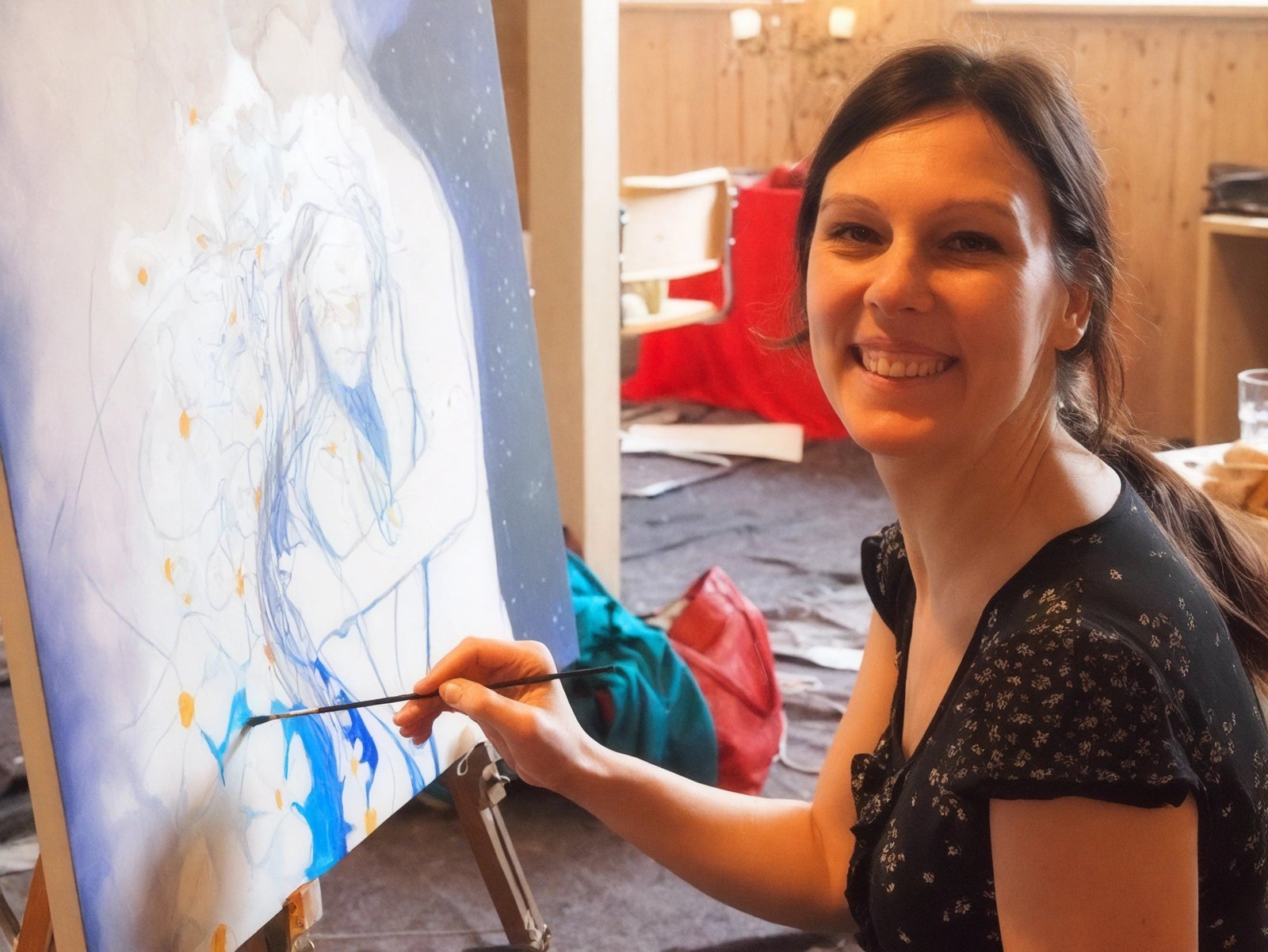
Honfi’s work exemplifies MISA’s sacred eroticism in series such as Divine Couple and Feminine Mystery, while other paintings explore yogic themes in a dreamy, semi-abstract style. She also produces yantras that are used in meditation and ritual practice. Her career illustrates how MISA’s teachings can shape the content and purpose of artistic production: art becomes a form of spiritual service, a means of transmitting beauty, energy, and initiation.
MISA’s integration of sacred eroticism and art thus reflects a broader neo-Tantric attempt to re-enchant aesthetic experience. Erotic energy, far from being a taboo, is treated as a subtle force that can be refined, sublimated, and embodied in visual form. The controversies surrounding MISA and its founder have often overshadowed this dimension. Yet, the movement’s artistic output—its yantras, paintings, performances, and ritual aesthetics—offers a rich case study in how sacred eroticism continues to inspire new forms of esoteric creativity.
Conclusion
Across the diverse landscapes surveyed in this paper, a single thread emerges: sacred eroticism and artistic creation are structurally intertwined. Each tradition, in its own idiom, treats erotic energy and aesthetic form as parallel modalities of transformation. The question, then, is not whether sacred eroticism can be expressed through art, but whether, within a Tantric or neo-Tantric worldview, the distinction between art and eroticism retains any real meaning at all.
Tantric traditions, both Indian and Western, begin from a premise that sharply diverges from the dominant religious and philosophical assumptions of the modern West. Rather than viewing the material world as a distraction from spiritual life, Tantra treats it as the very field in which spiritual realization unfolds. The body is not an obstacle but an instrument; sensation is not a temptation but a pathway; form is not a veil but a revelation; eroticism is not a deviation from the sacred but one of its privileged expressions. And art, far from being a secondary or decorative activity, becomes a method for shaping consciousness, transmitting energy, and embodying metaphysical truths.
Ancient Tantric statues, Crowley’s paintings, YahRA’s Astrofocus works, and MISA’s yantras all operate within this same logic. The controversies that surround these modern and contemporary figures—Crowley’s scandals, YahRA’s legal battles, MISA’s public vilification—reveal how profoundly unsettling this worldview remains. Western culture, shaped by centuries of Christian dualism and Enlightenment rationalism, tends to separate art from ritual, sexuality from spirituality, and aesthetics from metaphysics. When a movement or artist refuses these separations, insisting instead on their unity, the reaction is often suspicion or moral panic. Sacred eroticism becomes conflated with deviance; esoteric art becomes dismissed as delusion or manipulation; the aesthetic dimension of erotic spirituality becomes invisible beneath layers of scandal.
Yet the persistence of these traditions—and the intensity of the artistic production they inspire—suggests that the union of art and eroticism answers a deep human need. This convergence also invites a reconsideration of what we mean by “art” in the first place. If art is understood as the creation of forms that transform the viewer, then Tantric eroticism is already an art. If eroticism is understood as the cultivation of heightened awareness through embodied experience, then art is already erotic. The union of the two—art as eroticism, eroticism as art—is simply a return to an older, more integrated understanding of human creativity.

Massimo Introvigne (born June 14, 1955 in Rome) is an Italian sociologist of religions. He is the founder and managing director of the Center for Studies on New Religions (CESNUR), an international network of scholars who study new religious movements. Introvigne is the author of some 70 books and more than 100 articles in the field of sociology of religion. He was the main author of the Enciclopedia delle religioni in Italia (Encyclopedia of Religions in Italy). He is a member of the editorial board for the Interdisciplinary Journal of Research on Religion and of the executive board of University of Pennsylvania Press’ Nova Religio. From January 5 to December 31, 2011, he has served as the “Representative on combating racism, xenophobia and discrimination, with a special focus on discrimination against Christians and members of other religions” of the Organization for Security and Co-operation in Europe (OSCE). From 2012 to 2015 he served as chairperson of the Observatory of Religious Liberty, instituted by the Italian Ministry of Foreign Affairs in order to monitor problems of religious liberty on a worldwide scale.