An elderly man who devoted his life to faith is now treated as a public menace.
by Massimo Introvigne
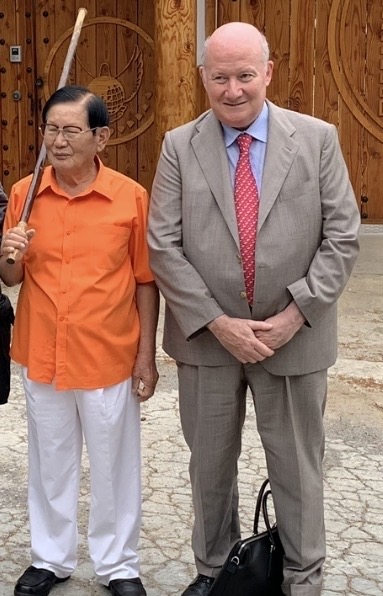
The arrest of Shincheonji founder Lee Man-hee, aged ninety-five, marks a moment that no civilized democratic country should ever reach. A non-violent religious leader of such advanced age is taken into custody as if he represented a threat to society. International human rights norms, including the United Nations Standard Minimum Rules for the Treatment of Prisoners (the Mandela Rules) and the principles articulated by the UN Working Group on Arbitrary Detention, require that the detention of elderly individuals be a measure of last resort and proportionate to the alleged offense. The arrest of a man approaching one century of life for accusations that involve no violence violates these standards.
Authorities claim that Lee “compelled” tens of thousands of Shincheonji members to join the conservative People Power Party (PPP) to influence primary elections. Korean media report that prosecutors allege a coordinated plan, codenamed “Pilates,” through which followers were enrolled in the PPP and their membership dues paid on their behalf. They also claim this was intended to reward former President Yoon Suk-yeol, then a candidate, for supposed leniency toward Lee during the COVID-19 investigations when he was Prosecutor General.
The narrative collapses under its own weight. Lee did not receive leniency. He was jailed during the COVID crisis despite his age, and only through the full judicial process, including the Supreme Court, was he eventually acquitted of all pandemic-related charges after judges reaffirmed their independence from political pressure.
The present arrest is even more disturbing because Lee has been cooperating with prosecutors. Korean reports confirm that he appeared for questioning, walking with a cane, and submitted to the procedures required of him. There is obviously no risk of flight, and after so many raids, nothing remains to alter or conceal.
The charges themselves criminalize the ordinary civic participation of citizens who happen to belong to a religious minority. Shincheonji members, like all Korean citizens, have the right to join political parties and support candidates. International law recognizes that members of unpopular or stigmatized religions retain the same civil and political rights as everyone else. The International Covenant on Civil and Political Rights protects both freedom of religion and the right to take part in public affairs.
The arrest of Lee should be viewed alongside the prolonged detention of Unification Church leader Hak Ja Han, who is eighty-three years old. The ruling party is also promoting a law that would allow the government to dissolve religious bodies whose leaders have been sentenced for criminal offenses or for political interference, and to confiscate their assets.
President Lee Jae-myung has repeatedly spoken of eliminating what he calls “heretical” religions. His political allies among certain left-leaning clergy have enthusiastically supported him, and their involvement in political advocacy does not appear to be under investigation. The state is constructing a system where religious minorities are exposed to punitive measures whenever their existence becomes inconvenient. The inquisition that once tormented souls now extends its reach to the bodies of elderly leaders, whose frailty becomes a tool in the hands of prosecutors who seem determined to see them remain behind bars and perhaps die there.
The spectacle of a ninety-five-year-old man being led into detention under accusations that criminalize the political choices of his followers is a stain on South Korea’s democratic credentials. A society that respects human dignity does not place its oldest religious leaders in chains for non-violent allegations. A legal system that honors international norms does not treat civic participation as a criminal conspiracy. A democracy that values pluralism does not target communities because their beliefs are unpopular.
The arrest of Lee Man-hee, like the detention of Mother Han, is more than a judicial action. It is a warning sign. And the world should pay attention.

Massimo Introvigne (born June 14, 1955 in Rome) is an Italian sociologist of religions. He is the founder and managing director of the Center for Studies on New Religions (CESNUR), an international network of scholars who study new religious movements. Introvigne is the author of some 70 books and more than 100 articles in the field of sociology of religion. He was the main author of the Enciclopedia delle religioni in Italia (Encyclopedia of Religions in Italy). He is a member of the editorial board for the Interdisciplinary Journal of Research on Religion and of the executive board of University of Pennsylvania Press’ Nova Religio. From January 5 to December 31, 2011, he has served as the “Representative on combating racism, xenophobia and discrimination, with a special focus on discrimination against Christians and members of other religions” of the Organization for Security and Co-operation in Europe (OSCE). From 2012 to 2015 he served as chairperson of the Observatory of Religious Liberty, instituted by the Italian Ministry of Foreign Affairs in order to monitor problems of religious liberty on a worldwide scale.