An academic who left the church in 1992 denounces the misinterpretation of its theology in the verdict that dissolved the Family Federation.
by Masaki Nakamasa
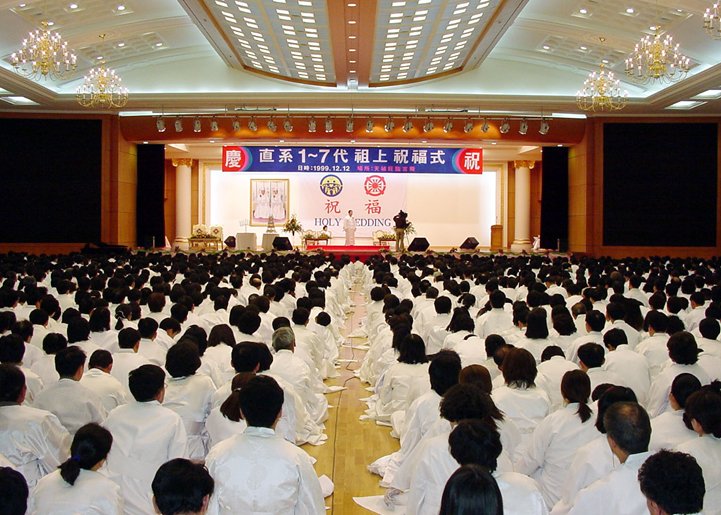
What surprised me after reading the High Court decision was that the court developed its own interpretation of the doctrines of the Family Federation (formerly known as the Unification Church) and used it to justify the dissolution order. Since only those involved can know how they understand and practice the doctrines, the law should not intrude on that, and the fundamental principle of modern law is to maintain neutrality in evaluating doctrines. In a case where the question was whether wooden mandalas were objects of faith in Nichiren Shoshu, the Supreme Court stated that “the authenticity of objects of faith, which are the essence of religion, and the issue of doctrines that should be resolved religiously are matters that directly concern inner faith, and are not matters that the court can definitively resolve by applying laws and regulations” (Supreme Court, Showa 51 [O] No. 749, April 7, 1981, Third Petty Bench, Supreme Court Civil Case Reports Vol. 35 No. 3, p. 462).
In the special appeal hearing against the dissolution order for Aum Shinrikyo, the Supreme Court also confirmed that it does not intrude on doctrinal matters, stating, “As mentioned above, the system of dissolution orders for religious corporations stipulated in Article 81 of the Act targets only the secular aspects of religious corporations and is solely for secular purposes, and is not intended to interfere with the spiritual or religious aspects of religious organizations or their followers…” (Supreme Court Judgment, Case No. [Ku] 8 of 1996, First Petty Bench, January 30, 1996).
However, upon examining the High Court’s decision, I found numerous instances of unique and rather malicious interpretations of doctrine. For example, the judgment states: “Regarding the ancestral liberation gratitude offering, as stated above, ‘ancestral liberation’ requires the full payment of the ancestral liberation gratitude offering, and the amount of the offering is fixed regardless of the believer’s financial situation and is substantial (…). Therefore, conveying the above information to the target individual, inciting their anxiety, and demanding the completion of ‘ancestral liberation’ carries the risk of constituting inappropriate solicitation of donations, etc.” (High Court Judgment, p. 128). This suggests that coercion into high donations is unavoidable under the doctrine, and the court cites related internal documents of the religious organization (ibid., pp. 99 et seq.). However, there is no evidence of verification of how believers actually received these documents, whether they had any coercive power over individual believers, or to what extent.
The court seems to believe that if something is recommended or presented as a goal in the name of a “cult” leader, it becomes an absolute command that believers cannot defy. However, as a former believer myself, I see this as an unfair assumption that is far removed from the reality of believers’ faith. To assume that believers must do something based on documents related to the doctrine, without examining what that means to them specifically, is nothing more than a dogmatic interpretation of the doctrine.
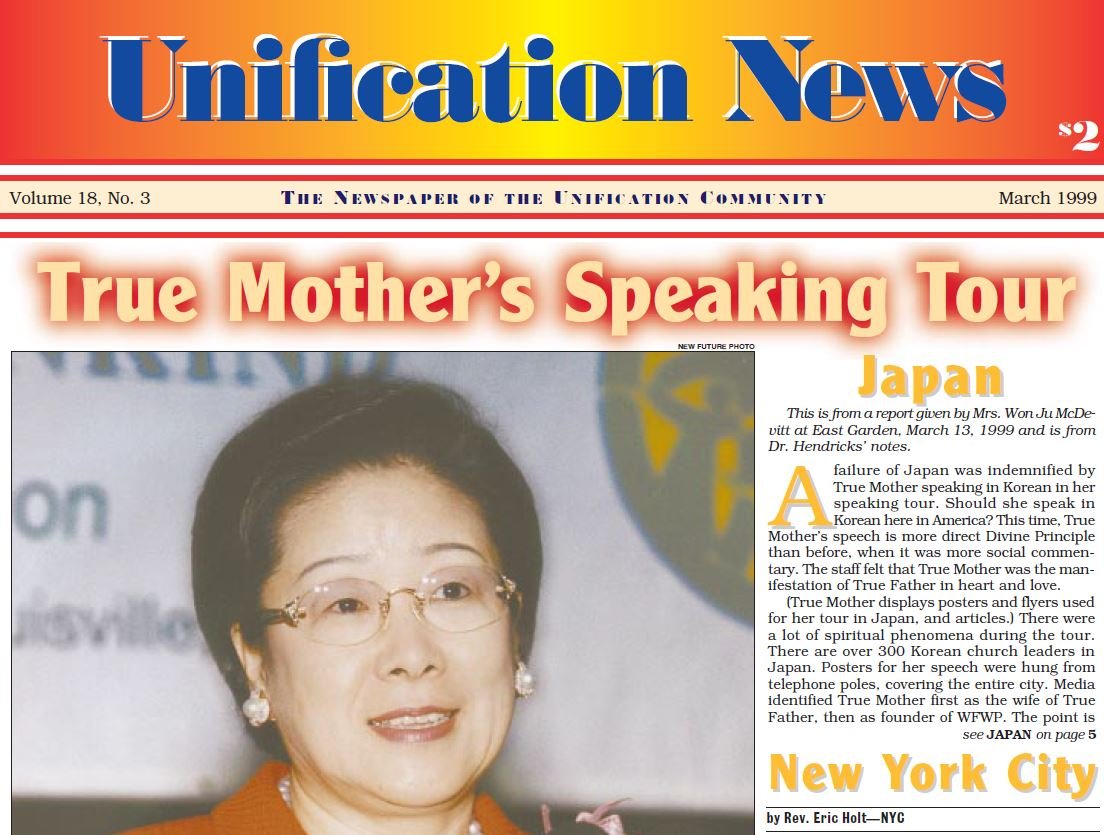
The court cited the statement by the late founder’s wife, Mother Hak Ja Han, as justification for the religious group’s renewed “solicitation of inappropriate donations,” that “Japan was able to become an economic superpower because Heaven blessed it. Those who have received blessings from Heaven must surely bestow blessings” (ibid., p. 149). However, it is a leap in logic to assume that such abstract expressions containing doctrinal content directly coerce individual believers into making donations. The court further speculated that “Hak Ja Han’s statements 1 and 3 above were made under the assumption that Sun Myung Moon believed that believers in Japan, the ‘Eve nation’ or ‘mother country,’ should provide economic assistance to countries around the world, even if it is difficult for them…” (ibid., p. 150), thus invoking doctrine to justify the coercion of donations. However, determining the fate of a religious group with tens of thousands of followers based on such a simplistic interpretation of doctrine is far too reckless. It seems like an unjust interference with the inner thoughts of the believers.
This issue is also related to treating this as a “noncontentious case.” In accordance with Article 81, Paragraph 1 of the Religious Corporations Act, orders to dissolve religious corporations are, without exception, treated as non-contentious cases. Because they are non-contentious cases, they are not open to the public. Instead of an adversarial structure between the two parties, they are resolved quickly through simple procedures at the judge’s discretion.
Whether the doctrine itself can be interpreted as inevitably giving rise to “unjust solicitation of donations,” and whether the court should make that judgment, is a crucial issue under the Constitution and the principle of the “rule of law.” Therefore, it should have been made a point of contention, and both sides’ arguments should have been heard in open court, if it were a trial in an adversarial court. However, since it was a noncontentious case, it seems that this important issue was handled solely through the judge’s superficial interpretation.
Isn’t it the same idea as the Inquisition in premodern Europe, for a state to interpret the doctrines of a religious group arbitrarily, without consulting those involved, and then make decisions based on those interpretations that have serious consequences for the future of its followers? In Japan, the prewar suppression of the Omoto religion comes to mind when considering the arbitrary interpretation of doctrine.
In the First Omoto Incident (1921), the founder and others were indicted for lèsemajesté because articles published in a magazine issued by the Omoto religion misrepresented the Emperor’s actions and disregarded his sovereignty (Omoto 70th Anniversary History Compilation Committee, “History of the Omoto Incident,” pp. 71 et seq.). On this occasion, they were acquitted by a general amnesty following the death of Emperor Taisho. However, in the Second Omoto Incident (1936), the doctrines of “rebuilding and uplifting the present world” and “achieving the divine rule of Miroku” were deemed attempts to “change the national polity” and were considered violations of the Public Security Preservation Law. The founder and others were indicted, and eight related organizations were ordered to cease association and disband (ibid., pp. 261 et seq., and pp. 338 et seq.).
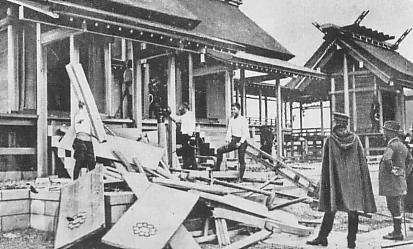
However, the Osaka Court of Appeals (1942), after examining the doctrines of Omoto religion, ruled that “rebuilding” referred to the “divine realm” and that there was no evidence to interpret it as an attempt to change the national polity in the “earthly realm,” and handed down a verdict of not guilty regarding the Public Security Preservation Law (ibid., pp. 436 et seq.). The legal system at the time granted the state the power and authority to determine whether the doctrines of individual religions were contrary to the national polity, so even when issuing a notguilty verdict, they had to delve into the doctrines to some extent.
Incidentally, Article 16 of the Religious Organizations Act (established in 1939), the predecessor of the Religious Corporations Act, stated that “when a religious organization or teacher proclaims religious doctrines, performs rituals, or conducts religious events that disrupt public order or violate the duties of a subject, the competent minister may restrict or prohibit such activities, suspend the teacher’s duties, or revoke the approval for the establishment of the religious organization.” This premise, under the guise of “public order” and “duties of a subject,” presupposes that the state can interfere with the doctrines and events of religious organizations.
Articles 19 and 20 of the Japanese Constitution and the Religious Corporations Act were supposedly enacted before the war to prevent undue interference by state power in religious doctrines and other matters. Article 1, Paragraph 2 of the Religious Corporations Act states that “no provision of this Act shall be interpreted as restricting individuals, groups, or organizations from spreading doctrines, performing rituals and ceremonies, or engaging in other religious activities based on their guaranteed freedoms,” thus presupposing the freedom to spread doctrines.
Considering this background, the Tokyo High Court’s decision to order the dissolution of the Family Federation, based on its own interpretation of the Family Federation’s doctrines and anticipating future dangers, carries the risk of regressing to the era of the Public Security Preservation Law and the Religious Organizations Act. I sincerely hope that the Supreme Court will correct the extremely dangerous error of the High Court’s judgment and restore the original roles of Articles 19 and 20 of the Constitution and the Religious Corporations Act.

Masaki Nakamasa (born February 22, 1963) is a Japanese philosopher and intellectual historian. He is a professor at the Faculty of Law, Institute of Human and Social Sciences of Kanazawa University. His specialties are History of Thought, Fundamental Law, and General Literature. Born in Kure City, Hiroshima Prefecture, he entered the University of Tokyo’s College of Arts and Sciences in 1981. He joined the Unification Church around that time and was active in the CARP (Collegiate Association for the Research of Principles) Movement at the University of Tokyo. He left the Unification Church in 1992 and studied abroad in Germany. He became an associate professor at Kanazawa University’s Faculty of Law in 1998 and a professor at the same university in 2008.