An exploration of anti-Jesuit polemics reveals a much older genealogy behind today’s campaigns against groups branded as outsiders, manipulators, or “cults.”
by Massimo Introvigne
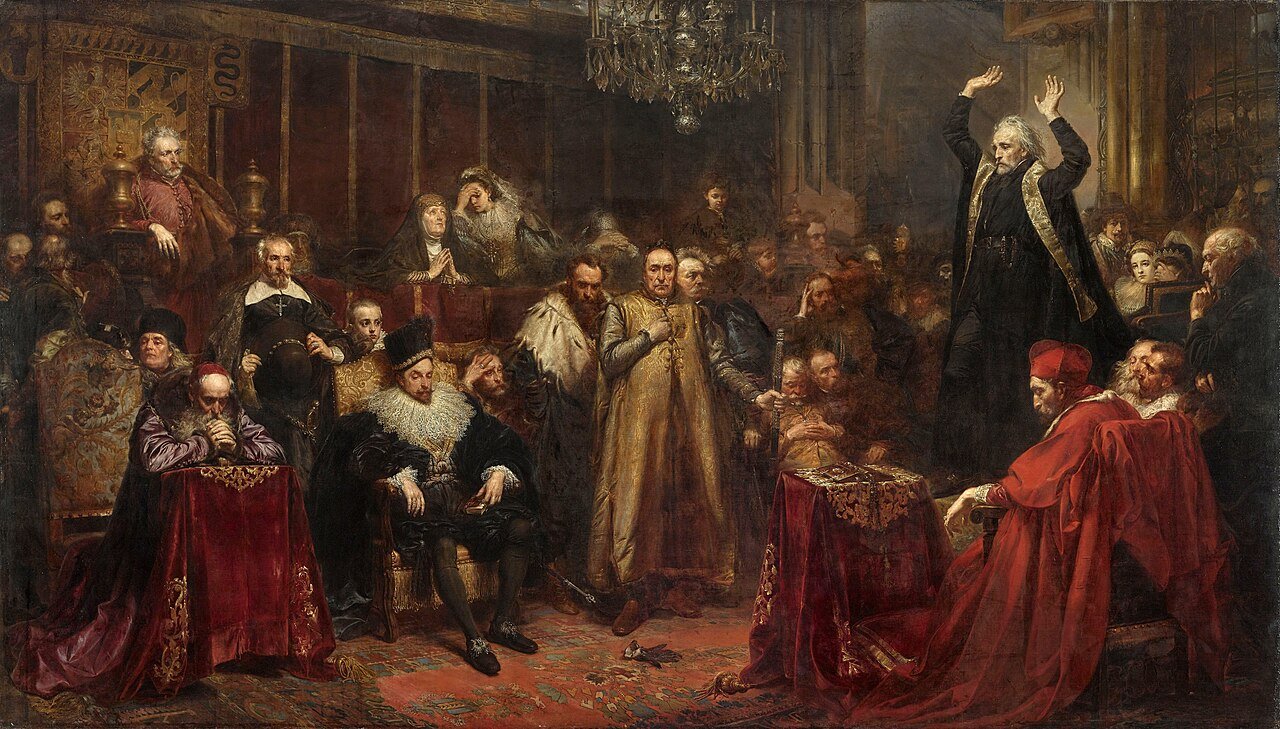
A storm does not begin with thunder. It starts with a subtle, almost invisible pressure change, until the air itself becomes accusatory. “Foreign Intruders: Anti-Jesuit Narratives in Poland-Lithuania during the Reigns of Stephen Báthory and Sigismund III, 1576–1632,” edited by Robert Aleksander Maryks and Michał E. Nowakowski (Leiden: Brill 2025), explores that pressure change: the moment when a religious order became a symbol of everything a society feared, resented, or refused to understand. It also serves as a mirror. The language once directed at the Jesuits—foreign agents, corrupters of youth, enemies of the nation—has not disappeared. It has simply found new targets.
The editors reference Henryk Barycz’s 1934 observation that an unbiased history of the Jesuits in the Polish-Lithuanian Commonwealth remains unwritten, stuck between apologetic defense and claims of the order’s ruinous influence. Their goal is not to defend the Jesuits but to reconstruct the world of their critics. The result is a work that resembles a map of fear, showing how anti-Jesuit narratives arose, spread, and became political weapons.
The Jesuits arrived late in the Commonwealth, in 1564, but expanded quickly, reaching “sixty houses and over 1,400 members by the 1640s”. Their free, high-quality education became the training ground for the Commonwealth’s elite. Yet their rise coincided with the fragile religious truce of the Warsaw Confederation of 1573, which Jesuits like Piotr Skarga openly opposed. This tension became the foundation for a new type of polemic.
The first sustained attack came from Jakub Niemojewski in Poznań. His 1577 “Diatribe” condemned the Jesuits as religious of the Roman court, accused them of misusing Jesus’s name, and ridiculed their preference for Latin over Polish. That the “Diatribe” was published in Poznań was no accident; under Jakub Wujek, its Jesuit college had become a powerful intellectual center. The Jesuits’ response—publicly burning all available copies of the “Diatribe” in the market square—only amplified Niemojewski’s message.
In Vilnius, Calvinist Andrzej Wolan escalated the rhetoric. His 1579 “Defensio” accused the Jesuits of using “seductive tricks to deceive various groups, including commoners, women, magnates (like the sons of Radziwiłł ‘the Black’), and even the king,” and depicted them as “blood-thirsty and cruel murderers” and destroyers of peace. Wolan’s persona—a simple believer armed only with Scripture—was designed to contrast with Jesuit Scholasticism. His imagery linked local grievances to the broader Protestant narrative of persecution.
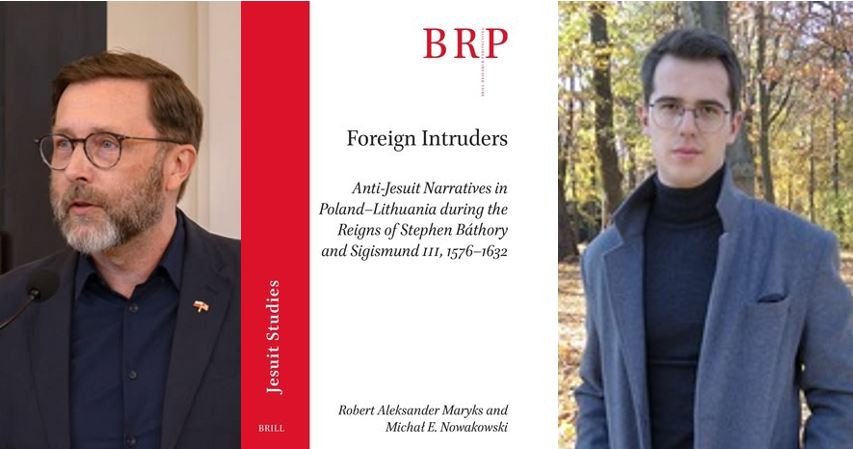
The anonymous 1582 poem “Apologeticus” added poetic intensity. Written after anti-Calvinist violence in Vilnius, it labeled the Jesuits as “knights of Babylon” and cast Skarga as the “hetman of the Vilnius war.” It provided the earliest known poetic defense of the Warsaw Confederation, framing the Jesuits as instigators of civic unrest.
Under Sigismund III, the polemics became explicitly political. The 1590 “Equitis Poloni in Jesuitas Actio Prima,” likely by Jan Drohojewski, branded the Jesuits a plague and a pestilence, accused them of being Spanish spies, and warned that their colleges were hidden fortresses planning a Habsburg takeover. The text should be placed within the broader European climate influenced by the French “politiques,” who also feared Jesuit political power more than their theology.
The Polish Brethren contributed their critiques. Wojciech of Kalisz described the 1592 Lewartów disputation as a display of Jesuit intimidation, while Marcin Czechowic mocked their pride, opulent buildings, and costly churches, contrasting them with Christ’s humility.
The book’s most dramatic chapter focuses on the Zebrzydowski Rokosz (1606-1607). The “Consilium de recuperanda et in posterum stabilienda pace regni Poloniae,” attributed to Jan Szczęsny Herburt, demanded the “complete expulsion” of the Society and likened the Jesuits to the Teutonic Knights, claiming they would one day subjugate the nation. Jesuit influence, Herburt argued, was a “disease or infection” needing surgical removal. With at least twelve Latin editions, the “Consilium” became a European bestseller of anti-Jesuit sentiment.
In Royal Prussia, Jan Turnowski documented Jesuit student violence in Toruń and Poznań. His pamphlets introduced the enduring theme of “equivocatio Jesuitica”—devious, slippery speech—and connected Jesuit theology to the regicide doctrines of Juan de Mariana. Translated into Latin and German, Turnowski’s work ensured that local conflicts resonated throughout Protestant Europe.
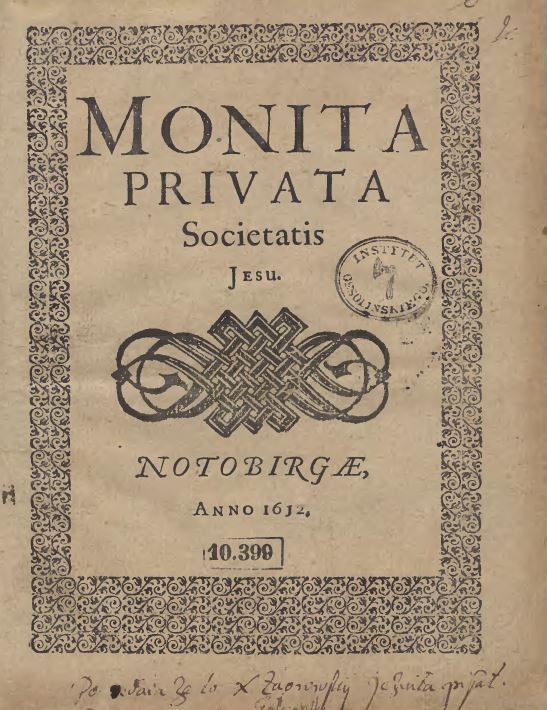
One of the book’s key contributions is its careful re-evaluation of the “Monita privata,” the infamous false Jesuitical “Secret Instructions.” Robert Aleksander Maryks claims it was first printed not in Kraków in 1614, as previously reported, but in Nysa, Lower Silesia, in 1612, placing it at the center of debates over the Jesuit-Habsburg alliance. He questions the traditional attribution to Hieronim Zahorowski, suggesting a more complex origin linked to Venetian anti-Jesuit circles around Paolo Sarpi. The “Monita” condensed local anxieties into a portable myth of Jesuit world domination, eventually leading to over 240 editions worldwide.
The final act unfolds within Catholicism. In 1625, Jan Brożek published “Gratis,” a detailed critique of Jesuit education. He contended that while the Jesuits claimed their teaching was free, they extracted “substantial endowments and donations from the nobility” and used students to evaluate family wealth. He also criticized their stance in the Chinese Rites controversy, accusing them of compromising doctrine to secure converts. His critique contributed to Władysław IV’s 1634 decision to close the Kraków Jesuit school to non-Jesuit students.
In their conclusion, Maryks and Nowakowski summarize the era’s anti-Jesuit themes: “greed, foreign influence, the manipulation of society (particularly of youth and wealthy widows), and the Jesuits’ destabilizing effect on the state.” The imagery—Jesuits as “Satan’s whorehouse,” “Spanish spies,” and “cloaked sirens” —reflected patterns across Europe. Yet the Commonwealth was not just a recipient of these ideas; it helped create them. Works like the “Monita privata” and Wolan’s “Defensio” shaped the European view of Jesuitism.
What makes the book so unsettling—and so relevant—is how familiar these patterns are. The same accusations once directed at the Jesuits are now used against Jehovah’s Witnesses, Opus Dei, and groups labeled as “cults” both within and outside mainstream churches in Eastern Europe, as well as in Korea and Japan. The vocabulary changes, but the structure of suspicion remains the same.
Maryks and Nowakowski have produced a work that is both an archival resource and a warning. Religious fear rarely centers on theology. It focuses on identity, sovereignty, and the narratives communities create to protect themselves from imagined threats. As this book shows with impressive clarity, those narratives can endure through the centuries.

Massimo Introvigne (born June 14, 1955 in Rome) is an Italian sociologist of religions. He is the founder and managing director of the Center for Studies on New Religions (CESNUR), an international network of scholars who study new religious movements. Introvigne is the author of some 70 books and more than 100 articles in the field of sociology of religion. He was the main author of the Enciclopedia delle religioni in Italia (Encyclopedia of Religions in Italy). He is a member of the editorial board for the Interdisciplinary Journal of Research on Religion and of the executive board of University of Pennsylvania Press’ Nova Religio. From January 5 to December 31, 2011, he has served as the “Representative on combating racism, xenophobia and discrimination, with a special focus on discrimination against Christians and members of other religions” of the Organization for Security and Co-operation in Europe (OSCE). From 2012 to 2015 he served as chairperson of the Observatory of Religious Liberty, instituted by the Italian Ministry of Foreign Affairs in order to monitor problems of religious liberty on a worldwide scale.