Table of Contents
The striking cases of Ludezhuang, Mozi Mountain, Sheshan Hill and Niuyu Cross Mountain forced to recognize the state. We heard the voice of the witnesses.
Yang Xiangwen
Following decades of strife between the Holy See and Beijing, the Vatican-China deal of 2018 was signed. The agreement regulates the appointment of Catholic bishops in China. They will be selected and approved by the Chinese authorities but should be ultimately appointed by the Pope. The Vatican also “regularized” seven excommunicated bishops who had been appointed without Vatican approval by the Chinese government.
But despite this agreement, which seemed to many to be a small sign of religious autonomy in the Communist country, the Chinese government is still persecuting Catholics in China. Not only by continuing to persecute dissident clergy who refuse to obey the CCP, but also intensifying its suppression of, and restrictions on, Catholic pilgrimage activities.
Ludezhuang
Ludezhuang is a famous Catholic pilgrimage site in the Diocese of Cangzhou, in the north China’s Hebei Province and every year, on the second Sunday of May, is a pilgrimage day. Tens of thousands of churchgoers from various regions, as well as many foreign churchgoers, embark on a pilgrimage to this renowned site.
On May 12 of this year, the atmosphere of this pilgrimage site was especially tense. More than 300 fully armed special police and police officers arrived at the Ludezhuang pilgrimage site and erected iron railings at the intersections leading to the pilgrimage site, setting up a security gate and head-counting equipment at the entrance to the site.

The police were guarding the entrance to the pilgrimage site.
A local churchgoer told Bitter Winter that the police arrived at the pilgrimage site at 4:00 a.m. and started carrying out security checks and counting the number of people. When the number displayed on the counting device exceeded 10,000 people, the police prohibited anyone else from entering the pilgrimage site. Thousands upon thousands of believers were stopped outside the pilgrimage site, leaving them no choice but to kneel, worship and pray outside the entrance.
“This year, it is being managed more strictly than in any previous year,” said an elderly churchgoer who was stopped outside.
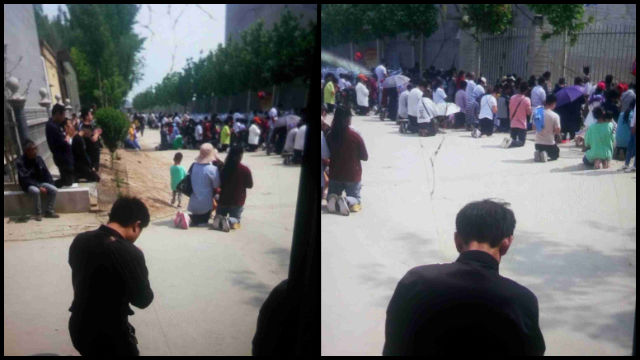
Churchgoers were kneeling and praying on the road outside the pilgrimage site.
The churchgoer also revealed that in order to restrict believers from going on pilgrimages, on each pilgrimage day, the authorities order local schools to continue holding classes.
“The government is doing this to prevent children from being taken on pilgrimages,” the churchgoer told us. “In addition, many parents have to pick up and drop off their children, so they cannot come on the pilgrimages.”
Mozi Mountain
Another pilgrimage site that has been subjected to strict government control is the Mozi Mountain pilgrimage site in the Inner Mongolia Autonomous Region. On the pilgrimage day of August 2, 2018, the local government mobilized more than 200 personnel – including public security officers and armed police –, dispatched 70 to 80 police cars and set up checkpoints at all the main traffic routes leading to Mozi Mountain. They also installed two security gates and a recognition system at the entrance to the pilgrimage site to inspect each pilgrim at the scene. Churchgoers who went on the pilgrimage in organized groups were required to show their travel pass issued by the Religious Affairs Bureau; otherwise, they wouldn’t be allowed to enter.
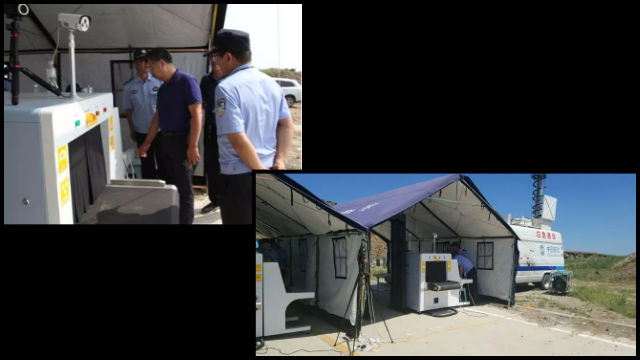
The security gates at the entrance to the Mozi Mountain pilgrimage site, installed with person recognition system
A churchgoer who participated in the pilgrimage told Bitter Winter that the government used drones to interfere with the electronic signal at the pilgrimage site. This was done to prevent pilgrims from filming or photographing their pilgrimage and transmitting the videos or images online.
Sheshan Hill
And this May, during Sheshan Hill pilgrimage in Shanghai, authorities in Fujian strictly controlled clergy and core believers within the jurisdiction, preventing underground churches from organizing group pilgrimages to Sheshan Hill.
The authorities also required believers to raise the national flag and sing the national anthem during the pilgrimage in an attempt to assimilate their religious doctrine and erode their religious faith.
Niuyu Cross Mountain belongs to Niuyu Parish of the Catholic Diocese of Weinan. It is located in the deep mountains of Gaotang town in Huazhou district of Weinan city in the northwest province of Shaanxi. After 1940, when Father P.A. Piunti was appointed as priest, he established the diocesan pilgrimage site after receiving approval from the diocese. In 1995, the government approved it as a legal religious venue.
Niuyu Cross Mountain
So each year, the days between May 1 and May 3, as well as September 14, are days considered to be “Glorious Holy Cross” holy ones, on which churchgoers go on a pilgrimage. However, unlike previous years, the pilgrims were forced to sing the national anthem and hold a flag-raising ceremony before carrying out their normal pilgrimage activities.
Video: Believers were holding a flag-raising ceremony before carrying out pilgrimage activities.

A local believer told Bitter Winter, “Unless the national flag is raised, they [the government] will forbid you from making a pilgrimage up the mountain. Starting May 1, the police have been intercepting church members on their journey. Anti-riot police have also gathered in front of the church.”
“Singing the national anthem before holding mass is an insult to us, but we have no choice. If we resist, the CCP will arrest and imprison us,” another church member told us.

Uses a pseudonym for security reasons.