How a once-marginal thesis reshaped the understanding of modernism’s spiritual roots.
by Massimo Introvigne*
*A paper presented at the 112th National Conference of the Italian Theosophical Society, “Thought-Forms as Architectures of the Soul,” Padova, May 30, 2026.
Article 4 of 4. Read article 1, article 2, and article 3.
In 1983, American art historian Linda Dalrymple Henderson published “The Fourth Dimension and Non-Euclidean Geometry in Modern Art,” a landmark study that explored how scientific and mathematical ideas about higher dimensions had influenced artists such as Duchamp, Picasso, and Kandinsky. Henderson acknowledged that Theosophical and related esoteric ideas, including those presented in “Thought-Forms,” had provided artists with a language for thinking about invisible dimensions and non-Euclidean spaces. In doing so, she implicitly validated part of Ringbom’s intuition: that modernism’s engagement with the invisible was not merely metaphorical but often grounded in specific esoteric doctrines.
A few years later, in 1986, Maurice Tuchman curated the exhibition “The Spiritual in Art: Abstract Painting 1890–1985” at the Los Angeles County Museum of Art. The exhibition and its massive catalog brought together a wide range of artists and movements under the rubric of “the spiritual,” including Theosophical, Anthroposophical, and other esoteric influences. “Thought-Forms” was repeatedly mentioned, and Ringbom was invited to contribute an essay and to lecture. For the first time, his work was placed at the center of a major institutional project. Tuchman’s exhibition was controversial—some critics accused it of mystifying modernism—but it had a lasting impact. It made it possible, in a way that had not been admitted before, to speak publicly about the spiritual and esoteric dimensions of abstract art and the influence of “Thought-Forms” without being immediately dismissed.
From that point on, the field began to shift. The study of Western esotericism emerged as a recognized academic discipline, with scholars such as Wouter Hanegraaff arguing that esoteric currents had been systematically marginalized in the construction of modern Western culture. In this new context, the idea that artists might have been influenced by Theosophy no longer seemed absurd. It became part of a broader reassessment of how “modernity” had been defined and policed. Conferences, exhibitions, and publications multiplied. The 2013 Amsterdam conference, “Enchanted Modernities: Theosophy and the Arts in the Modern World,” in Amsterdam, with its large international participation (I was one of the speakers), symbolized the new situation: what had once been a marginal, even taboo, topic had become a vibrant field of inquiry.
Within this evolving landscape, the status of “Thought-Forms” also changed. For a long time, the book had been either ignored or treated as a curiosity, occasionally mentioned in footnotes as an example of Theosophical eccentricity. When it was discussed, it was often done in an amused, condescending tone. The fact that some of its plates anticipated Kandinsky or Mondrian was noted, but usually as a kind of visual joke. The deeper implications of the book’s claims—its theory of thought as visible vibration, its quasi-scientific use of clairvoyance, its systematic mapping of inner states—were rarely taken seriously.
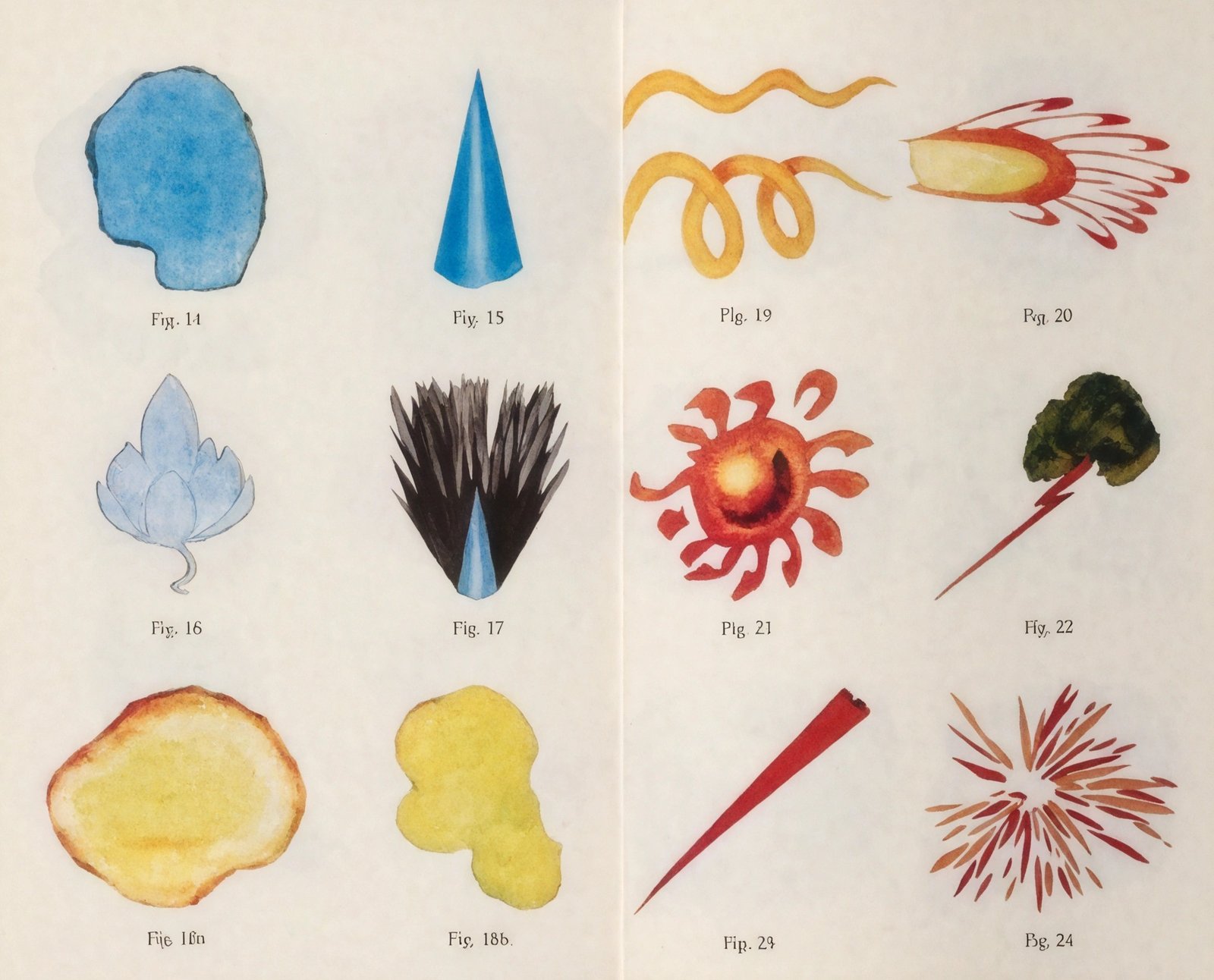
As scholars began to look more closely, however, a more nuanced picture emerged. It became clear that “Thought-Forms” had circulated widely, had been translated, excerpted, and reproduced in various contexts, and had been read or at least seen by several artists and intellectuals. It also became clear that the book’s visual language was not an isolated oddity but part of a broader Theosophical effort to develop a “science of the unseen,” in which color, form, and vibration were treated as objective indicators of spiritual states. For artists searching for a way to move beyond representation, this was not trivial. It offered a conceptual and visual framework in which non-figurative forms could be understood as meaningful rather than arbitrary.
At the same time, the danger of overstatement became apparent. Some popular accounts began to suggest that “Thought-Forms” had “invented” abstract art, or that modern painters had copied its plates. The evidence does not support this kind of claim and, in fact, risks discrediting the serious study of esotericism in art by replacing one myth with another. The reality is more complex and, in many ways, more interesting. “Thought-Forms” was one important source among many. Its influence was sometimes direct, sometimes indirect, sometimes merely atmospheric. It intersected with other currents—scientific, philosophical, artistic—that were also pushing toward abstraction.
In the case of Kandinsky, the situation remains particularly delicate. Ringbom believed that Kandinsky had read “Thought-Forms” and that the book had played a significant role in his development. As mentioned earlier, subsequent research has shown that Ringbom misdated the book, relying on a typographical error that suggested a 1901 publication rather than the actual 1905 date. This makes it unlikely that “Thought-Forms” influenced Kandinsky’s earliest steps toward abstraction. Whether he read it later remains uncertain. What is beyond doubt is that he was immersed in a Theosophical milieu in which ideas very similar to those of “Thought-Forms” were circulating: the notion of refined matter, the belief in inner vibrations, the conviction that color and form could express spiritual realities. In that sense, even if the book itself never passed through his hands, he was working within a conceptual universe that it helped to articulate.
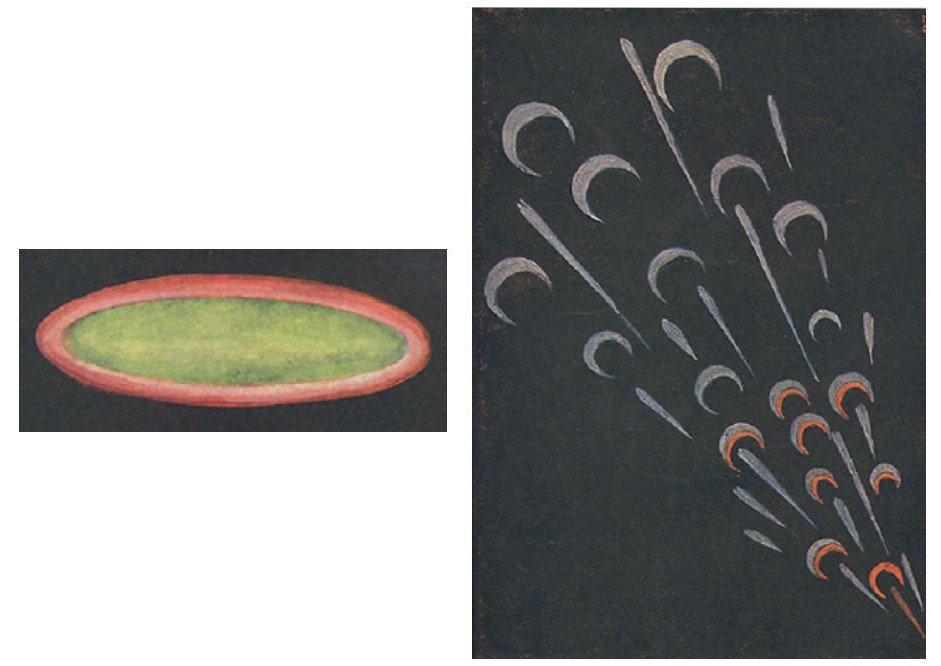
How, then, should we speak about “Thought-Forms” and modern art today? A balanced position, I would suggest, has three components. First, we should acknowledge the book’s genuine historical importance. It is one of the earliest and most systematic attempts to visualize inner states in a non-figurative way. It provided a repertoire of forms and a theory of perception that resonated with artists moving toward abstraction. It contributed to the intellectual climate in which non-representational art could be seen as spiritually serious rather than merely decorative or anarchic. Second, we should resist the temptation to treat “Thought-Forms” as a master key to explaining everything about the origins of modern abstract art. The latter did not spring from a single source. It emerged from a complex interplay of factors: Symbolism, Cubism, non-Western art, scientific theories of space and time, personal visions, and yes, esoteric doctrines and Theosophy. To isolate “Thought-Forms” as the origin of abstraction is to flatten this complexity and to ignore the agency of the artists themselves. Third, we should take the book seriously on its own terms, without either endorsing or dismissing its claims. For Theosophists, “Thought-Forms” remains a testimony to a particular way of seeing the world, one in which thoughts are not private but radiate into the subtle environment. For scholars, it is a document that reveals how early-twentieth-century seekers sought to reconcile science, spirituality, and aesthetics.
In closing, we might return for a moment to Ringbom’s letter from the Warburg Institute. When he wrote to his wife that he had “DYNAMITE in my baggage,” he was thinking of Kandinsky and the birth of abstract art. But the explosive charge he sensed was not only about one painter or one movement. It was about the possibility that the story of modern art, and perhaps of modernity itself, had been told in a way that systematically excluded certain kinds of experience, certain books, and certain kinds of knowledge. Bringing “Thought-Forms” and other esoteric documents back into the picture is not to abandon critical rigor. It is to recognize that the modern imagination was more “enchanted” than we were once willing to admit. The task now is to explore that enchantment with precision, nuance, and a sense of proportion—acknowledging the role of books like “Thought-Forms” in the birth of abstract art, while also seeing them as part of a larger, richer, and still unfolding story.

Massimo Introvigne (born June 14, 1955 in Rome) is an Italian sociologist of religions. He is the founder and managing director of the Center for Studies on New Religions (CESNUR), an international network of scholars who study new religious movements. Introvigne is the author of some 70 books and more than 100 articles in the field of sociology of religion. He was the main author of the Enciclopedia delle religioni in Italia (Encyclopedia of Religions in Italy). He is a member of the editorial board for the Interdisciplinary Journal of Research on Religion and of the executive board of University of Pennsylvania Press’ Nova Religio. From January 5 to December 31, 2011, he has served as the “Representative on combating racism, xenophobia and discrimination, with a special focus on discrimination against Christians and members of other religions” of the Organization for Security and Co-operation in Europe (OSCE). From 2012 to 2015 he served as chairperson of the Observatory of Religious Liberty, instituted by the Italian Ministry of Foreign Affairs in order to monitor problems of religious liberty on a worldwide scale.