Beijing’s new Tibet boss, Hu Changsheng, met the false Panchen Lama in a political puppet show that put fire extinguishers at center stage.
by Tashi Dhargey
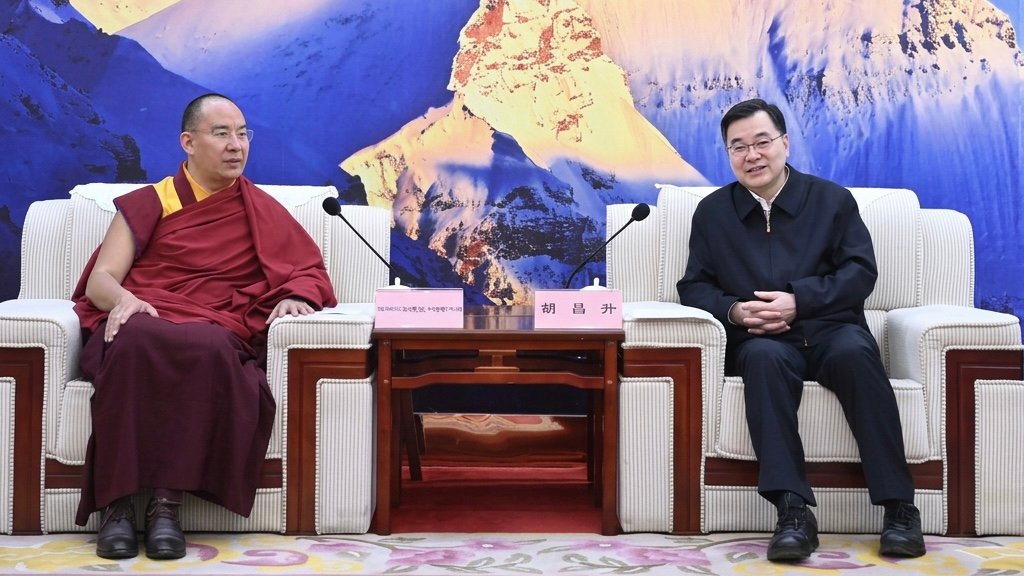
Shigatse, 26 September. The monasteries were quiet, the incense was lit, and the newly installed Party Secretary of the Tibet Autonomous Region arrived to check whether the Buddha had finally learned to quote Xi Jinping Thought verbatim.
Hu Changsheng, new to the job and eager to demonstrate zeal, toured Sakya and Tashilhunpo with the solemn air of a man inspecting fire extinguishers for signs of separatism. The monks explained centuries of scholarship; Hu explained the “Sinicization of religion,” which in practice means that even statues should ideally face Beijing.
At Tashilhunpo, Hu met the man the CCP calls the Panchen Lama—Choekyi Gyalpo—whose official biography is so polished that one almost forgets the real Panchen Lama, recognized by the Dalai Lama, vanished in 1995 and has not been seen since. The CCP‑appointed false Panchen Lama, however, is very much present, smiling dutifully and ready to praise the Party’s “care and love,” a phrase that in Tibet tends to mean surveillance, ideological training, and frequent visits from cadres with clipboards.
Hu thanked him for “maintaining harmony and stability,” a polite way of saying that his primary religious duty is to keep the monasteries politically quiet. He reminded him that Xi Jinping has received him twice—an honor that in the CCP’s cosmology elevates him somewhere between a model worker and a reliable border checkpoint. The Secretary encouraged him to continue guiding monks and lay believers to “listen to the Party, feel the Party’s kindness, and follow the Party,” a triad that would make even Mao raise an eyebrow.
The CCP‑appointed Panchen Lama responded with the expected vows: oppose separatism, strengthen patriotic education, improve doctrinal alignment with socialism, and help build a “beautiful new Tibet,” presumably one where the Buddha smiles approvingly at policy documents. He promised to “write a new chapter,” though in this arrangement the United Front Work Department supplies the chapter headings.
Hu’s broader message was that monasteries must be fire‑safe, relic‑safe, and thought‑safe. He inspected fire extinguishers one monastery after the other, perhaps thinking of the young Tibetans who set themselves on fire to protest CCP oppression, although this rarely happens in the so-called Autonomous Region.
Cultural relics should “tell stories of ethnic exchange,” Hu said, which in practice means they should not tell stories of actual history but repeat the fiction of a Tibet that was always Chinese. Monks’ living conditions should be improved, but only after their ideological reliability is confirmed. And the “four major tasks”—stability, development, ecology, and border security—remain the sacred pillars of governance, overshadowing any traditional religious concerns.
The entire event had the atmosphere of a carefully staged morality play: the Party Secretary as benevolent overseer, the CCP‑appointed false Panchen Lama as loyal spiritual functionary, and the monasteries as scenic backdrops for political messaging. The official press dutifully reported the meeting as a harmonious exchange between religion and socialism. Observers of Tibetan affairs recognized it as another episode in the long-running series. “Sinicization of Religion: Now with Extra Fire Safety.”

Uses a pseudonym for security reasons.