The lesson of the French political scientist, relevant for Taiwan, is that there can be no peace without justice, prudence, and a correct application of the law.
by Michele Olzi *
*A paper presented at the webinar “Peace, Justice, and the Tai Ji Men Case,” co-organized by CESNUR and Human Rights Without Frontiers on September 20, 2026, on the eve of the United Nations International Day of Peace

In “Peace and War: A Theory of International Relations,” Raymond Aron shows that peace cannot simply be defined as the absence of war. In his work, Aron examines different forms of peace: peace through law, equilibrium, consent, disarmament, empire, hegemony, satisfaction, and even fear. Peace is therefore a political condition shaped by history, and it can take different forms that do not always coincide with justice. This distinction is important. Aron notes that, in international relations, the absence of war may result not from a common will but from fear. States remain independent wills that confront each other, and international society thus remains in an intermediate condition in which the use of force is never completely excluded. This creates the possibility of a conflictual peace: war does not take place, but conflict remains present.
This point leads to Aron’s distinction between three forms of political morality: the morality of struggle, the morality of law, and the morality of prudence. The first has a role as long as war remains the final sanction in relations between states, but it cannot provide lasting, universal peace. The morality of law opposes struggle and aims at an order in which rules apply to everyone, regardless of personal status or power. But international society has no higher authority able to enforce the law in every case. For Aron, this is why we also need the morality of prudence, which considers concrete circumstances, power relations, actors’ will, and the possible effects of political decisions. Its aim is to find the most acceptable compromise.
Prudence is therefore not simply a form of political realism. The prudent states-persons prefer the limitation of violence to the pursuit of absolute justice, and they look for concrete and attainable goals. Peace thus becomes a problem of political settlement. It does not mean the complete elimination of conflict; it means creating conditions that prevent conflict from becoming permanent violence. This raises a further question: can authentic peace exist when a situation perceived as unjust continues? Aron’s analysis allows us to question a form of peace that only stops violence but does not resolve the institutional conditions that keep a conflict open.

The Tai Ji Men case offers an interesting example from which to address this perspective. The controversy began in 1996, when the movement and its Shifu (Grand Master), Dr. Hong Tao‑Tze, became involved in criminal and tax proceedings. Among the accusations was tax evasion. In 2007, Taiwan’s Supreme Court definitively acquitted the defendants. The tax dispute, however, continued separately. In 2018, the Supreme Administrative Court also recognized important elements concerning the nature of Tai Ji Men, rejecting its classification by the prosecutor who started the case and the National Taxation Bureau (NTB) as a cram school.
This is where the persecutory dimension denounced by Tai Ji Men dizi (disciples) and international scholars who have studied the case becomes important. According to them, the controversy is not simply a long tax dispute. They describe it as part of a wider form of institutional pressure against a spiritual minority. This interpretation must be kept separate from the strictly legal reconstruction of the case, yet it is important because it shows how the conflict is experienced by the dizi and by independent observers. It is not only about taxation; it is also about the recognition of its spiritual identity.
The nationalization of land in Miaoli regarded by the movement as sacred is particularly relevant in this context. In 2020, the land, intended for a center for spiritual cultivation and educational activities, was seized and later confiscated and nationalized after an unsuccessful auction, based on a contested tax bill. The episode gave the conflict a material and symbolic dimension, since the dispute also affected a place that the movement regarded as central to its spiritual life.
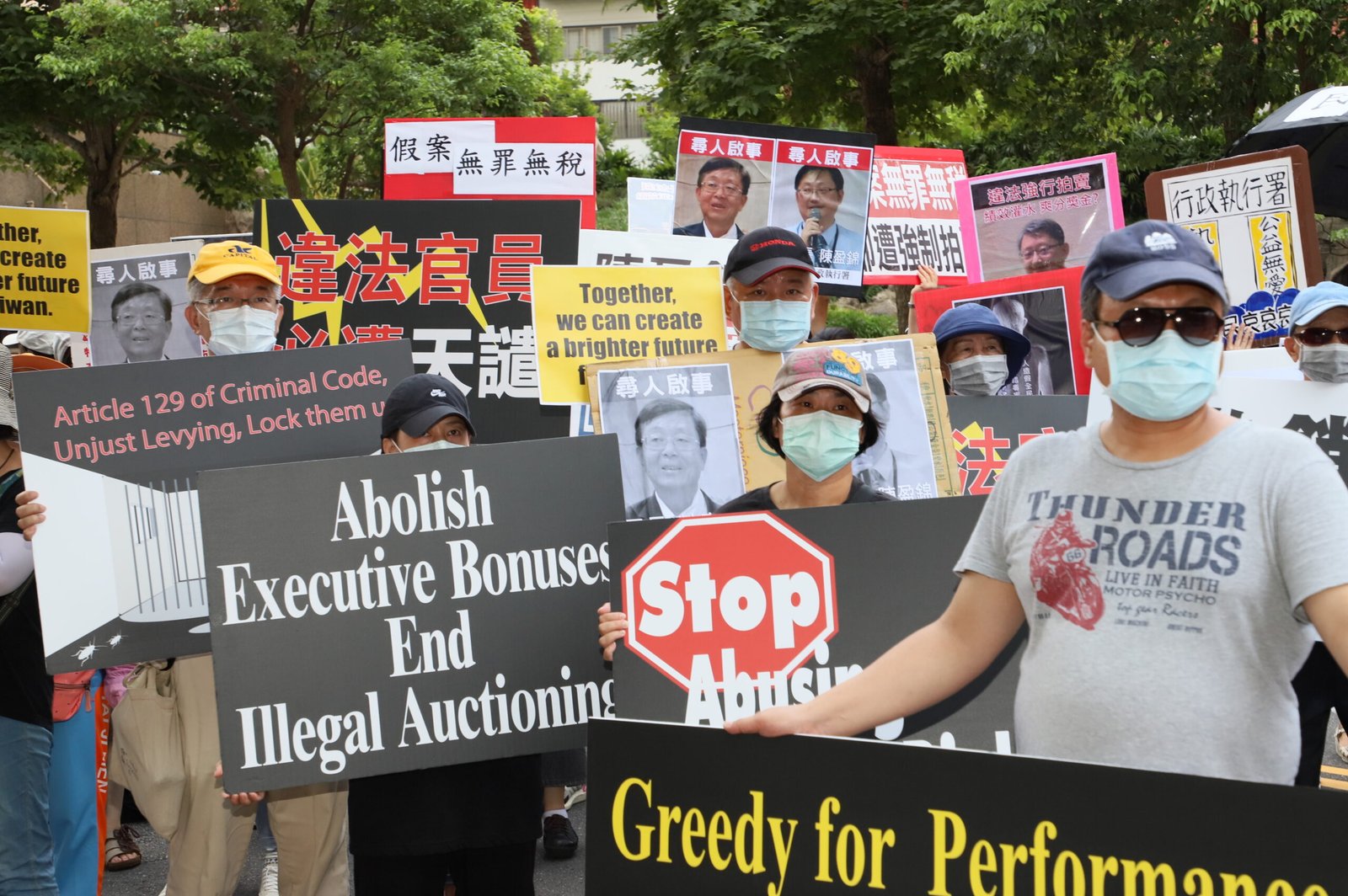
In 2019, the NTB reduced the tax assessments for 1991 and 1993–1996 to zero. It nevertheless maintained the assessment for 1992, including penalties, referring to the final status of an earlier administrative decision from 2006. According to the position maintained by the NTB, an outstanding tax liability for that year therefore still remains, despite the 2007 Supreme Court judgment. This situation shows the distance between the formal end of one part of a conflict and its effective institutional settlement.
The Tai Ji Men case therefore allows us to develop Aron’s question about peace by law. A truly legal form of peace should not simply suspend conflict; it should provide ways to rebuild a shared order. The Tai Ji Men case belongs to a context very different from the international relations studied by Aron, yet it shows the continuing value of his basic insight: peace is not only the absence of violence. It is also the construction of an order in which law, prudence, and recognition can make an effective settlement of conflict possible. Because there were no prudence, no recognition, and no correct application of the law in the Tai Ji Men case, the conflict was not settled and there were no peace and no justice. Aron’s lesson, thus, becomes a call for the urgent restoration of justice as a way to peace in Taiwan and a solution of the Tai Ji Men case.

Michele Olzi is currently teaching assistant to the chair of Political Theory and to the course of Religion and Media at the University of Insubria (Varese and Como). His interests include political theory, collective imaginaries, history of ideas, history of religions, religion & media, new religious movements, “technognosticism,” hyper-real Religions, religions and politics. He is a member of the organizing and scientific committee of the annual conference of Foro di Studi Avanzati Gaetano Massa. He edits the online journal La Rosa di Paracelso.