What happens when an American political movement mistakes an authoritarian state for an ally in its own ideological battles?
by Massimo Introvigne

While much of the public discussion focused on the symbolic act of Zohran Mamdani swearing his oath on the Quran, this act was neither unprecedented nor especially revealing. He is not a radical Muslim or, by many accounts, a particularly observant one. The more critical issue lies elsewhere. The real problem, as an in-depth “Newsweek” investigation indicates, is China. This investigation looks not at China in abstract terms but at the internal documents, meeting minutes, and travel presentations from the Democratic Socialists of America (DSA), the group described as Mamdani’s “political home” and the subject of the report titled “How Mamdani’s Democratic Socialists Sought Ties With Chinese Officials.”
The investigation relies on a collection of internal materials dating back to 2021, which includes meeting notes, chat logs, and photo slideshows. In one meeting on October 8, an activist excitedly announced that “China wants to interface with the DSA,” encouraging colleagues to create a “killer two-week itinerary” to strengthen ties with the Chinese Communist Party.
The visual material is even more telling. A slideshow from an August 2025 trip to Guizhou features photos with captions that could have come directly from the CCP’s publicity bureau. One image of a mechanical harvester in a cotton field is captioned “No slaves!!,” suggesting both defensiveness and a tourist-like naïveté. A photo of a mosque tells viewers that worshippers “come and go freely,” a phrase that sounds surreal in the context of Xinjiang. These captions reflect the enthusiasm of visitors eager to see only what their hosts want them to see.
The report connects this outlook to a planned strategy of “narrative filtering.” In June 2023, Jodie Evans of Code Pink updated the DSA on her “China Is Not Our Enemy” campaign, advising members to “stay out of the weeds” and focus on simpler topics, such as poverty reduction. The “weeds,” of course, involve issues like Xinjiang, Hong Kong, and the One China policy—all subjects that complicate a clear anti-imperialist story. Meeting notes show members agreeing to avoid these matters, with some dismissing reports of Uyghur oppression as a U.S. media “propaganda campaign.” The group also discussed building connections with pro-CCP media outlets such as the Shanghai-based China Academy and Wave Media, suggesting ideological sympathy and a desire for promotion.
Direct interaction with Chinese officials was not hypothetical. During the 2025 Guizhou trip, DSA members were hosted by the Communist Party School, with the agenda set by the provincial foreign affairs department. Officials urged the group to create “official exchanges,” a term in CCP parlance that typically signals a desire for lasting influence channels. Photos show DSA members participating in seminars on programs such as “Social Pairing,” which critics say serve as tools of surveillance and social control. The images capture DSA members with a slightly confused look, as though they stumbled into an ideological training session without fully realizing it.
Not everyone within the DSA was comfortable with this direction. One member voiced disagreement: “Saying we can’t talk about their rights until we defeat American imperialism doesn’t work for me.” The reaction was swift; the dissenting member was labeled “unkind” and pressured to apologize. The whistleblower who shared documents with “Newsweek” described a “sustained pattern of ideological alignment” that conflicted with the organization’s stated commitment to democracy and transparency. The culture depicted in the report resembles a smaller version of the dynamics the group claims to oppose: consensus achieved through moral pressure, with dissent framed as betrayal.
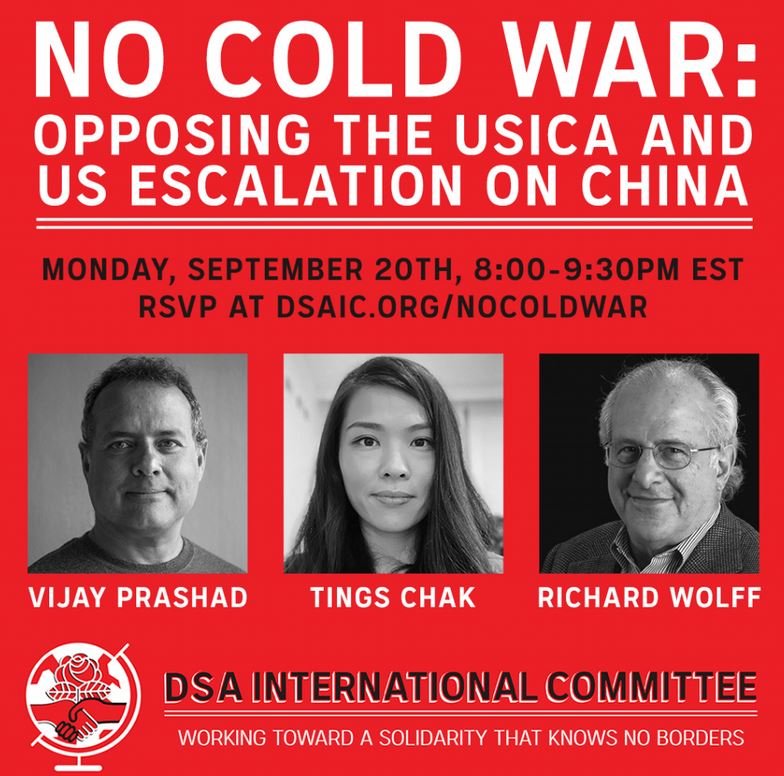
The report cautiously notes that Mamdani did not personally attend the relevant DSA meetings. The investigation does not accuse him of any wrongdoing; instead, it raises a more nuanced question about the extent of China’s influence on him and his team through their core political network and allies.
The Chinese Embassy in Washington dismissed the concerns, calling the interactions “local exchanges and cooperation” that strengthen bilateral ties. This familiar framing presents influence operations as cultural diplomacy and ideological grooming as friendship.
What the “Newsweek” report ultimately uncovers is not a traditional scandal but a pattern—a willingness among certain groups on the American left to view China not as a complex authoritarian power but as a convenient reflection of their own narratives about U.S. influence. In this reflection, uncomfortable truths fade away, replaced by slogans about development and anti-imperialism. The issue is that mirrors, unlike windows, do not show the world as it truly is; they show only the viewer.
In this case, the viewer is not just a political group but, at least indirectly, a key elected official who come to power with its backing. The oath on the Quran may have made headlines, but the more significant question is not what book Mamdani swore on. It is what stories, alliances, and blind spots shape the political movements that shaped his rise to office.
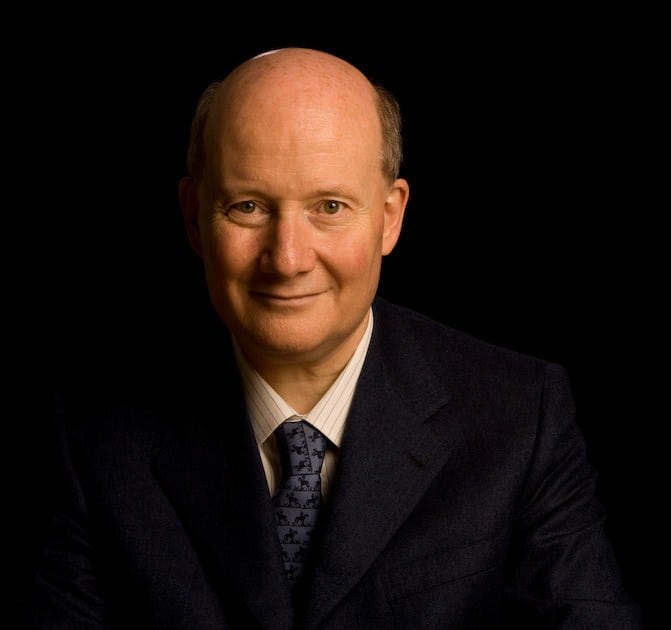
Massimo Introvigne (born June 14, 1955 in Rome) is an Italian sociologist of religions. He is the founder and managing director of the Center for Studies on New Religions (CESNUR), an international network of scholars who study new religious movements. Introvigne is the author of some 70 books and more than 100 articles in the field of sociology of religion. He was the main author of the Enciclopedia delle religioni in Italia (Encyclopedia of Religions in Italy). He is a member of the editorial board for the Interdisciplinary Journal of Research on Religion and of the executive board of University of California Press’ Nova Religio. From January 5 to December 31, 2011, he has served as the “Representative on combating racism, xenophobia and discrimination, with a special focus on discrimination against Christians and members of other religions” of the Organization for Security and Co-operation in Europe (OSCE). From 2012 to 2015 he served as chairperson of the Observatory of Religious Liberty, instituted by the Italian Ministry of Foreign Affairs in order to monitor problems of religious liberty on a worldwide scale.