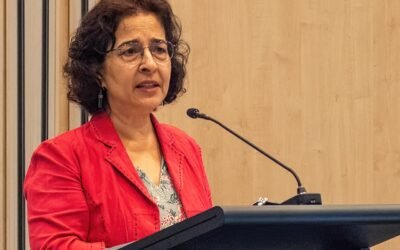
A court ordered that a child should not be exposed by his mother to the “harmful” teachings of Calvary, based on the “expert’s” testimony. The case is now before Maine’s Supreme Judicial Court.
by Massimo Introvigne

Even Calvary Chapel can be called a “cultic organization”–at least by a Maine judge, supported by a well-known anti-cult “expert.”
The case, “Bickford v. Bradeen,” involves a custody dispute. Emily Bickford, a fit parent by all accounts, was barred by a lower court from taking her 12‑year‑old daughter to Calvary Chapel in Portland, reading the Bible with her, or even allowing her to socialize with youth group friends. The judge, a former ACLU president, concluded that the child suffered “psychological harm” from exposure to Calvary Chapel’s teachings on spiritual warfare and fallen angels.
The judge relied on the testimony of Janja Lalich, a left‑wing activist long notorious for her crusades against “cults.” She avoided using the word “cult,” knowing of its dubious status in American courts, but the judge rightly summarized her testimony as indicating that Calvary Chapel is a “cultic organization.” Lalich regarded Calvary’s teachings as “evidence” that the child would be harmed by going to the church.
In Lalich’s lexicon, it appears that “harm,” particularly to children, is associated with any religious group whose theology she dislike—some may even less charitably suspect any church whose opponents are willing to hire her as an expert witness.
This is not Lalich’s first performance. She has a starring role in the controversial Victoria, Australia “Cult Inquiry”, which we recently criticized for its sweeping, prejudiced approach to minority religions. Now, in Maine, she has managed to stretch the definition of “harmful group” to encompass Calvary Chapel, a fellowship of some 1,800 churches worldwide whose theology and practices most Christians would recognize as orthodox evangelicalism.
The ruling effectively gave the divorced father veto power over all religious matters, treating mainstream Christian worship as inherently dangerous. Liberty Counsel, representing Bickford, has appealed to Maine’s Supreme Judicial Court, arguing that the decision violates both parental rights and the First Amendment.
Calvary Chapel has had its scandals. One minister was convicted of sexual abuse—a tragedy, but sadly not unique to Calvary Chapel. Such cases have occurred in Catholic, Protestant, and even secular institutions.

In reality, Calvary Chapel is a large charismatic fellowship with a theology centered on the Bible, salvation through Christ, and practices most Christians would find familiar. To call this a “harmful” group, leading a judge to assert that it is a “cultic organizations” is to drain the words of meaning.
What is striking is Lalich’s consistency—not in her definitions, but in her crusades. Whether in Victoria or Maine, she appears wherever governments or litigants need someone to brand a religious group as dangerous. Her testimony is less about careful sociological analysis and more about ideological disdain.
The result is predictable: ordinary churches are rebranded as “harmful” or “cultic” organizations, parents are stripped of their rights, and judges are encouraged to treat mainstream Christianity as a psychological hazard.
If Maine’s ruling stands, it sets a precedent that any judge, armed with a “cult expert,” can forbid a parent from raising a child in their faith. It is a dangerous conflation of secular prejudice with judicial authority.
Lalich’s testimony is just the latest example of how prejudice, dressed up as expertise, can erode fundamental freedoms.
Calvary Chapel is not perfect. No church is. But to pretend going there “harms children” who are exposed to a “cultic organization” is not analysis—it is ideology. And if courts continue to indulge such testimony, the next parent forbidden to read the Bible with their child may not be in Maine, but anywhere in America.
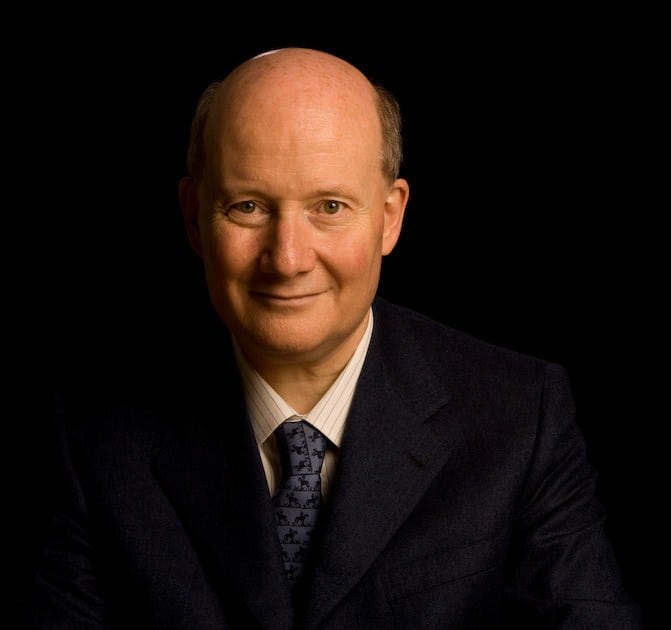
Massimo Introvigne (born June 14, 1955 in Rome) is an Italian sociologist of religions. He is the founder and managing director of the Center for Studies on New Religions (CESNUR), an international network of scholars who study new religious movements. Introvigne is the author of some 70 books and more than 100 articles in the field of sociology of religion. He was the main author of the Enciclopedia delle religioni in Italia (Encyclopedia of Religions in Italy). He is a member of the editorial board for the Interdisciplinary Journal of Research on Religion and of the executive board of University of California Press’ Nova Religio. From January 5 to December 31, 2011, he has served as the “Representative on combating racism, xenophobia and discrimination, with a special focus on discrimination against Christians and members of other religions” of the Organization for Security and Co-operation in Europe (OSCE). From 2012 to 2015 he served as chairperson of the Observatory of Religious Liberty, instituted by the Italian Ministry of Foreign Affairs in order to monitor problems of religious liberty on a worldwide scale.