An exclusive investigation into a secretive group that tries to control the labor protests of the Jasic Workers Solidarity Group and attacks the CCP from the left.
by Xiao Ziqi
Article 1 of 3.
When people discuss the United Front policy, they often think of the political strategy the Communist Party has used since Lenin’s time: uniting secondary enemies or non-Communist political allies to confront the primary enemy.
The Left Socialist-Revolutionary Party around the time of the Russian October Revolution; the social democrats and Trotskyists during the Spanish Civil War; the Christian Democratic Union and the Free Democratic Party in East Germany after World War II; the eight “participating political parties”—including the China Democratic League—around the time of the CCP’s establishment of the PRC in 1949; and the Korean Democratic Party, which enjoyed relative independence during the early years of Kim Il-sung’s rule in North Korea—all are typical examples of the Communist Party’s “United Front targets” or temporary allies. All benefited at one time from the Communist Party’s United Front policy and were treated as honored guests. Still, without exception, the Party ultimately betrayed and suppressed them once it achieved its stage-specific goals. They either completely lost their independence and became satellite parties or were labeled as class enemies and subjected to political purges.
This left a bloody and painful lesson for those political forces that sympathize with the Communist Party ideologically but hold differing political views. In the 21st century, the Chinese Communist Party (CCP)—now firmly in power—has shifted its United Front policy to a model of co-opting and monitoring intellectuals, entrepreneurs, and religious believers domestically, while simultaneously engaging in political infiltration of democratic nations and exporting cross-border repression. This shift has drawn significant attention and sparked extensive discussion among political scholars and human rights activists.
However, the above is not the main focus of this article. Imagine a secret organization—one that subscribes to the ideals of fundamentalist Communism but believes the state-capitalist model adopted by the currently ruling CCP betrays those ideals—drawing lessons from the United Front policies Communist parties have used throughout history to seize power. Suppose this organization used a united front to unite with liberals and other factions of fundamentalist Communists whose views differ greatly from its own, to instigate a “socialist revolution” against the ruling CCP. What kind of unexpected “chemical reaction” would that produce in a country under Communist rule? According to information recently obtained by “Bitter Winter,” this is precisely what the “Maoist Communist Party of China” (中国毛泽东主义共产党) did during the 2018 Jasic workers’ movement.
The “Jasic factory incidents” refer to a labor dispute that erupted in mid-2018 at Jasic Technology, a welding-equipment manufacturer in Shenzhen, where workers attempted to form an independent trade union in response to low wages, excessive fines, and abusive management practices. When employees submitted a formal application to establish a union under China’s official trade-union framework, local authorities rejected it, and the company retaliated by dismissing and beating several organizers.
The ensuing arrests triggered an unusually broad wave of solidarity from left-wing students, labor activists, and self-identified Maoists across China, who traveled to Shenzhen to support the workers and demand their release. This constellation of supporters became known as the Jasic Workers’ Solidarity Group (佳士工人声援团)—a loose network of labor-rights advocates and student Marxist societies that framed the struggle as emblematic of systemic exploitation under China’s state-capitalist model. Although the movement was swiftly suppressed through police raids, detentions, and forced confessions, it marked one of the most visible attempts in recent years to link labor activism with ideological dissent. It provided the organizational environment in which various underground Maoist groups—including the Maoist Communist Party of China—interacted with student activists and attempted to shape the direction of the protests.
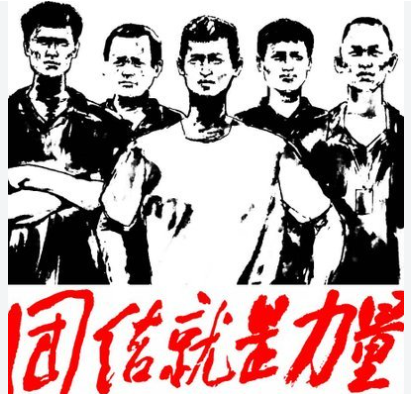
“Bitter Winter” has now documented an unknown part of the story: how both clandestinely in China and semi-openly in the Chinese diaspora abroad the Jasic Workers’ Solidarity Group continues to exist, and the Maoist Communist Party of China struggles to control it, discussing internally and oscillating between a “fundamentalist” Marxist approach and a “United Front” strategy aimed at co-opting “bourgeois” protesters.
The story began on August 24 of this year—the eighth anniversary of the CCP police’s suppression of the Jasic Workers’ Solidarity Group —when those controlling the group’s website reacted with indignation to a request for comment from a liberal media outlet. On August 24 this year, the Jasic Workers’ Solidarity Group website—which had not published any content for three years—suddenly released a “debunking” statement.
The statement claimed the group had received a request for comment from the liberal Chinese-language media outlet “Xuexi China” (学习墙国) about an article on the Jasic Workers’ Solidarity Group’s shift in political line and the organization’s historical origins. In a highly indignant tone, it labeled “Xuexi China” as a reactionary “right-wing media outlet,” asserting that the entire article consisted of “rumors” with ulterior motives targeting the Maoist Communist Party of China and the Jasic Workers’ Solidarity Group. Subsequently, “Xuexi China” also published a statement on its Telegram channel asserting that its team members’ political stances span a broad spectrum from left to right and that it is not the “right-wing media” portrayed by the Chinese Maoist Communist Party.
They also said the article resulted from their citizen journalist network interviewing participants and eyewitnesses of the movement and cross-referencing their accounts with publicly available information. Sending a request for comment to the Jasic Workers’ Solidarity Group’s email address was in accordance with basic journalistic principles. It was not intended to fabricate fake news to attack the Maoist Communist Party of China. At the same time, “Xuexi China” said it ultimately did not publish the article because it contained a large amount of previously undisclosed information about Maoist-leftist organizations involved in the protests. Disclosing this information could have caused trouble for those who participated in the protests at the time, and the Maoist-leftist online publication “The Leninist Path” also opposed its publication for similar reasons.
Subsequently, the Jasic Workers’ Solidarity Group website published the content of the comment request email previously sent to them by “Xuexi China” on the page for the so-called “debunking statement,” adding a watermark that read, “For the debunking, please see the official website of the Jasic Workers’ Solidarity Group,” seemingly as a show of defiance toward “Xuexi China.”

Uses a pseudonym for security reasons.