New data from the Centre for Social Justice count 84 cases in ten months of 2026, with Christians now the main target and Lahore the worst district.
by A. Sahara Alexander
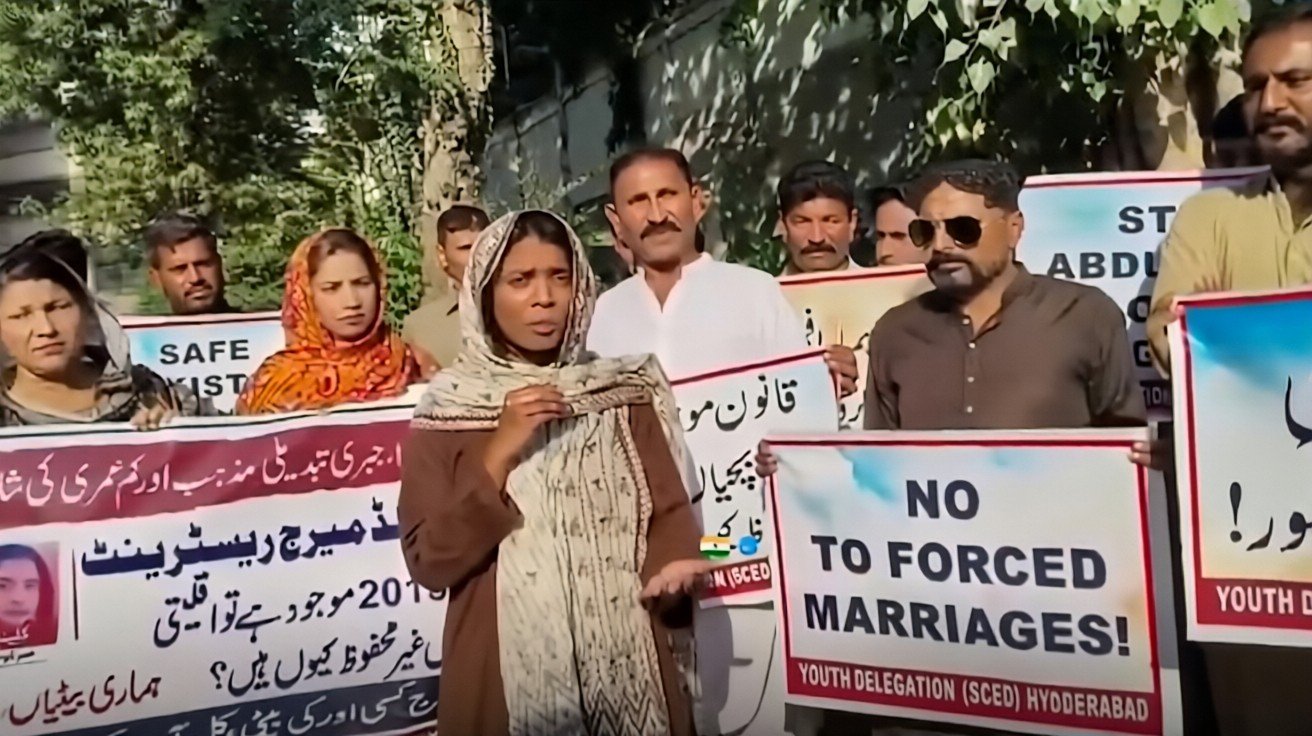
“Bitter Winter” has reported for years on the Christian and Hindu girls who are abducted in Pakistan, converted to Islam, and married to their captors. New figures show that the phenomenon continues and that its geography is changing. On November 3, the Centre for Social Justice (CSJ), a Lahore-based organization that has monitored violations against religious minorities since 2014, issued an update titled “The Persisting Issue of Forced Conversions of Christian and Hindu Girls.” Its findings were summarized by the Pakistani outlet Voicepk and by Christian Daily International–Morning Star News.
Between January and October 2026, the CSJ documented at least 84 cases of abduction and forced conversion of girls and women from religious minorities. The victims were 49 Christians and 35 Hindus. Punjab accounted for 47 cases, Sindh for 36, and Balochistan for one. Religion follows geography almost perfectly: 46 of the 47 victims in Punjab were Christian, and 33 of the 36 in Sindh were Hindu.
The ages are the most disturbing part of the update. Thirty-seven victims, or 44 percent, were between 14 and 17 years old. Six were younger than 14. At least 43 of the 84, more than half, were thus minors under the United Nations Convention on the Rights of the Child, which Pakistan ratified in 1990. Thirty-one were adults. The age of the remaining ten could not be established, and the real share of children may be higher.
These numbers should be read against the five-year series the CSJ had already published. From 2021 to 2025, the organization counted 515 cases: 78 in 2021, 124 in 2022, 136 in 2023, 83 in 2024, and 94 in 2025. With 84 cases in ten months, the current year runs at more than eight per month. Should the pace hold in November and December, 2026 would close at around one hundred, above last year’s total. The decline observed in 2024 now looks like a pause.
The map has changed even more than the totals. In 2021–2025, Sindh accounted for 363 cases, or 70 percent, and Punjab for 146, or 28 percent, with four in Balochistan and two in Khyber Pakhtunkhwa. In ten months of 2026, Punjab alone has produced 47 cases, about a third of what it had registered in five full years. Lahore, the provincial capital, leads all districts with 18, almost half of the 39 it recorded in the whole previous period. Faisalabad follows in Punjab with six. In Sindh, Sanghar has seven cases, Tando Allahyar five, and Hyderabad and Mirpur Khas four each.
The religious composition has turned around as well. According to CSW, which relies on CSJ data, last year’s 94 victims included 71 Hindus and 23 Christians. The Christian girls and women abducted in the first ten months of 2026 are already more than twice as many as in all of 2025.
Caution is in order. The CSJ itself notes that its figures cover only cases that were reported and verified, and may be updated. A lower count in Sindh may mean fewer abductions. It may also mean that poor Hindu families, many of them from the lowest castes, have stopped expecting anything from the police and the courts and no longer report. What cannot be disputed is that the increase in Punjab comes in a year in which the country’s new constitutional court sent a discouraging signal to Christian parents.
The CSJ update mentions the case of Maria Shahbaz, a Christian girl from Lahore. According to her family and the documents it produced in court, she was 13 in July 2025, the month she was abducted, converted, and married to a 30-year-old Muslim man. Earlier this year, the Federal Constitutional Court upheld the marriage. As “Bitter Winter” commented in April, the judges declared a child an adult and a minor a wife. In July, a two-judge bench of the same court admitted a review petition filed by Maria’s father, and a larger bench has since started hearing it. The CSJ fears that the proceedings will take a long time. Every month that passes is a month a teenager spends with the man her parents call her kidnapper, and a month in which others may conclude that a marriage certificate is enough to end a criminal investigation.
A second case concerns Rita, a 21-year-old Hindu woman from Sanghar District, who was allegedly lured into a relationship and persuaded to convert by a man from Gujranwala, in Punjab. In August, a judicial magistrate rejected a police request to move her to a shelter and ordered that she be returned to her family. The CSJ observes that the same man had previously converted and married a Christian woman, a detail suggesting that some of these “love stories” are organized exploitation.
The update also raises the alarm about two Hindu girls, 14-year-old Bindiya Kumari from Sibi, in Balochistan, and Kalpana Meghwar from Umerkot, in Sindh, who is 13 according to her school records. Both were reportedly converted at the Bharchundi Sharif shrine in Sindh’s Ghotki District, with the involvement of Pir Abdul Haq, known as Mian Mithu, a cleric and politician whose name has surfaced in such stories for more than a decade. He has always denied that the conversions he presides over are forced. The Bindiya Kumari case remains at the center of a legal and political battle. The CSJ expresses concern about the whereabouts of the two girls, their families’ access to them, and their legal status.
On the response of the institutions, the CSJ is severe. Police and courts are described as generally slow. The National Commission for Human Rights, the National Commission on the Rights of the Child, and the National Commission on the Status of Women have repeatedly raised the problem with the government, yet preventive and protective measures have been delayed.
The CSJ asks Parliament to take up a draft bill regulating religious conversions, which the National Commission on the Rights of the Child submitted to the Ministry of Human Rights in October after consulting the CSJ itself. It also calls for administrative action to identify and arrest those who exploit minority girls, and for a public awareness campaign.
Pakistan has been here before. In 2016, the Sindh Assembly passed a bill against forced conversions, which never became law after religious parties took to the streets. In 2021, a federal bill was rejected by a parliamentary committee following objections by the Ministry of Religious Affairs. The new draft has one advantage over its predecessors. It comes from a statutory body of the Pakistani state, which makes it more difficult to dismiss as a project inspired by foreign critics of Islam. Whether this will be enough to overcome the opposition of clerics for whom every conversion to Islam is by definition free and meritorious remains to be seen.
Earlier this month, I reported on how the situation of Pakistan’s Hindus had reached the British Parliament. International attention matters, and Islamabad is sensitive to it. Yet the CSJ’s tables tell us that statements of concern issued abroad have not reduced the number of girls who disappear on their way to school or to work and reappear weeks later with a new name, a new religion, and a husband. Eighty-four of them in ten months are those whose families found the courage to go to the police and whose stories could be verified. Nobody knows how many others there are.

Uses a pseudonym for security reasons.