August days of prayer and testimony—and the fragile dignity of a ninety‑five‑year‑old man.
by Massimo Introvigne
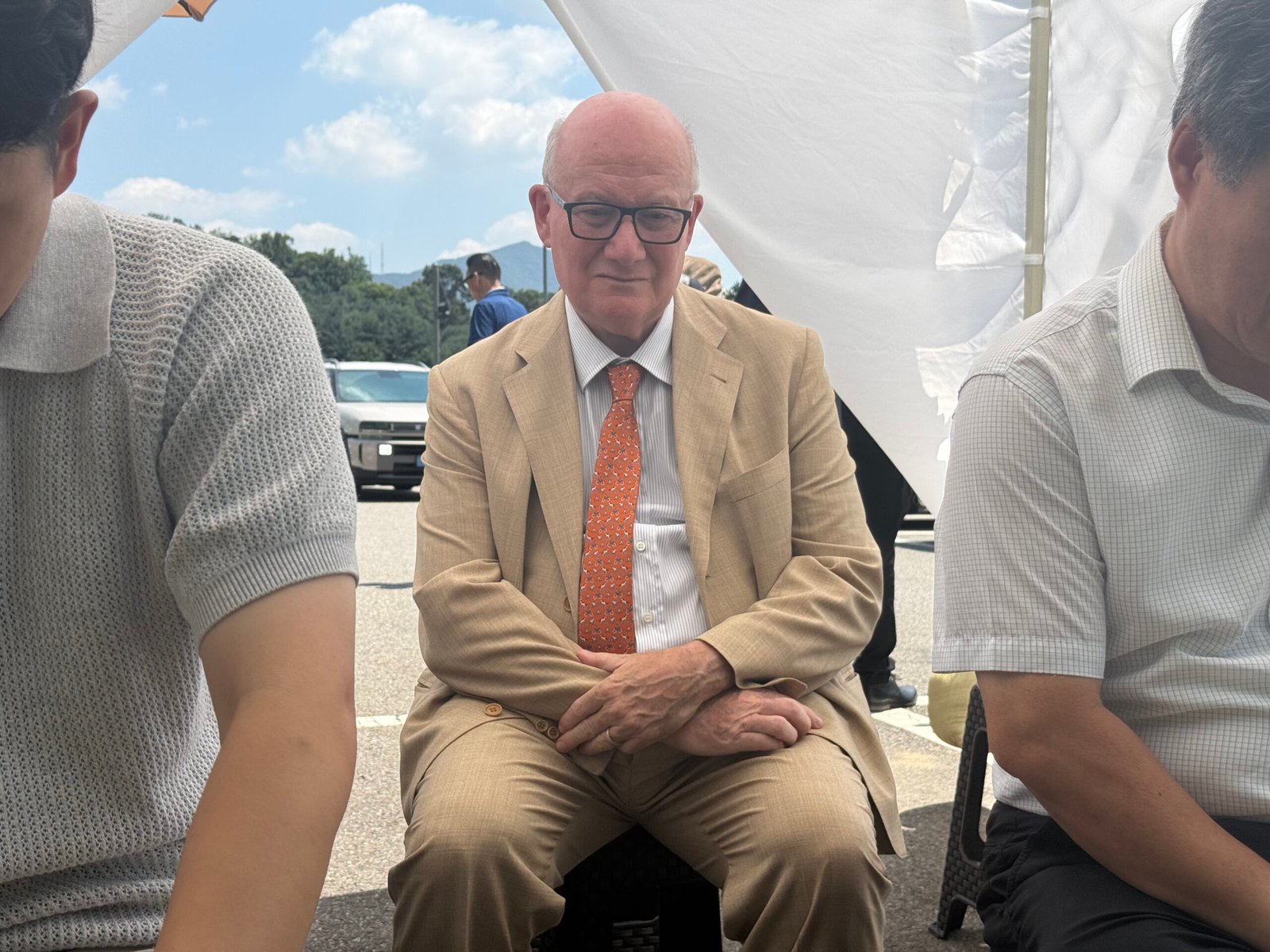
The road to the Seoul Detention Center has a peculiar stillness in a Korean summer afternoon. It is a place where time seems to slow down, as if the air itself were aware of the stories carried within those walls. On August 6, accompanied by Hans Noot of Human Rights Without Frontiers and Thierry Valle of CAP‑LC, I walked once more along that familiar path. I had been there before, during the long ordeal of the Unification Church’s Mother Han, who now spends her days in a hospital bed. The building, with its severe geometry and muted colors, has become a reluctant witness to the suffering of elderly religious leaders.
Before entering, we stopped where the members of Shincheonji maintain their vigil for their detained leader, Chairman Lee Man-hee. They stand in quiet shifts, day after day, under the changing sky of Seoul. There is no spectacle in their presence. No slogans, no banners, no raised voices. Only prayer. A soft murmur of devotion that seems to rise from the road itself. Some utter prayers; others close their eyes, as if listening to something only they can hear. Their perseverance has the quality of a ritual, a rhythm of faith that does not falter. Sharing a moment of prayer with them felt like stepping into a stream of collective hope. Not to be moved by the gentleness of their determination was impossible.
Inside the detention center, the atmosphere changed. The silence itself was heavy. When Chairman Lee entered one of the small rooms reserved for meetings, the contrast between his age and the setting was almost unbearable—ninety-five years of life, distilled into the fragile figure of a man wearing a prison uniform. Yet the shock lasted only a moment. His posture was upright, his gaze clear, his voice steady. There was an unexpected vitality in him, a kind of inner radiance that seemed untouched by confinement.
A guard sat nearby, transcribing every word he spoke. We were forbidden from recording or taking notes, and warned that quoting him would be illegal. But he did not speak in anecdotes or commentary. He spoke through Scripture. Each sentence was a passage from the Bible, recalled with precision and offered with the calm assurance of someone who has lived his faith for decades. The guard, dutifully writing, was receiving a lesson in biblical exegesis he had not asked for. Chairman Lee’s strength did not appear to come from physical resilience alone. It came from a spiritual reservoir that imprisonment could not drain.
The following day, August 7, we awakened to a different kind of gathering. Human Rights Without Frontiers held a press conference in Seoul, attended by over a hundred journalists, both in person and online. The room was filled with the quiet tension that precedes important discussions. Reporters from major international media listened as speakers described the concerns surrounding Chairman Lee’s detention. The coverage in Korea and beyond reflected the gravity of the moment: the case was no longer seen as a local matter, but as a question touching the universal principles of human dignity, freedom of belief, and the treatment of older defendants.
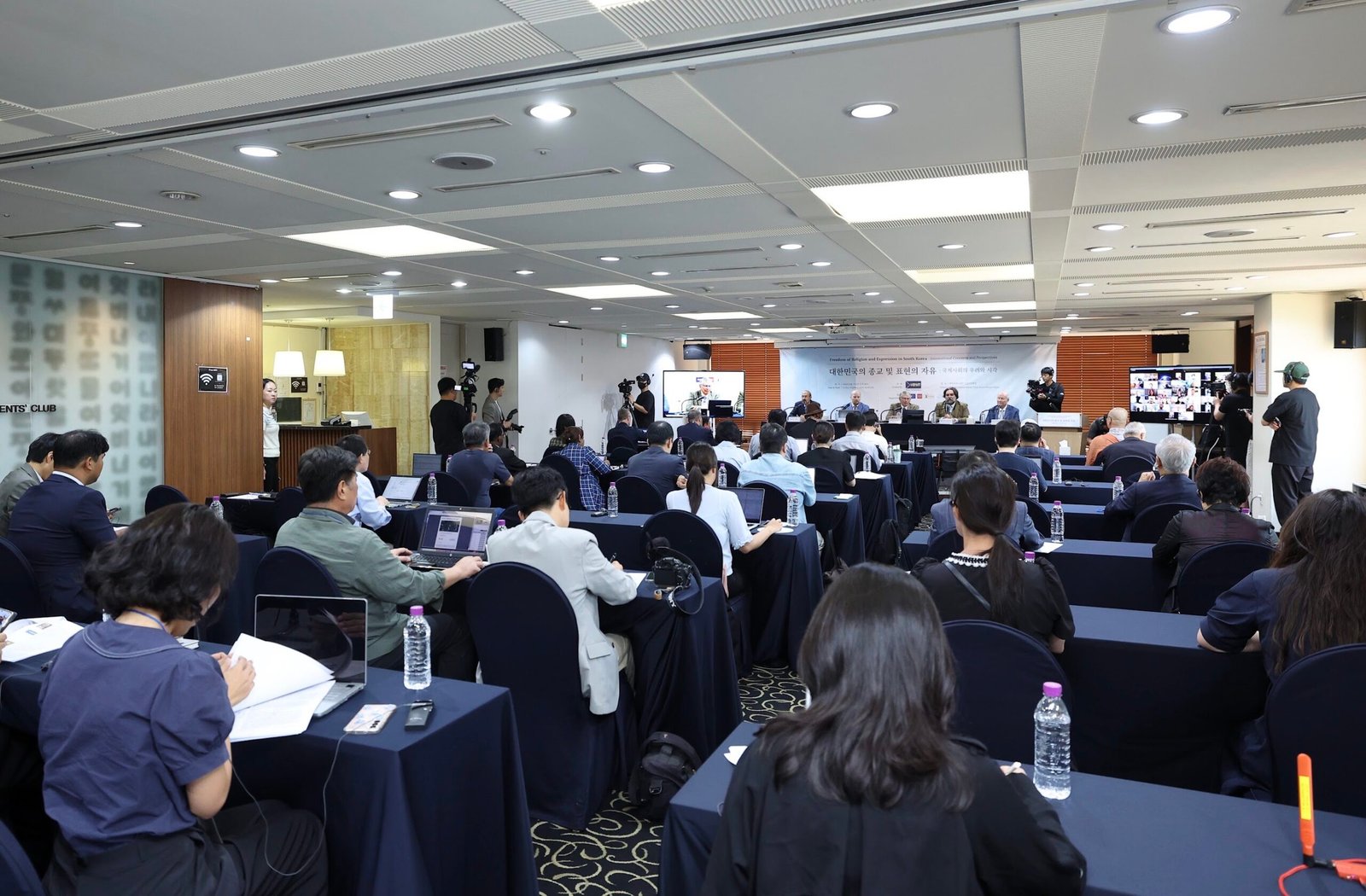
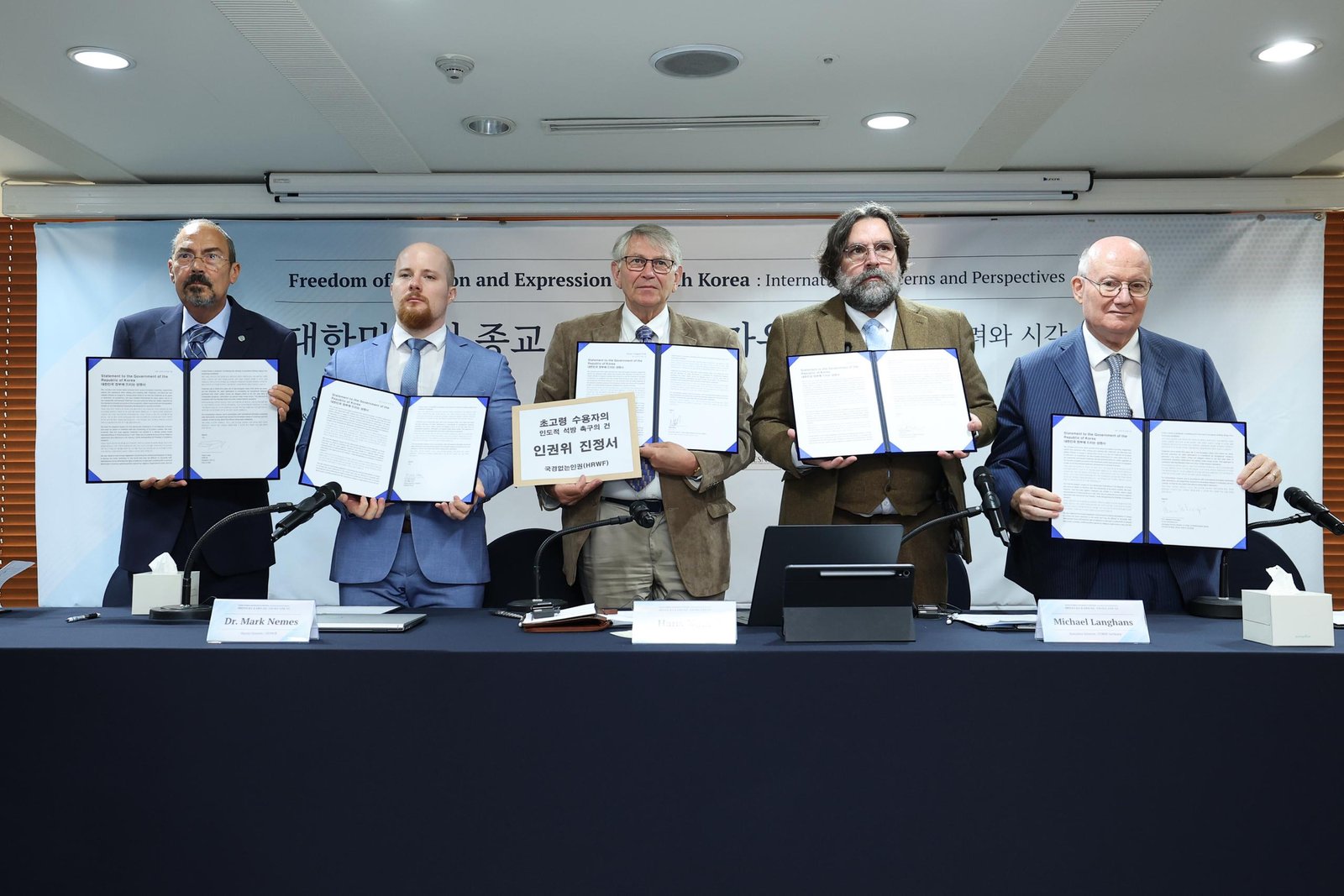
Hans Noot, Hungarian scholar Márk Nemes, German lawyer Michael Langhans, representing the Forum for Religious Freedom Europe (FOREF), and I presented reasons for concern about religious freedom in Korea. They include media dominated by distorted anti-cult narratives, a draft for a law allowing for swift dissolution of religions pending in the Parliament, the selective application of laws against polical activism of the clergy, which has led to the imprisonment of Mother Han, 83, and Chairman Lee, 95, and the violence of deprogramming, or forced conversion, of believers, which in some cases led to the assassination of Shincheonji members.
The arrest and prosecution for alleged violations of the Electoral Law of Busan’s Pastor Son Hyun-Bo—now liberated while the harassment of his Segero Church continues—confirms that the crackdown is politically motivated. I also mentioned the influence of China, which has quietly worked to encourage persecution of conservative groups it has its own reason to dislike, establishing what is now a regular cooperations with Korean organizations opposing “heresies.” Left-wing Japanese lawyers, who promoted the dissolution of the Unification Church in their country, are also part of this trilateral cooperation with Chinese anti-religious bureaucrats and Korean heresy hunters.
During the conference, Thierry Valle presented the written statement CAP‑LC had submitted to the United Nations Human Rights Council a few days before. His summary echoed the solemnity of the original text. The statement expressed concern that a man of ninety‑five, accused of non‑violent acts related to political participation by members of his religious community, was being held in custody despite international standards urging restraint in such circumstances. It recalled that political engagement is a right enjoyed by all citizens, and that the separation of religion and state protects institutions, not individuals’ civic freedoms.
Download CAP-LC’s written statement in PDF
The statement noted that public remarks by the Minister of Justice, describing punishment as inevitable and referring to Chairman Lee as a false prophet, risked eroding the presumption of innocence. It also warned against inaccurate references to foreign cases, particularly concerning Japan, where political ties were not part of the judicial decision dissolving the Unification Church that has been repeatedly cited in Korea. CAP‑LC urged the government to review the necessity of continued detention, ensure impartial proceedings, and base any measures affecting religious organizations on accurate information consistent with international human rights standards.
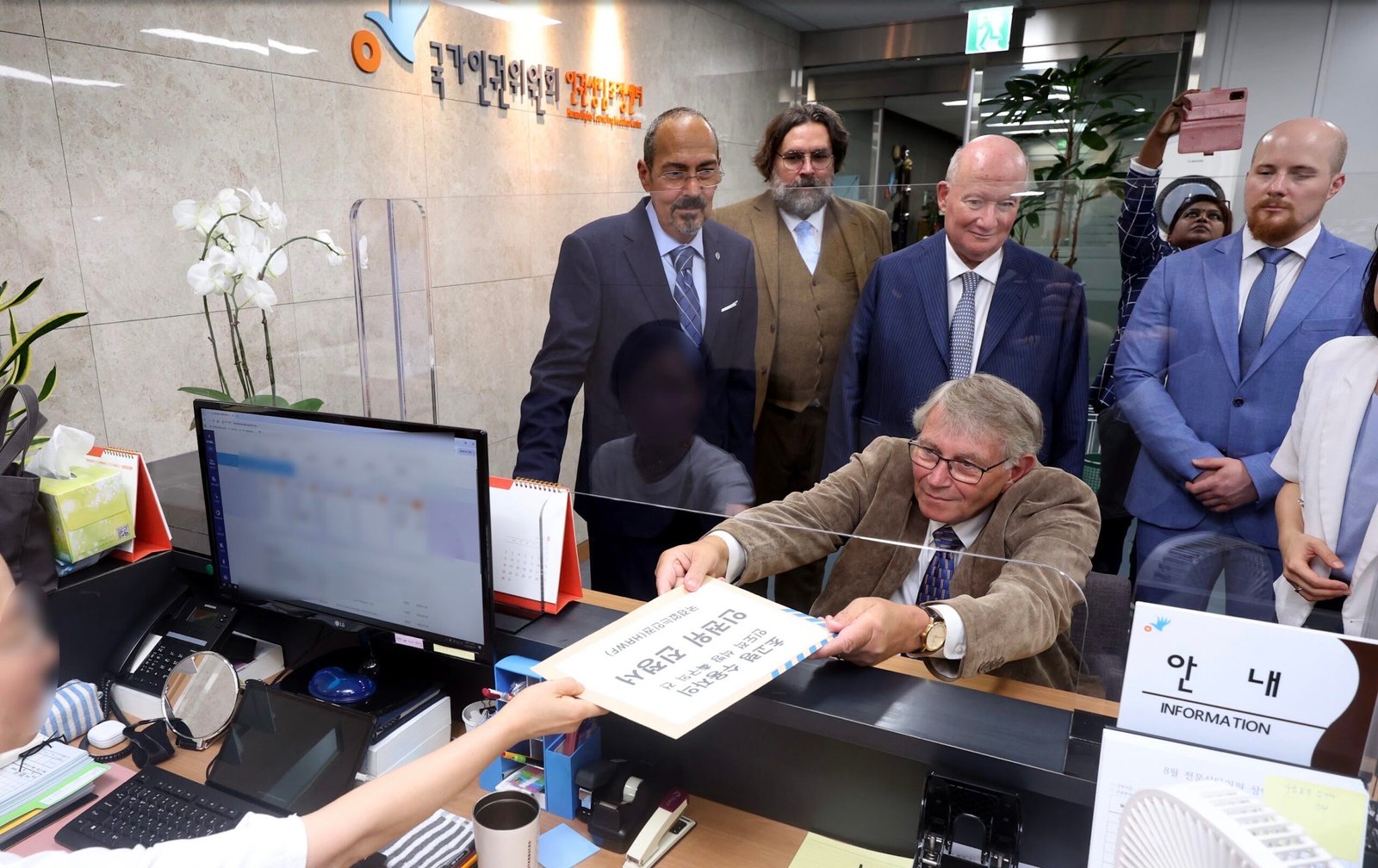
Supported by the testimonies of Korean personalities, all the speakers signed an appeal asking the Korean authorities to release Chairman Lee from custody, so that he may stand trial without being held in detention. We delivered it in person to the Korean Human Rights Commission.
When one leaves the detention center, the world outside feels strangely loud. Cars rush by, conversations spill into the streets, and the city resumes its restless rhythm. Yet the image of Chairman Lee remains. A ninety‑five‑year‑old man, seated with dignity, speaking only through the Bible, holding onto his faith as if it were a lifeline. His presence lingers like a question that refuses to fade.
South Korea has earned admiration for its democratic institutions in a part of the world plagued by totalitarian regimes. Those values shine brightest when applied to the most vulnerable. Chairman Lee’s case is not only a legal matter. It is a human one. His continued detention raises concerns that touch the core of compassion and justice.
For reasons grounded in substance and reasons grounded in humanity, which also apply to Mother Han, Chairman Lee should be released. The dignity of an older man, and of a nation that values freedom, both call for his return to the world outside those walls.
These cases touch the pulse of religious liberty in Korea, a freedom that has flourished through hardship yet still bends under the weight of suspicion toward minority faiths. The prayers whispered outside the Seoul Detention Center are more than solidarity for elderly leaders. They are a reminder that conscience is fragile, and that the dignity of belief must be guarded every day.
Korea’s democracy has grown strong because it learned to protect the voices that stand apart. Its future will remain strong only if those voices continue to breathe without fear. If a community is treated as an outsider to civic life, the promise of freedom becomes thinner for everyone. The measure of a nation is taken at the margins, where groups seek only the right to exist without being misunderstood.
Cases like Chairman Lee’s and Mother Han’s are crossroads. Their release would honor their age and humanity, yet they would also affirm something deeper: that Korea chooses to stand with the principle that faith, in all its diversity, deserves space to live. Religious liberty is not an ornament of democracy. It is its heartbeat. And the world hopes to see that heartbeat remain steady and strong in Korea.

Massimo Introvigne (born June 14, 1955 in Rome) is an Italian sociologist of religions. He is the founder and managing director of the Center for Studies on New Religions (CESNUR), an international network of scholars who study new religious movements. Introvigne is the author of some 70 books and more than 100 articles in the field of sociology of religion. He was the main author of the Enciclopedia delle religioni in Italia (Encyclopedia of Religions in Italy). He is a member of the editorial board for the Interdisciplinary Journal of Research on Religion and of the executive board of University of Pennsylvania Press’ Nova Religio. From January 5 to December 31, 2011, he has served as the “Representative on combating racism, xenophobia and discrimination, with a special focus on discrimination against Christians and members of other religions” of the Organization for Security and Co-operation in Europe (OSCE). From 2012 to 2015 he served as chairperson of the Observatory of Religious Liberty, instituted by the Italian Ministry of Foreign Affairs in order to monitor problems of religious liberty on a worldwide scale.