Artists associated with eroticism, particularly with the esoteric erotic traditions, faced discrimination, censorship, and reputational destruction.
Rosita Šorytė*
*A paper presented at the 6th CEENASWE (The Central and Eastern European Network for the Academic Study of Western Esotericism) Conference, “Transcription of Visuality: From the Tradition of Esotericism to Traditional and Contemporary Artistic Practices,” University of Rijeka, Croatia, June 5, 2026.
Sacred eroticism occupies a paradoxical position in the modern imagination. It is both ancient and marginal, deeply rooted in esoteric traditions yet persistently misunderstood. When erotic symbolism, ritualized sensuality, or embodied spirituality appear in an artistic or spiritual context, they often provoke not reflection but alarm. The combination of the sacred and the erotic triggers a reflex of suspicion. The erotic is assumed to be corrupting, the sacred is assumed to be fragile, and the union of the two is assumed to be dangerous. The result is a recurring pattern of demonization—sometimes metaphorical, sometimes literal—directed at artists and practitioners whose work draws on esoteric forms of embodied spirituality.
This paper explores how sacred eroticism becomes a target of contemporary moral panics, how esoteric art is misread through the lens of “Satanism,” and how artists associated with esoteric erotic traditions face discrimination, censorship, and reputational destruction.
I begin with a recent example from the United States, then turn to two case studies—Rosaleen Norton and Guru Jara (now YahRA)—before concluding with a broader reflection on the art world’s long discomfort with esotericism, even in its non-erotic forms.
1. Contemporary Moral Panics: When Esoteric Eroticism Becomes “Satanism”
The 2016 U.S. presidential election provides a revealing entry point into the contemporary demonization of sacred eroticism. During the campaign, supporters of Donald Trump circulated claims that Hillary Clinton’s campaign chairman, John Podesta, had participated in “Satanic rituals.” These allegations were based on leaked emails referring to a performance art event hosted by Marina Abramović. Abramović’s work, which often incorporates symbolic gestures, ritualized actions, and references to Western esoteric traditions, was instantly reframed by conspiracy theorists as evidence of occult malevolence. In fact, Abramović has connections to Spiritualism, New Age theories, and sacred eroticism, but not to Satanism.
Yet, the logic was simplistic but powerful: “esoteric symbolism + erotic or embodied ritual = Satanism.”

This equation has become a staple of contemporary conspiracy culture. It collapses all forms of esoteric practice—whether artistic, spiritual, or performative—into a single category of presumed evil. It also reveals a deeper anxiety: the fear that eroticized spirituality destabilizes conventional boundaries between body and soul, purity and transgression, religion and art.
The Abramović episode exemplifies a broader dynamic in which sacred eroticism is treated as inherently suspect. Contemporary groups that teach forms of sacred eroticism are routinely dismissed as “dangerous cults.” Their artistic productions are judged not on aesthetic merit but on their association with taboo forms of spirituality. The erotic becomes a pretext for moral condemnation; the esoteric becomes a pretext for demonization.
This dynamic is not new. It echoes earlier waves of moral panic in which esoteric practices were conflated with deviance, immorality, or criminality. What is new is the speed with which such accusations now circulate, amplified by social media ecosystems that reward outrage and sensationalism. In this environment, sacred eroticism becomes a perfect target: visually striking, symbolically rich, and easily misrepresented.
To understand how this dynamic operates, it is useful to examine historical and contemporary cases in which artists working within esoteric erotic traditions have been targeted by campaigns of legal repression, media sensationalism, and cultural exclusion.
2. Case Study One: Rosaleen Norton and the Invention of the “Witch of Kings Cross”
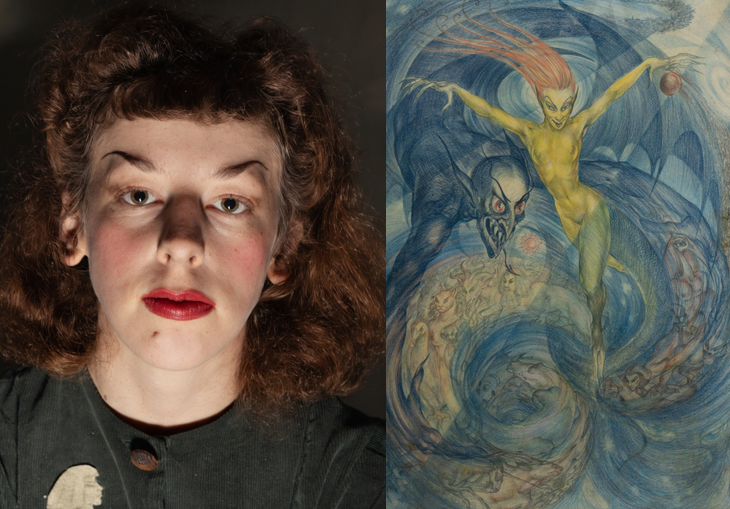
Few figures illustrate the demonization of sacred eroticism more vividly than Rosaleen Norton (1917–1979), the Australian artist whose work combined visionary imagery, pagan symbolism, and erotic esotericism. Norton’s life and art were shaped by a profound engagement with the occult, particularly with the figure of the God Pan and with strands of Western esoteric thought influenced by Jung and Aleister Crowley. Her paintings, often produced in trance states, depicted gods, spirits, and archetypal forces encountered in altered states of consciousness.
Norton’s sense of being “different” emerged early. Born in New Zealand in 1917 into a religious family, she found the Christian environment of her childhood stifling. She moved out of the family home and lived for three years in a tent in the garden, creating a personal sanctuary where she could explore alternative spiritualities. She collected animals—a goat, a toad, lizards, a spider—forming what she later described as her first magical circle. Her imagination was vivid, her drawings precocious, and her interest in the occult already evident.
By the time the family moved to Australia, Norton’s artistic and spiritual identity was firmly established. She was expelled from school at fourteen for producing drawings deemed “demonic” by the headmistress of her Church of England school. This early act of institutional rejection foreshadowed the pattern that would define her adult life: the conflation of esoteric imagery with moral deviance.
In 1949, Norton and her young lover, the poet Gavin Greenlees, hitchhiked to Melbourne for her first solo exhibition. The show was a revelation: intricate, visionary, erotic, and unapologetically esoteric. It was also a provocation to conservative Australia. Police raided the exhibition, confiscated paintings, and charged Norton with obscenity. The case made national headlines. Although she ultimately won in court, the damage was done. Norton had been publicly branded as a corrupter of public morals.
The media seized on the story. Norton’s esoteric eroticism was irresistible to tabloids, which portrayed her as a practitioner of “black magic,” a seductress, a corrupter of youth, and a danger to society. Stories circulated about orgies, rituals, and occult crimes—stories that bore little resemblance to reality but satisfied the public appetite for scandal.
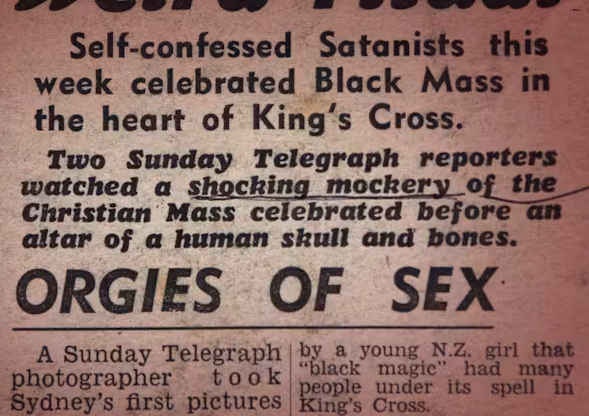
Returning to Sydney, Norton settled in Kings Cross, a bohemian enclave known for its artists, writers, and sex workers. Here she lived as a pagan, a trance artist, and a practitioner of sacred eroticism. She openly worshipped Pan and conducted rituals that explored the intersection of sexuality and spirituality.
Kings Cross offered a degree of freedom, but it also attracted police attention. Norton was repeatedly arrested, charged with vagrancy, and subjected to raids. Her art book was banned; her exhibitions were shut down; her associates were targeted. When private photographs from a birthday celebration were sold to the press, police used them as evidence to charge Norton and Greenlees with “unnatural sexual acts.” The charges were part of a broader effort to suppress her work and silence her voice.
Norton eventually embraced the persona the media had created for her: the “Witch of Kings Cross,” which was also the title of a 2020 film on the artist. She used the role as a form of performance art, a way to reclaim agency in a hostile environment. But the strategy had limits. The more she played the witch, the more the media used the persona to justify further attacks. Her new lover, the renowned conductor Sir Eugene Goossens, saw his career destroyed after becoming entangled in the moral panic surrounding Norton.
Norton’s persecution was not simply a reaction to erotic imagery. Many artists of her era produced erotic art without facing such extreme consequences. What made Norton dangerous, in the eyes of the authorities, was the combination of eroticism and spirituality. Her art suggested that eroticism could be a path to spiritual insight, that the body could be a site of transcendence, and that the sacred could be encountered through erotic ritual. This was intolerable to a society that viewed eroticism as something to be regulated and spirituality as something to be controlled.
Norton’s story reveals how sacred eroticism becomes a lightning rod for moral panic. Her art was not judged on its aesthetic or symbolic merits but on its perceived threat to social norms. She was demonized not because she was an erotic artist, but because she was an esoteric erotic artist.
3. Case Study Two: Guru Jára (YahRa), MISA, and the Contemporary Politics of Sacred Eroticism
The second set of cases brings us into the present. Jaroslav Dobeš, Guru Jára, now known as YahRa, is a Czech spiritual teacher whose work includes teachings on sacred eroticism. Whatever one thinks of his practices, there is no doubt that he is also a notable artist. Yet even before he was sentenced for his allegedly abusive erotic rituals, his artistic work encountered resistance because of his association with sacred eroticism.
In 2011, a series of exhibitions in the Czech Republic was planned to accompany the publication of his book “Casanova Sutra.” An exhibition scheduled at the Rock Café in Prague was abruptly canceled a week before the event. The organizers assumed that a venue known for its alternative culture would be open to such an exhibition, but the association with sacred eroticism proved too controversial.
After contacting numerous venues, they eventually found a space willing to host the event. But the pattern repeated itself. A literary café in Prague that regularly hosted exhibitions informed the organizers that they could not display Jára’s work after all. A cultural venue in Olomouc canceled an exhibition at the last minute, forcing the organizers to relocate the event to a restaurant’s basement. Despite the improvised setting, the exhibition drew a large audience.
Other exhibitions faced pressure from local media and anonymous callers urging venue owners to cancel. In Letovice, a château that hosted several exhibitions of Jara’s work did so only because the owner resisted sustained attempts to intimidate him. The hostility demonstrated how deeply the stigma of sacred eroticism can penetrate cultural institutions.
The exhibitions were frequently hindered by resistance from public institutions, which at times openly obstructed their realization. Nevertheless, interest in YahRa’s work continued to grow steadily among the public.
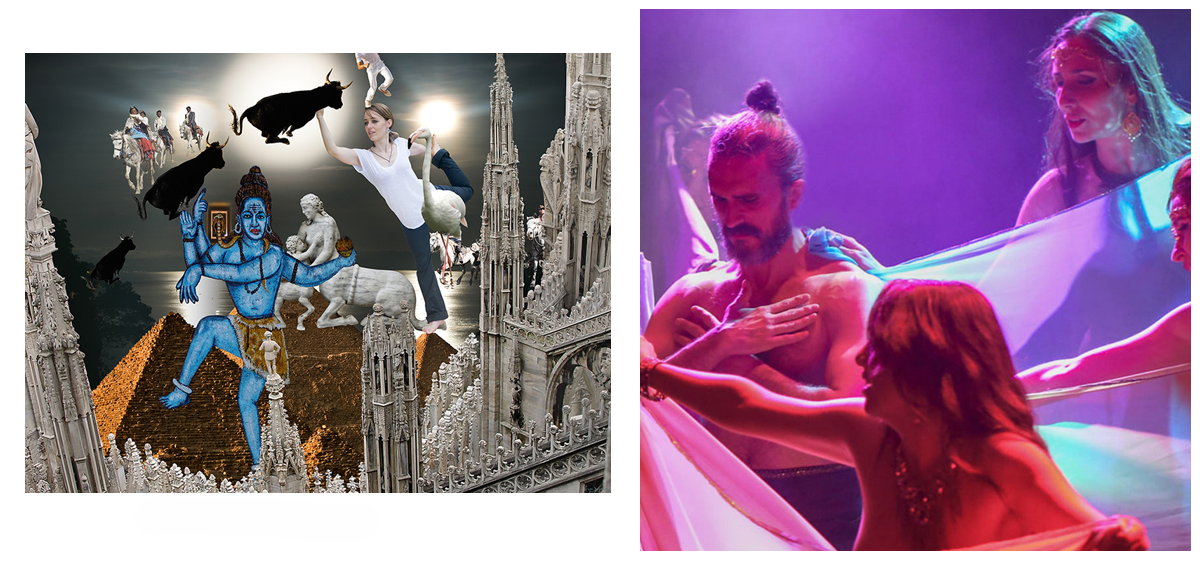
Members of MISA, the Movement for Spiritual Integration into the Absolute, founded in Romania, engage in a variety of artistic activities. Some of them (but by no means all, and not even the majority) express concepts connected to sacred eroticism. Wherever they organize performances or exhibitions, anti-cult activists contact the organizers, denouncing them as members of a “sex cult” whose activities should not be permitted. In 2023, anti-cult activists sent emails to festival organizers in the Czech Republic and Portugal, urging them to cancel ArtExtasia’s participation. ArtExtasia is a Budapest-based organization that includes MISA students among its members and describes itself as “an artistic project exploring beauty and pure Eros.” In 2026, a hostile article in a Portuguese newspaper, derived from the same sources, followed. As a result, ArtExtasia was unable to continue performing in Lisbon and Prague, resulting in the loss of important cultural and artistic opportunities.
In these cases, art itself was not the problem. ArtExtasia’s performances do include erotic content, but so do other projects that were not attacked or banned. The problem was the artists’ association with esoteric erotic teachings. The venues that canceled the exhibitions did not object to the content of the paintings or photographs; they objected to the artist’s public image. Sacred eroticism, once again, became a pretext for exclusion.
The pattern is clear. When artists are associated with sacred eroticism, their works become suspect, regardless of their actual content. The art world, which prides itself on openness and avant-garde experimentation, often proves remarkably conservative when confronted with esoteric erotic traditions.
4. Esotericism Without Eroticism: The Art World’s Long Discomfort – Kandinsky…
If sacred eroticism provokes moral panic, esotericism more broadly has long provoked embarrassment within the art establishment. Even when eroticism is absent, the association with esoteric societies or occult philosophies has been treated as a threat to artistic legitimacy.
Kandinsky’s relationship with esotericism, as Finnish scholar Sixten Ringbom argued in 1970, was not peripheral but foundational, as is now generally acknowledged. Less well known is his engagement with the Lithuanian painter Mikalojus Konstantinas Čiurlionis, which was not unimportant. Although the two artists never met, Kandinsky saw reproductions of Čiurlionis’s paintings around 1910–1911 and was deeply struck by their visionary, symbolic, and musical qualities. Čiurlionis’s synthesis of sound, color, and metaphysical cosmology resonated with Kandinsky’s own emerging ideas about abstraction. Kandinsky even attempted to contact Čiurlionis to offer support and collaboration, but the letter arrived too late: Čiurlionis had already died at thirty-six, after years of poverty and exhaustion. But Kandinsky had glimpsed in Čiurlionis a kindred spirit, whose work confirmed his intuition that painting could express spiritual realities beyond the material world.
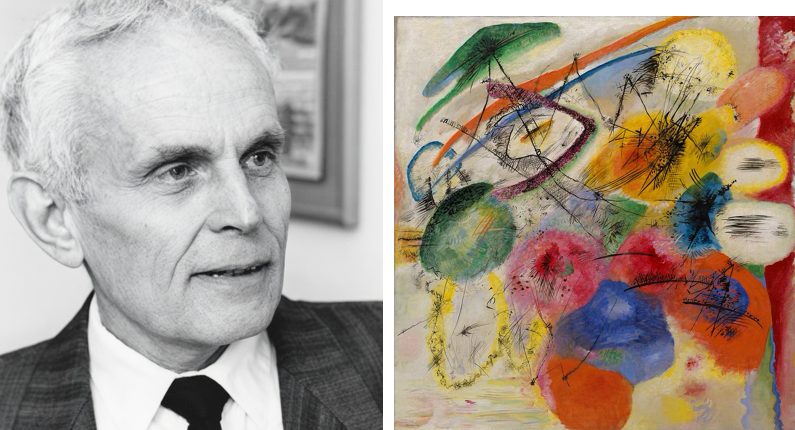
Yet this connection was systematically minimized after Kandinsky’s death. His widow Nina, who lived until 1980 (when she was murdered by thieves in her Swiss chalet), actively shaped the narrative of his legacy and feared that any association with occultism—or with an artist like Čiurlionis, widely regarded as esoteric—would damage Kandinsky’s reputation and depress the market value of his works. She discouraged scholars from pursuing the topic, denied that esoteric thinkers had influenced Kandinsky, and even attempted to suppress documents that revealed his interest in Theosophy, Anthroposophy, and psychic experimentation. Nina’s influence was considerable: she controlled access to the archives, corresponded with curators, and used her authority to promote a sanitized image of Kandinsky as a purely formal innovator.
5 … and Mondrian
This strategy shaped the reception of Ringbom’s groundbreaking 1970 study “The Sounding Cosmos,” which demonstrated the centrality of esoteric ideas in Kandinsky’s path to abstraction. Ringbom’s work was met with hostility bordering on professional ostracism. Major journals refused to review the book; Kandinsky specialists accused him of sensationalism; and access to archival materials in Munich was restricted not only to Ringbom but to all scholars, as a defensive reaction to his findings. Before being somewhat rehabilitated towards the end of his life, Ringbom had to abandon modern art entirely and devote himself to studying ancient Finnish churches. For decades, the art establishment preferred a narrative in which abstraction emerged from formal experimentation alone, untainted by occult philosophies. Only recently has Kandinsky’s esoteric dimension been acknowledged as essential rather than incidental Mondrian’s case is equally revealing. Unlike Kandinsky, Mondrian openly declared his allegiance to Theosophy and never attempted to hide the esoteric foundations of his art. He joined the Theosophical Society in 1909, remained a member until his death, and repeatedly stated that his artistic evolution was inseparable from his spiritual convictions. In a 1918 letter to Theo van Doesburg, Mondrian wrote that he “got everything from The Secret Doctrine,” referring to Helena Blavatsky’s monumental synthesis of esoteric cosmology. This was not a casual remark but a declaration of intellectual lineage: Mondrian believed that Theosophy provided the metaphysical structure that made abstraction possible.
His correspondence with Rudolf Steiner is even more explicit. In 1921, Mondrian wrote to Steiner that Neo-Plasticism was “the art of the foreseeable future for all true Anthroposophists and Theosophists.” When Steiner did not respond, Mondrian reiterated the point in another letter to van Doesburg in 1922, insisting that “it is Neo-Plasticism that exemplifies Theosophical art (in the true sense of the word).” These statements leave no doubt that Mondrian saw his work as a direct artistic expression of esoteric principles: the dissolution of the personal ego, the harmonization of opposites, and the revelation of universal order through pure relationships of line and color.
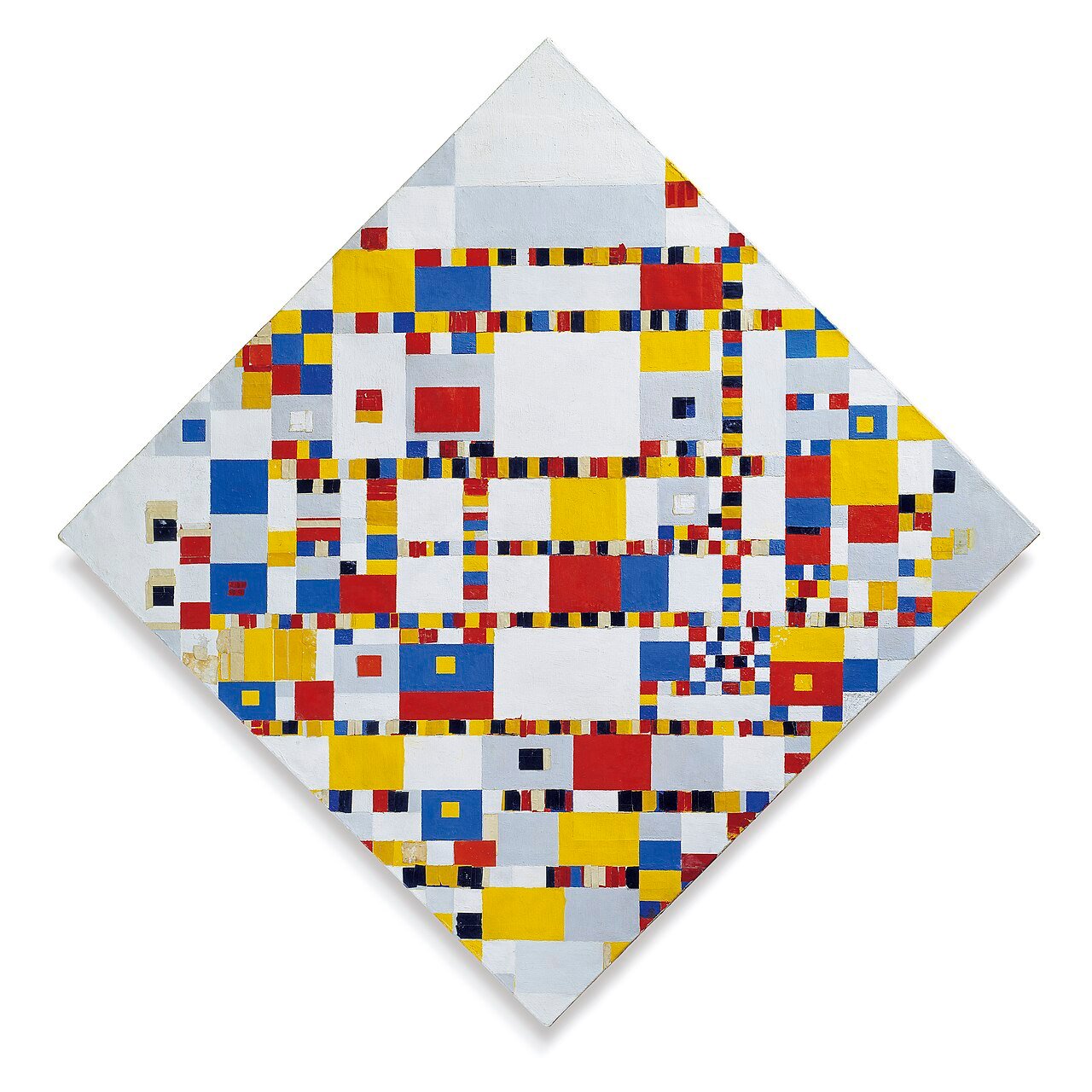
Yet for decades, Mondrian scholars downplayed or dismissed these declarations. The leading specialist Yve-Alain Bois famously referred to Mondrian’s esoteric writings as “Theosophical nonsense with which the artist’s mind was momentarily encumbered,” claiming that such ideas quickly disappeared from his work. This interpretation contradicted Mondrian’s own words and ignored the consistency with which he articulated the spiritual foundations of his art. The reluctance to acknowledge Mondrian’s esotericism stemmed not from lack of evidence but from a fear that association with occultism would undermine his status as a rational, modernist pioneer.
Today, scholarship has begun to correct this distortion. Mondrian’s writings make clear that his abstraction was not a retreat from spirituality but its intensification. His grids, far from being purely formal exercises, were conceived as visual embodiments of metaphysical truths. Theosophy was not an influence he outgrew; it was the conceptual engine of his artistic project.
6. Conclusion: Why Sacred Eroticism Still Scandalizes
What do these cases tell us?
First, sacred eroticism challenges deeply rooted cultural binaries: sacred/profane, spiritual/physical, pure/impure. When artists or spiritual practitioners blur these boundaries, they provoke anxiety. That anxiety often manifests as moral panic, media sensationalism, or legal repression.
Second, esotericism—whether erotic or not—threatens the secular narrative of modern art. If occult philosophies shaped modernism, then the story of artistic progress becomes more complex, less rational, and less marketable. This is why the art establishment resisted acknowledging the esoteric influences on Kandinsky and Mondrian.
Third, sacred eroticism remains particularly vulnerable because it touches on sexuality, a domain that societies regulate with special intensity. When eroticism is framed as spiritual, it becomes doubly transgressive.
Finally, the demonization of sacred eroticism reveals a broader cultural discomfort with embodied spirituality. In many societies, spirituality is expected to be disembodied, abstract, and morally sanitized. Sacred eroticism insists that the body is not an obstacle to transcendence but a vehicle for it. This is a radical proposition—and one that continues to provoke resistance.
Scholars have a responsibility to examine these dynamics critically. Sacred eroticism is now recognized as a significant strand of esoteric tradition with a long and rich history. Its demonization tells us more about contemporary anxieties than about the practices themselves. By studying the persecution of artists like Rosaleen Norton, the censorship of contemporary figures like YahRa, and the suppression of esoteric influences on canonical artists, we can better understand how societies police the boundaries of the sacred—and how those boundaries can be challenged.
Sacred eroticism will continue to scandalize. But it will also continue to inspire, provoke, and illuminate. Our task is not to sanitize, but to understand it.

Rosita Šorytė was born on September 2, 1965 in Lithuania. In 1988, she graduated from the University of Vilnius in French Language and Literature. In 1994, she got her diploma in international relations from the Institut International d’Administration Publique in Paris.
In 1992, Rosita Šorytė joined the Ministry of Foreign Affairs of Lithuania. She has been posted to the Permanent Mission of Lithuania to UNESCO (Paris, 1994-1996), to the Permanent Mission of Lithuania to the Council of Europe (Strasbourg, 1996-1998), and was Minister Counselor at the Permanent Mission of Lithuania to the United Nations in 2014-2017, where she had already worked in 2003-2006. In 2011, she worked as the representative of the Lithuanian Chairmanship of the OSCE (Organization for Security and Cooperation in Europe) at the Office for Democratic Institutions and Human Rights (Warsaw). In 2013, she chaired the European Union Working Group on Humanitarian Aid on behalf of the Lithuanian pro tempore presidency of the European Union. As a diplomat, she specialized in disarmament, humanitarian aid and peacekeeping issues, with a special interest in the Middle East and religious persecution and discrimination in the area. She also served in elections observation missions in Bosnia and Herzegovina, Georgia, Belarus, Burundi, and Senegal.
Her personal interests, outside of international relations and humanitarian aid, include spirituality, world religions, and art. She takes a special interest in refugees escaping their countries due to religious persecution and is co-founder and President of ORLIR, the International Observatory of Religious Liberty of Refugees. She is the author, inter alia, of “Religious Persecution, Refugees, and Right of Asylum,” The Journal of CESNUR, 2(1), 2018, 78–99.
Languages (fluent): Lithuanian, English, French, Russian.