A volume edited by Lukas Pokorny and Franz Winter classifies and analyzes references by Western esotericists to China.
by Massimo Introvigne
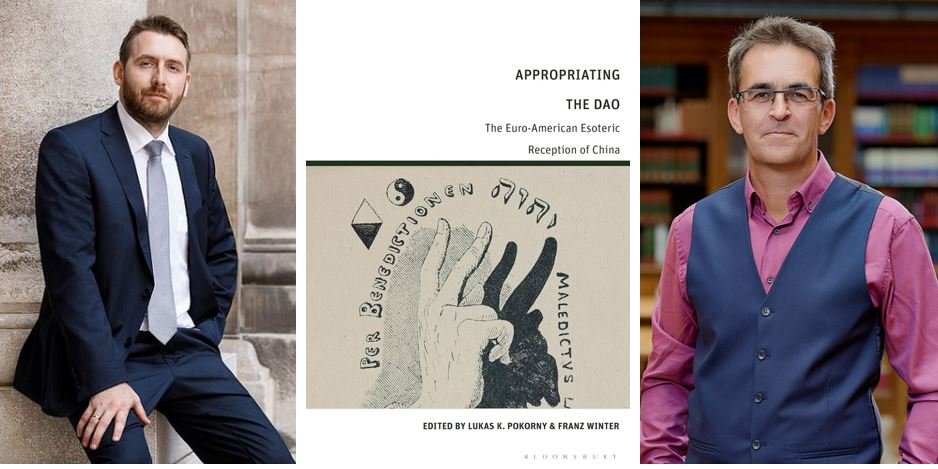
“Appropriating the Dao: The Euro-American Esoteric Reception of China,” edited by Lukas K. Pokorny and Franz Winter (paperback edition: London: Bloomsbury Academic, 2026), clearly states its objective: to address what the editors term an “esoteric lacuna.” This gap in scholarship is significant. Extensive research exists on the transformation of Western esotericism through its 19th-century engagement with India, and numerous studies have examined how China, both real and imagined, influenced Jesuits, Enlightenment thinkers, and even provoked Hegel.
However, the manner in which esotericists—including Theosophists, occultists, magicians, and other metaphysical figures—engaged with China has received comparatively little scholarly attention. China was neither the primary mystical inspiration nor the central focus of Western Orientalist interests. Nevertheless, as this volume demonstrates with academic rigor and occasional wit, China played a significant, if often overlooked, role.
The volume opens with Julian Strube’s detailed analysis of 18th-century dialogues between Paris and Beijing, in which Jesuits and Freemasons debated whether Mesmerism, the magnetic phenomenon widespread in France, had Chinese parallels. Key figures include the French Jesuit Joseph-Marie Amiot, his Chinese friend Prince Hongwu, and Antoine Court de Gébelin, a Freemason and Mesmerist known for his enthusiasm for cultural parallels. Strube demonstrates that, well before Blavatsky identified Tibet as the source of esoteric wisdom, Europeans were already attributing esoteric qualities to China.
Franz Winter examines Alphonse-Louis Constant, known as Éliphas Lévi, whose references to China have frequently been dismissed as superficial exotica. Winter challenges this view, rejecting the narrative of Lévi’s abrupt transformation from radical Catholic socialist to occultist, and instead emphasizes continuity in his thought. This perspective is significant because Lévi’s references to China are deeply rooted in Jesuit Figurism, an interpretive tradition that identified Christian truths within Chinese classics. Thus, Lévi was not simply appropriating China, but rather engaging with it through a distinct Catholic, or post-Catholic, interpretive framework.
Lukas Pokorny’s chapter on the Theosophical Society’s engagement with the “Daodejing” offers a significant contribution to intellectual history. Theosophists such as Walter Richard Old and Franz Hartmann produced translations that were often derivative and inaccurate. Despite these shortcomings, these translations profoundly influenced the Theosophical understanding of Taoism, to the extent that the “Daodejing” remains essential reading for members today. As Pokorny suggests, imaginative resonance was prioritized over textual accuracy.
Davide Marino’s chapter may prove the most controversial in the volume. It focuses on Albert de Pouvourville, a French military officer who became an esotericist under the pseudonym Matgioi. Matgioi claimed initiation in Vietnam by a Taoist master, Nguyễn Văn Luật, whose son, Nguyễn Văn Cang, was said to have later traveled to France, contributed to esoteric journals, and met René Guénon.
Marino contends that while both Văn Luật and Văn Cang were real individuals, Văn Cang never traveled to France. The articles attributed to him were, in fact, authored by Matgioi. This finding challenges the widely held belief that Guénon received direct Taoist instruction from a Vietnamese initiate. Marino traces the origin of this narrative to Guénon’s associate, Paul Chacornac, and later to the Canadian scholar Marie-France James, and, through her, to several academics, including the reviewer.
Marino’s argument is convincing enough, though he curiously refers to Guénon’s male associate, Marcel Clavelle, as “Marcelle,” a feminine form of the name in French. While the issue is not conclusively resolved (a lawyer might say that the absence of proof—of Văn Cang’s presence in France—is not proof of absence), Marino’s reconstruction remains persuasive, and I, for one, wouldn’t mind standing corrected.
Johan Nilsson examines Carl Henrik Andreas Bjerregaard, a Danish-American librarian who left the Theosophical Society but continued to publish extensively on the “Daodejing.” Like many contemporaries, Bjerregaard believed in an original, uncorrupted Taoism later altered by “priestcraft,” a common Theosophical critique of religions. Nilsson demonstrates that Bjerregaard’s interpretations, though inaccurate by modern scholarly standards, were influential for many years.
In a subsequent chapter, Nilsson examines the standard view that 19th-century esotericists contrasted a “materialist West” with a “mystic East.” He argues that perceptions of India, rather than China, primarily influenced this paradigm. In fact, Jesuits and Enlightenment thinkers had historically regarded China as rational and compatible with Western intellectual traditions. Although esotericists later focused on Taoism, they continued to view China as a society in which spirituality informed social organization. This view differed significantly from the “mystic Asia” model associated with India.
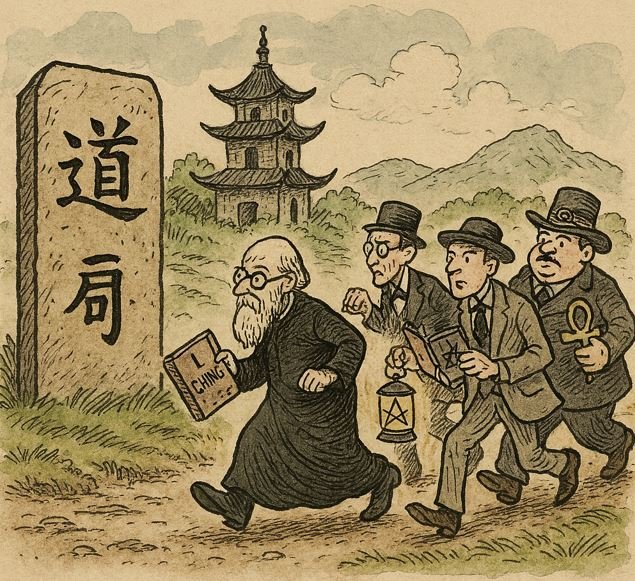
Gordan Djurdjevic examines Aleister Crowley, who, unlike other esoteric masters, traveled to China. Crowley aspired to reconcile Taoism and the “I Ching” with the Kabbalah. Scholars from both traditions have often dismissed his efforts as products of his amateurism, flamboyant lifestyle, and provocative character. Djurdjevic contends that, despite lacking philological rigor, Crowley’s interpretations offer creative insights when considered beyond his personal controversies.
Karl Baier provides an in-depth analysis of Carl Gustav Jung’s engagement with Taoism, particularly through the translations of Richard Wilhelm, a Lutheran missionary whose work significantly influenced Jung’s thought. Baier traces Jung’s and Wilhelm’s association to Count Hermann Keyserling’s enigmatic “School of Wisdom,” noting that Keyserling visited Wilhelm in China in 1912. Taoist sources strongly shaped Jung’s concepts of alchemy and synchronicity. Although his interpretations remain controversial, Jung’s influence on Western perceptions of Taoism and the “I Ching” is substantial.
The concluding chapter, authored by Tao Thykier Makeef, traces a lineage from Bruce Lee to the development of “hermetic Taijiquan,” encompassing figures such as Australian teacher Mark Rasmus and his pupils, Adam Mizner and Damo Mitchell. Makeef contends that these teachings are not exclusively Chinese; for example, Rasmus was significantly influenced by Western esotericist Franz Bardon, and Bruce Lee interpreted Chinese traditions through the perspectives of Alan Watts and Krishnamurti. Makeef emphasizes that the exchange between East and West is reciprocal.
“Appropriating the Dao” represents a significant contribution to the study of esotericism and the history of Chinese reception. The volume challenges simplistic binaries such as East/West, rational/mystical, and authentic/appropriated, which continue to influence the field. And it will undoubtedly fuel ongoing debates about how “Western” Western esotericism really is, and how “Eastern” the “Eastern wisdom” sold in countless workshops and retreats may be.
The volume addresses its identified “esoteric lacuna” with scholarly rigor, stylistic sophistication, and a degree of provocation that sustains reader engagement. It is highly recommended for scholars and readers interested in esotericism and cross-cultural intellectual history.
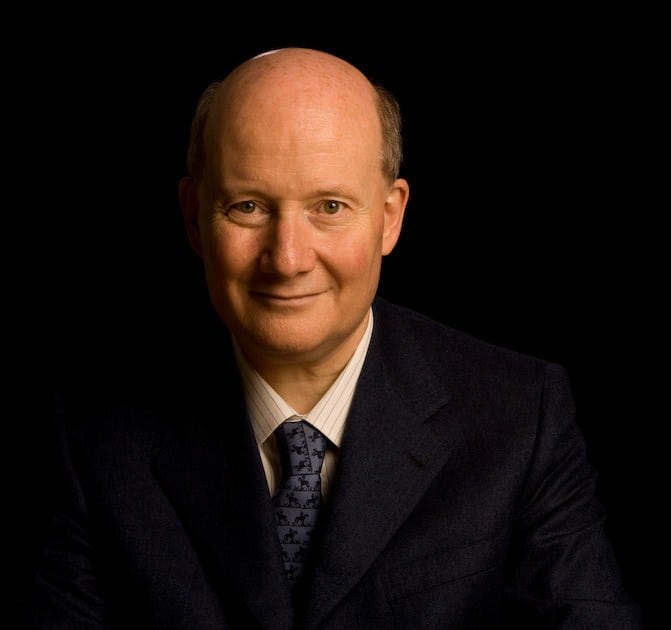
Massimo Introvigne (born June 14, 1955 in Rome) is an Italian sociologist of religions. He is the founder and managing director of the Center for Studies on New Religions (CESNUR), an international network of scholars who study new religious movements. Introvigne is the author of some 70 books and more than 100 articles in the field of sociology of religion. He was the main author of the Enciclopedia delle religioni in Italia (Encyclopedia of Religions in Italy). He is a member of the editorial board for the Interdisciplinary Journal of Research on Religion and of the executive board of University of Pennsylvania Press’ Nova Religio. From January 5 to December 31, 2011, he has served as the “Representative on combating racism, xenophobia and discrimination, with a special focus on discrimination against Christians and members of other religions” of the Organization for Security and Co-operation in Europe (OSCE). From 2012 to 2015 he served as chairperson of the Observatory of Religious Liberty, instituted by the Italian Ministry of Foreign Affairs in order to monitor problems of religious liberty on a worldwide scale.