New research shows how authorities have found a new way to punish prisoners of conscience by taking away their earned pensions.
by Massimo Introvigne
The Chinese government has long been creative in disciplining those who think, speak, or worship outside official norms. But new research from Chinese Human Rights Defenders (CHRD) reveals that authorities have developed a refined form of post-prison retaliation: leaving elderly prisoners of conscience in poverty by denying them the pensions they worked a lifetime for. As CHRD states, Chinese authorities are denying retirement-age prisoners of conscience their pension benefits following their release from wrongful detention, a practice that has led some to financial ruin and left others struggling.
The logic is straightforward. First, imprison individuals for exercising their rights—writing articles, petitioning, practicing religion, or proposing amendments to the laws. Then, after they spend years or decades in prison, inform them that the pension payments they received while incarcerated were a serious administrative error. They must now return the money, even if this means they cannot pay for food or housing. Alternatively, if they reached retirement age after release, authorities claim that the contributions they or their families made while they were imprisoned don’t count. Why? Because time in prison, according to the social security system, seems to suspend not only freedom but also the passage of time.
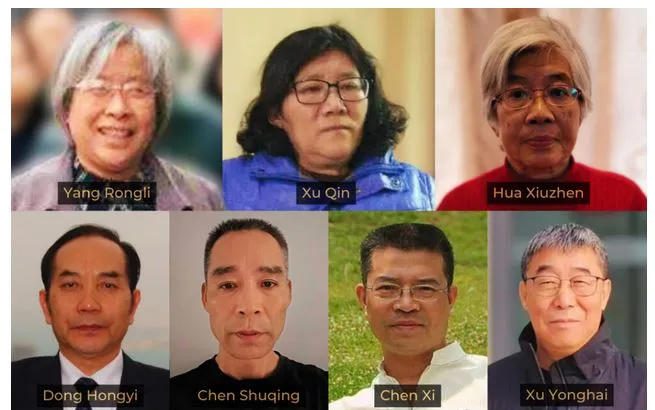
Consider the case of activist Xu Qin, 64, who returned home in 2025 after four years in prison for “inciting subversion of state power”—essentially, for researching, writing, and supporting other human rights defenders. UN experts had warned that her detention might be arbitrary and that she had been tortured. However, the Gaoyu Social Security Bureau had its own issues: Xu continued to receive her pension while in prison. She was informed that this was unacceptable. Her monthly benefits would now be cut until she repays the full amount. She filed a complaint and then a lawsuit because, apparently, the only thing more exhausting than four years in prison is the bureaucratic struggle that follows.
Retired engineer and Communist Party member Dong Hongyi, 80, faced a similar predicament. After serving 1.5 years for “picking quarrels and provoking trouble”—a charge so vague it could apply to nearly anyone—he found that his pension was quietly being taken to repay the benefits he received while incarcerated. Dong, who has no home or income, appealed to local authorities and even sought the legal basis for this policy. One suspects that any response he might receive will be as enlightening as a blackout.
Falun Gong practitioners Xia Huiqiong, 70, and Guo Bing, 65, learned in Sichuan that their pensions had been suspended because they had served prison sentences. After months of petitions, the authorities kindly agreed to reinstate their benefits—at a lower level. Naturally, the difference would be kept as repayment. In other words, the state generously returned part of what it had taken while keeping the rest as a fee for the inconvenience of imprisoning them.
Then there is Hua Xiuzhen, 79, a retired university teacher who began petitioning after an unapproved rabies vaccine disabled her daughter. For this, she was imprisoned twice. Her pension was canceled, and she was ordered to repay the 140,000 RMB she had already received. Unable to pay, she continued petitioning, which led to yet another prison sentence. It creates a perfect cycle: petition, be imprisoned, lose pension, petition again, be imprisoned again. It’s a perpetual-motion machine, Chinese-bureaucracy style.
Pastor Yang Rongli of Linfen Golden Lampstand Church, serving a 15-year sentence for collecting church donations, had her pension suspended years earlier due to a prior prison term. Her case demonstrates that once a pension is revoked, it tends to stay revoked—religious devotion may be eternal, but so is administrative punishment.
For others, the cruelty appears in different ways. Activist Chen Shuqing, 60, found out after completing a 10.5-year sentence that only 9 years and 10 months of his 24 years of contributions were acknowledged. The rest had vanished into bureaucratic limbo. He must now apply for a refund of the “ineligible” contributions and then repay them over time, a process that resembles being forced to buy back one’s own stolen property. As Chen stated, “The judgments in my two sentences only deprived me of my personal liberty and political rights… but they did not deprive me of my socio-economic rights.” The social security office seems to disagree.
Pro-democracy writer Chen Xi, 71, was told that only eight of the 18 years he and his family paid into the system were valid. He must contribute another seven years before receiving a pension—an impressive requirement for a man in his seventies. Christian writer and former doctor Xu Yonghai, who made catch-up payments in 2020, was denied benefits entirely because he had once been imprisoned. He has been petitioning for the return of his pension since 2024, a process that may well take longer than Xu’s remaining lifetime.
CHRD notes that these cases likely represent just the tip of an iceberg. Given how opaque China’s social security system is and the large number of people imprisoned for political or religious reasons, the actual scale of pension stripping may be much broader. The practice serves two purposes: it punishes former prisoners of conscience long after their release and sends a warning to anyone considering dissent. In China, even retirement can be revoked for political missteps.
The state not only imprisons your body, but it also reserves the right to impoverish your old age. And if you dare to complain, well, there is always room for one more petitioning-related conviction.

Massimo Introvigne (born June 14, 1955 in Rome) is an Italian sociologist of religions. He is the founder and managing director of the Center for Studies on New Religions (CESNUR), an international network of scholars who study new religious movements. Introvigne is the author of some 70 books and more than 100 articles in the field of sociology of religion. He was the main author of the Enciclopedia delle religioni in Italia (Encyclopedia of Religions in Italy). He is a member of the editorial board for the Interdisciplinary Journal of Research on Religion and of the executive board of University of Pennsylvania Press’ Nova Religio. From January 5 to December 31, 2011, he has served as the “Representative on combating racism, xenophobia and discrimination, with a special focus on discrimination against Christians and members of other religions” of the Organization for Security and Co-operation in Europe (OSCE). From 2012 to 2015 he served as chairperson of the Observatory of Religious Liberty, instituted by the Italian Ministry of Foreign Affairs in order to monitor problems of religious liberty on a worldwide scale.