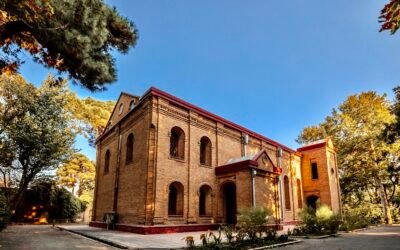
Mãe Stella de Oxóssi died in 2018. Her statue had been repeatedly vandalized by Christian fundamentalists and has now been burned.
by Massimo Introvigne

On December 4, a statue of Mãe Stella de Oxóssi, a world famous Candomblé priestess who died on December 27, 2018, at age 93, was set on fire and burned in Salvador, the capital city of the Brazilian state of Bahia.
The statue was the work of Bahian sculptor Tatti Moreno, who died in July 2022, and was inaugurated four months after Stella’s death. The monumental complex, made of polyester resin and fiberglass, included a giant statue of Oxóssi, the hunter, one of the main spirits (orishas) in the Candomblé religion and the special protector of Stella, and a smaller statue of Stella. Now, Stella’s statue has been destroyed by the unknown arsonist, while Oxóssi’s statue remains standing.

After its inauguration by authorities of the city and the state, who also renamed the road where it stands after Mãe Stella de Oxóssi, the monument has been repeatedly attacked and vandalized, following criticism by fundamentalist Christians who regard Candomblé as a form of devil worship. Indeed, attacks by fundamentalist Christians against Afro-Brazilian religions and their symbols has become an endemic problem in Brazil.
Mãe Stella de Oxóssi was born on May 2, 1925, in Salvador as Maria Stella de Azevedo. She was initiated into Candomblé at age 14 by another famous priestess, Maria Bibiana do Espírito Santo, known as Mãe Senhora, the third Ialorixá (leading priestess) of the terreiro (temple) Ilê Axé Opô Afonjá in Salvador. Stella remained a pupil of Mãe Senhora until the latter’s death in 1967, but did not work at the terreiro full time. She got a Health and Nursing diploma, and worked for thirty years as a medical sales representative.

After the death in 1975 of Ondina Valéria Pimentel, Mãe Ondina de Oxalá, who had succeeded Mãe Senhora and was the fourth Ialorixá of Ilê Axé Opô Afonjá, in 1976 Stella was designed by divination as the fifth Ialorixá of the terreiro. She left her job and became a full-time priestess. She also traveled domestically and internationally promoting a version of Candomblé more faithful to its roots in Africa and “de-Catholicized” by downplaying references to Catholic saints, and wrote several books.

Local authorities promised to restore the statue at public expenses. Intolerance against Afro-Brazilian religions remains, however, a national problem in Brazil.
Massimo Introvigne (born June 14, 1955 in Rome) is an Italian sociologist of religions. He is the founder and managing director of the Center for Studies on New Religions (CESNUR), an international network of scholars who study new religious movements. Introvigne is the author of some 70 books and more than 100 articles in the field of sociology of religion. He was the main author of the Enciclopedia delle religioni in Italia (Encyclopedia of Religions in Italy). He is a member of the editorial board for the Interdisciplinary Journal of Research on Religion and of the executive board of University of Pennsylvania Press’ Nova Religio. From January 5 to December 31, 2011, he has served as the “Representative on combating racism, xenophobia and discrimination, with a special focus on discrimination against Christians and members of other religions” of the Organization for Security and Co-operation in Europe (OSCE). From 2012 to 2015 he served as chairperson of the Observatory of Religious Liberty, instituted by the Italian Ministry of Foreign Affairs in order to monitor problems of religious liberty on a worldwide scale.