Painful for the believers, the destruction also harmed the local economy due to the decreased number of visitors.
Zhou Xiaolu
Located in a 4A-level scenic area in Feng county of Baoji city, in the northwestern province of Shaanxi, Xiaozai Temple, with a history spanning over 1,400 years, became renowned because Emperor Xuanzong of Tang (685-762), the seventh emperor of the Tang dynasty (618-907), once prayed there for blessings.
In the vicinity of the temple were the scenic area’s other major Buddhist attractions – the statue of height-adjustable Dripping-Water Guanyin, measured over 20 meters in height, and China’s sole Guanyin statues of the twelve Chinese zodiac animals. In August last year, the local authorities forcibly dismantled all these statues, 45 in total.

Dripping-Water Guanyin statue and Guanyin statues of the twelve Chinese zodiac animals in the Xiaozai Temple plaza after demolition.
A local official said that if everyone burns joss sticks and worships Buddha, there will be no one to believe in the Communist Party. The destruction of Buddhist statues is, therefore, a “political movement,” and all religious large-air statues must be torn down, despite the financial loss for the Feng county. The Guanyin statues were a major attraction for tourists and believers, contributing to the income for the local population.

After being dismantled, the Dripping-Water Guanyin statue was placed to the side and covered with a cloth.
According to an employee at the Xiaozai Temple scenic area, on August 9, the site was shut down unexpectedly. Closure notices were posted at nearby intersections, and visitors were blocked from entering. Local officials claimed that the temple was closed because they were worried that heavy rainfall would endanger the safety of tourists.

Closure notice of the Xiaozai Temple scenic area.
The employee told Bitter Winter that on August 13, the mayor of Feng county, accompanied by more than 40 police officers and government officials, came to the scenic area to oversee the dismantlement of the height-adjustable Dripping-Water Guanyin statue, which was built at the cost of nine million RMB (about $1.34 million).

Workers are demolishing Dripping-Water Guanyin statue at Xiaozai Temple.
The Guanyin statues of the “Twelve Fully-Enlightened Ones,” which were located halfway up the hillside of Xiaozai Temple and built at the cost of over two million RMB (about $300,000), were demolished one by one and buried.
Video: The base of Dripping-Water Guanyin statue has been destroyed.

One week later, the Guanyin statues of the twelve Chinese zodiac animals on either side of the plaza, as well as the statue of “Twenty-Four Hands of Great Compassion” were torn down as well.

After being dismantled, the “Twenty-Four Hands of Great Compassion” were aggregated in one place.
The “Xiaozai Temple” sign on the temple’s doorway was also removed. On the evening of August 24, officials ordered to scrape off the Buddhist patterns carved on the bases of six stone sculptures on either side of the entrance to Xiaozai Temple.
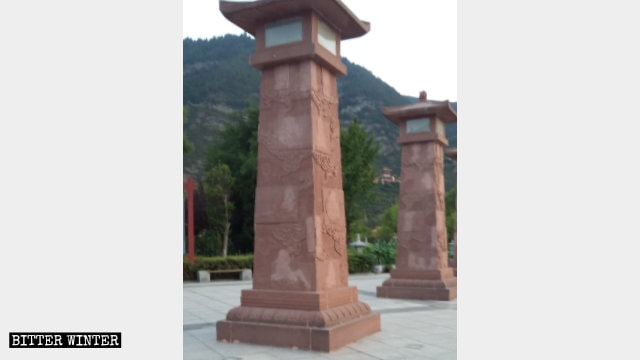
Buddhist patterns were scraped off from the bases of the stone sculptures.
The demolition operation was kept highly confidential and was carried out almost entirely late at night. The demolition site was surrounded by three layers of galvanized iron sheets, guarded during the daytime by six people who prohibited tourists from approaching. At night, heavily-armed special police patrolled the grounds.

The “Xiaozai Temple” sign on the temple’s doorway was changed into “Gufengzhou.”
According to a local Buddhist, on February 13, 2019, the number of visitors who came to Xiaozai Temple to attend the “Shangjiu Festival” – one of the oldest temple fair events in the region – was only one-third of that of previous years. Owners of shops in the area around Xiaozai Temple have also reported that after the Guanyin statues were dismantled, the number of visiting worshippers decreased, negatively affecting their business.

Uses a pseudonym for security reasons.