Academic community members across China are investigated for supporting democratic ideas or expressing views critical of the CCP’s policies and actions.
by Xiao Baiming
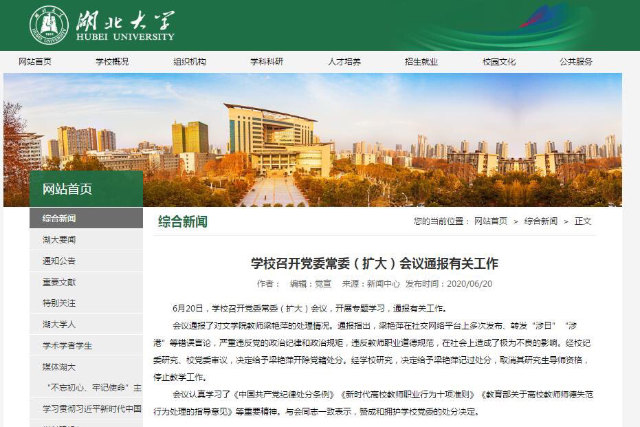
Liang Yanping, a professor at the Hubei University’s School of Chinese Language and Literature, was banned from teaching and supervising graduate students and expelled from the CCP on June 20. The university posted a statement on its website, explaining that Ms. Liang Yanping was punished for “wrong remarks about Hong Kong and Japan” and for violating teacher’s professional moral standards with a significant negative impact on society.”
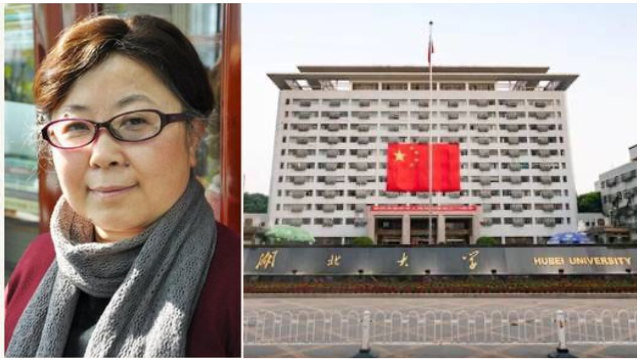
In March, the professor publicly expressed support to Fang Fang, the author of Wuhan Diary—an account of her life amid the epidemic in the city where the coronavirus originated. On November 8 last year, Liang Yanping posted an article on Weibo, China’s microblogging platform, mourning the death of Chow Tsz-lok, a Hong Kong student who fell off a building during the pro-democracy protests. On October 5, she posted a selfie wearing a black hat and black face mask, which was interpreted as support for the protestors.
Over the past two years, the number of university teachers in China who were punished for “improper remarks” has increased significantly. Twitter user 中国文字狱事件盘点(@SpeechFreedomCN) has collected some of such cases.
On April 30, Wang Xiaoni, a retired Hainan University teacher, was investigated by the school for posting “improper remarks” on Weibo a few years ago. The teacher expressed support to the Occupy Central with Love and Peace, a disobedience campaign in Hong Kong, and the Sunflower Student Movement in Taiwan, both in 2014, and stated that Mao Zedong should have been executed like Muammar Gaddafi, Libya’s autocratic ruler.
Yu Linqi, a Harbin Normal University professor, who also expressed support to Fang Fang, is being investigated since May for criticizing online Karl Marx, communism, and the CCP. Many other university teachers who spoke in favor of Fang Fang on social media are being examined, and even their remarks online years ago are being reviewed.
In September 2018, Hu Hao, a teacher at the Public Administration Department of the China Institute of Labor Relations, was fired and disciplined as a CCP member because he had forwarded information about the Hong Kong Occupy Central protests on Weibo and “talked about capitalism, liberalism, and democratization.”

In August that same year, Yang Shaozheng, a professor at the Economics College of the Guizhou University, was expelled for criticizing the CCP being supported with public funds and “posting and spreading politically incorrect speeches online over a long time.”

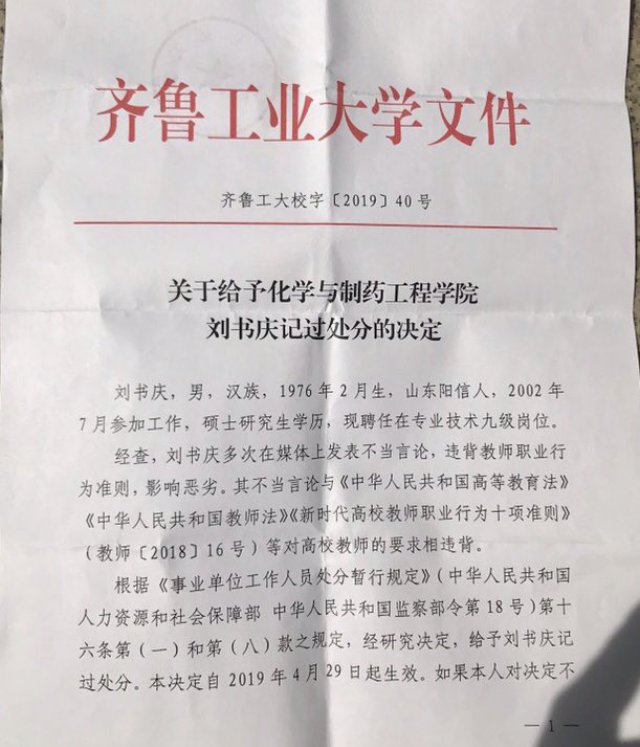
In April 2018, Liu Shuqing, a teacher at the School of Chemistry and Pharmaceutical Engineering of the Qilu University of Technology, was suspended for “anonymous articles that damaged the authority of CCP and violated the Party’s guidelines.”
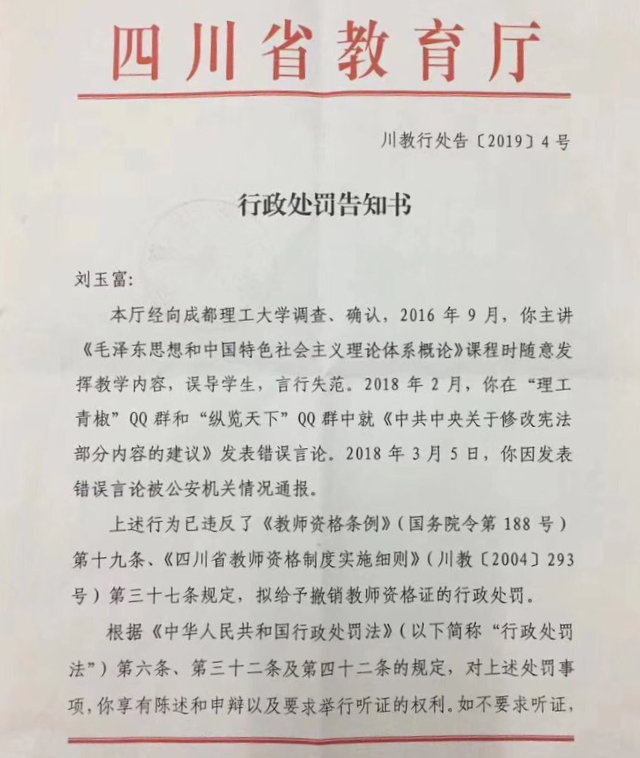
Liu Yufu, a teacher at the Law School of the Chengdu University of Technology, and Zhou Yunzhong, a professor at the Xiamen University, were punished for posting remarks critical of the government on social media.
Many more teachers were punished after their students reported on them. The CCP often plants informants among students to monitor their teachers’ remarks.
On February 7 this year, Zhou Peiyi, a teacher at the University of Chinese Academy of Social Sciences in Hong Kong, was reported by a student for posting comments about the coronavirus on WeChat, a multi-purpose messaging and social media platform. The university dismissed him for “attacking China’s political system.”
In August 2019, Zheng Wenfeng, an associate professor at the University of Electronic Science and Technology of China in Chengdu, was suspended from teaching for two years for telling a student online that the four great Chinese inventions—papermaking, printing, the magnetic compass, and gunpowder— “were not advanced in the world and did not generate any productivity or cooperation in reality.”
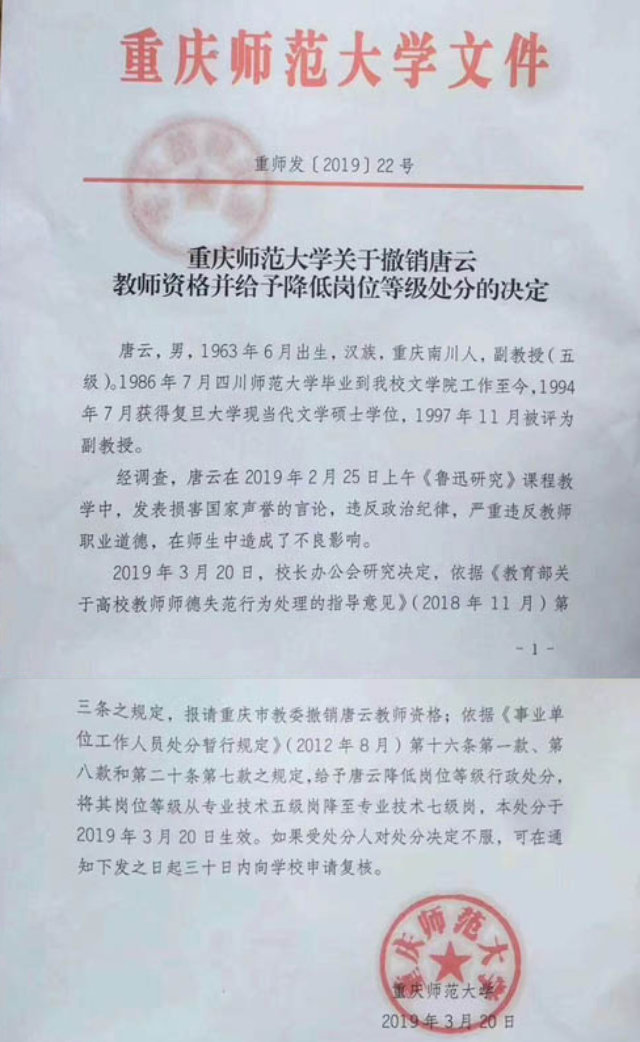
In March that year, Xu Zhangrun, a law professor at the Tsinghua University, was reported by a student and suspended by the school for criticizing the CCP. Tang Yun, an associate professor at the Chongqing Normal University, was disqualified from teaching after a student reported on him for making remarks in class that “damaged the state’s reputation.”
Zhai Juhong, an associate professor at the College of Public Administration of the Zhongnan University of Economics and Law in Hubei’s provincial capital Wuhan, was reported by students for criticizing the changes to the Chinese Constitution allowing President Xi Jinping to remain in power indefinitely. She was fired, expelled from the Party, and stripped of her Teacher Qualification Certificate in May 2018.

Uses a pseudonym for security reasons.