The relationship between Russia and Ukraine is a “terrible kinship.” Just as the relationship China has with the Uyghurs.
by Kok Bayraq
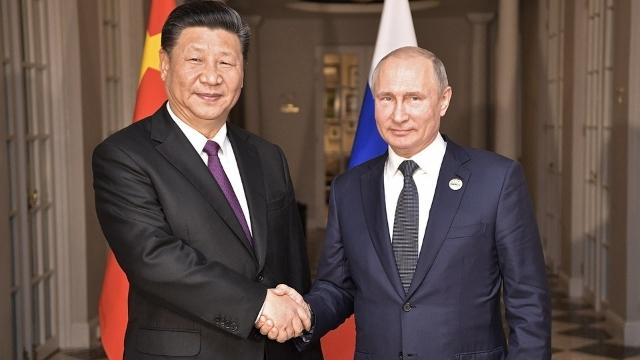
Humanity is currently witnessing the horrors of how some “brotherhoods” work in the world. Nowhere is this clearer and more terrifying than in China’s relationship with the Uyghurs and Russia’s relationship with Ukraine.
Putin has claimed that Ukraine and Russia were originally one nation, and that this kinship and the inability of Ukraine to self-govern itself were among the reasons for the war. Let us be naïve, as Putin perhaps expects us to be, and ask: If this is the case, then how could he shoot his brother? How does his heart allow him to drop bombs in his brother’s yard?
Similarly, China has been calling East Turkestan (Xinjiang to China) part of its country since its ancient times, claiming that the Uyghurs are the happiest members of the big Chinese family. If so, why are concentration camps being set up and Uyghurs not allowed to reunite with their families and submitted to forced birth control? Why is China worried about an increase in the population of its “brothers”?
There are many commonalities in kinship theories about China and about Russia. For example, just as Putin used historical “facts” to prove his kinship with Ukraine by stating that “Russians and Ukrainians are one people” and “Kiev is the mother of Russian cities; we cannot live without each other,” Xi Jinping claimed, “The Han nationality is inseparable from the minority (Uyghurs), and the minority is inseparable from the Han nationality.” He stated, “It is necessary to promote all ethnic groups to hug each other like pomegranate seeds in the large family of the Chinese nation.”
Russia is unhappy that Ukraine is trying to be a free and democratic state, and sees its possible accession to NATO as dangerous. Similarly, China is unhappy with the Uyghurs’ Muslim identity, and sees it as a threat to its national security. China even denies Uyghurs’ Turkic roots, and insists that “hostile forces are trying to split the country.” Even more surprisingly, although China is friends with the Islamic world, the Islamic faith of the Uyghurs is considered a disease and a virus, and China has set up camps to eliminate it.
In a civil society, older siblings may criticize younger siblings for making mistakes; in the worst case, the older one may slap the younger, but never stab. If Russia considers Ukraine its relative, it should offer full support to let Ukraine feel this brotherhood, help Ukrainians forget Soviet-era oppression, and allow them to return voluntarily to Russia if they want to. It should not be worried about Ukraine’s attempt to be a member of the NATO. If Ukrainians really are relatives and brothers, they may have their experiences outside the common home but in the end they will return there.
If China believes that the Uyghurs are part of the Chinese family, while exploiting the unlimited natural resources and strategic position of the Uyghur region, it should also give the Uyghurs the necessary political and economic status to help them feel their “brotherhood” and a sense of fairness.
Clearly, Russia and Ukraine, China and the Uyghurs are not brothers; they are strangers to each other. They may have been living together or been god or bad neighbors to each other in history, but they never were siblings.
So the real question in this topic is the mental status of the dictators while they make their statements, not kinship. Thus, why would Russia and China refer to these relationships as kinship instead of as historical neighbors? Why would they make obviously illogical statements? The purpose may be to gain time for their operations by deceiving and confusing the international community, which is a common tactic of both countries. Putin hid his intentions, even as he gathered 150,000 troops on the Ukrainian border by mocking Western media reports that Russia was about to occupy Ukraine. China, meanwhile, hid the existence of concentration camps for twenty months, but when they were discovered, the camps were labeled “vocational training centers.”
But more likely the real reason for the illogical “brotherhood” statements may not be intentional; rather, it could be the revelation of a criminal psyche. Studies have shown that when persons commit a crime, they lose their mental balance and make false judgments. The loss of balance may stem from being overconfident in their power or from fear about the damage their criminal actions have created. In either case, the false claim can be seen as an indicator of the crimes they committed or are planning to commit.
The lesson to be learned in these cases is that, when a totalitarian government refers to a particular group in or around the country as “our brother,” or declares that “we can’t live without each other,” yet it intends to occupy its land and destroy its identity, this is a sign that it had already started a genocide or waged a war against its “brothers.”
If the international community is sincere in its commitment to freedom and human rights, it is important for it to “detect” such “brotherhoods” in a timely manner, and prevent further escalation of their horrific actions, by showing no patience for the tyrants’ lectures.
China has silently eliminated a significant portion of its “brothers” from the Uyghur population and continues to do so through genocidal methods. “The birthrate across the region fell by nearly half (48.74 %) in the two years between 2017 and 2019,” according to an independent scholarly report. If this lesson is not learned, China will also proceed to “hug” its Taiwanese “brothers,” maybe with nuclear weapons, and Russia will do the same. After its war on Ukraine, Russia will likely be looking for other long lost “brothers” in Asia and Europe.

Shohret Hoshur (who until 2025 used the pseudonym of Kok Bayraq) is a political émigré from East Turkestan (Ch. Xinjiang) and an opponent of the Sinicization of his homeland. He left China in 1995 when his journalism got him “into trouble with the authorities,”and is now living in Washington, D.C.. His unique thoughts and feelings published in Taipei Times and Global Voice comment on the ongoing Uyghur genocide.