Reflecting on the denial of human rights, freedom of religion or belief, and civic participation, with implications for the rule of law in Taiwan.
by Marco Respinti*
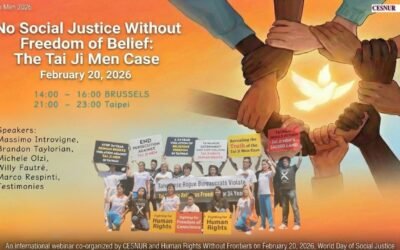
*Conclusions to the webinar “No Social Justice Without Freedom of Belief: The Tai Ji Men Case,” co-organized by CESNUR and Human Rights Without Frontiers on February 20, 2026, United Nations World Day of Social Justice.
Today we observe the United Nations World Day of Social Justice and, as on previous occasions, we take this opportunity to reflect on the relevance that UN international days of observance have in relation to the Tai Ji Men case—a blatant miscarriage of justice and a deeply troubling violation of religious liberty affecting a peaceful group of lawabiding citizens of the Republic of China (Taiwan).
Interestingly, the UN itself has questioned what the term “social justice” truly means, acknowledging that “[i]n recent years, [it] has become a significant part of public discourse, often invoked in discussions about equality, human rights, and societal reforms.”
The UN’s own answer is that “[s]ocial justice encompasses a wide range of issues,” extending “[…] from addressing economic inequality to access to education, healthcare, and the protection of human rights, to create a world where everyone has the opportunity to thrive.” The emphasis placed on human rights is, of course, what concerns us most today in relation to the Tai Ji Men case.
The UN further specifies that human rights, as a vital component of any genuine concept of social justice, must include recognition that individuals have different needs and circumstances; assurance that everyone has access to the resources and opportunities necessary to succeed; the concrete possibility for all individuals to participate in the political, economic, and social life of their communities; and respect for differences among people. Taken together, these elements ensure equity, access, participation, and diversity.
A comparison between this definition and the Tai Ji Men case in Taiwan reveals significant discrepancies, leading to the conclusion that social justice does not prevail in this instance. Indeed, the comparison demonstrates that all the basic tenets the UN identifies as constitutive of an authentic realization of social justice have been violated.
Let us review the matter.
If, according to the UN, true social justice ensures that everyone has access to the resources and opportunities necessary to succeed, the treatment of Tai Ji Men’s Shifu (Grand Master) and dizi (disciples) since 1996 has failed to provide them with the resources and opportunities required to thrive. Even though all levels of the Taiwanese judiciary, including the Supreme Court, have cleared the movement of all false charges, Tai Ji Men’s sacred land was nationalized for no apparent reason other than an arbitrary decision by certain corrupt bureaucrats who disregarded the judiciary’s ruling and imposed severe sanctions on individuals guilty of nothing. As a result, Tai Ji Men has been deprived of land crucial for its spiritual and social activities, thereby violating one of the principles the UN affirms should be guaranteed.
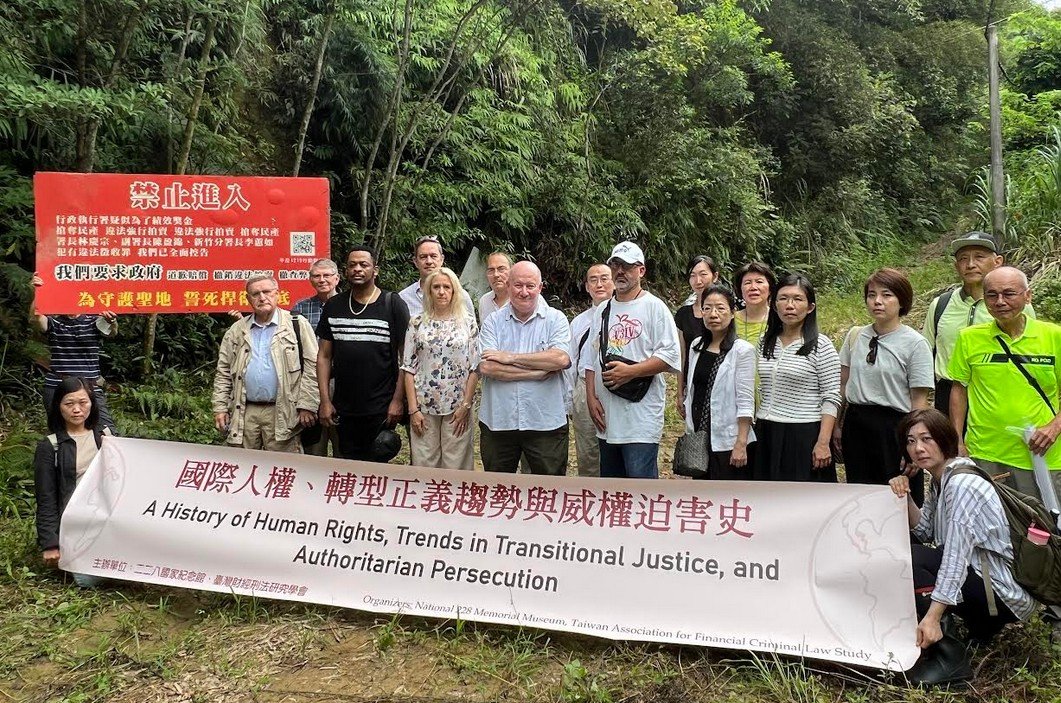
If, according to the UN, true social justice ensures the concrete possibility for all individuals to play a role in the political, economic, and social life of their communities, it clearly follows that the treatment of Tai Ji Men Shifu and dizi since 1996 has failed to grant them the possibility to play an active role in the public life of Taiwan, or has at least severely curtailed it. When a group of honest and innocent citizens is stigmatized as tax delinquents and even accused of raising goblins, as Tai Ji Men was, their credibility is thoroughly undermined, and the public’s trust in them is destroyed. How could such a group possibly play a full societal role?
If, according to the UN, true social justice is built upon respect for differences among people, it clearly follows that the treatment of Tai Ji Men’s Shifu and dizi since 1996 has failed to grant them the enjoyment of such conditions, subjecting them instead to harsh discrimination. What other term could accurately describe the labeling and targeting of an innocent group of honest citizens than discrimination, when that group is identified, denounced, and falsely characterized as criminal, leading to ostracism and marginalization? I emphasize that all levels of the Taiwanese judiciary have completely absolved Tai Ji Men of even the most serious charges, which were also proven to be fabricated. Yet, penalties have been, and continue to be, imposed on the group without justification, fostering the perception that Tai Ji Men has committed wrongdoing and thereby undermining public trust in its members.
This consideration, in light of the surreal case of a group still paying its dues to justice without having committed any offense that could constitute a debt to society, leads us once again to conclude that social justice remains incomplete in Taiwan.
Moreover, the entire situation appears to exemplify the heinous practice of the strong preying on the weak. Tai Ji Men is by no means weak in character, will, or determination; it is, however, comparatively weak when faced with the power of the state and its agencies, particularly when the bureaucratic apparatus decides to deploy its full might against a group of citizens whose core values are peace, harmony, and understanding. Tai Ji Men has consistently remained firm in its principles, relying on pacifist arguments and the tools of moral suasion and conviction, and the state has taken advantage of this.
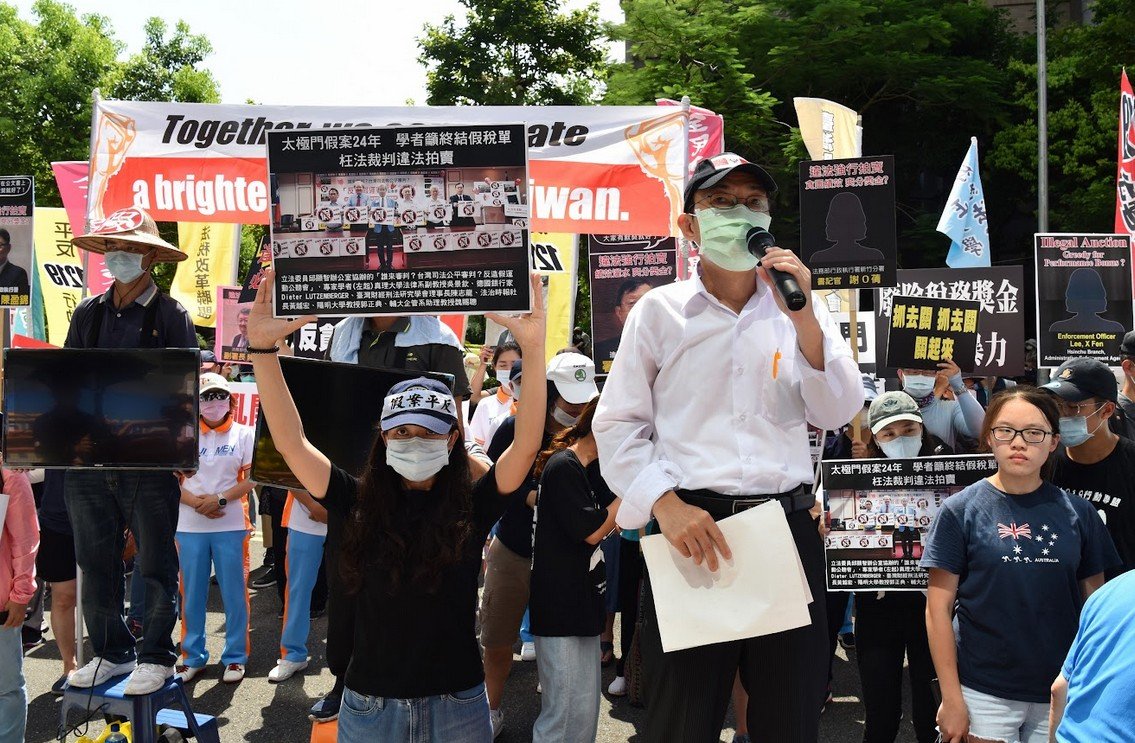
Thus, the issue remains gravely unresolved. Tai Ji Men continues to suffer for a guilt it has not committed, and Taiwan cannot claim to be a country where social justice is fully realized. This raises a question for the Taiwanese government in Taipei: can it tolerate being a country where justice is not accomplished? Can it tolerate being a country where some of its citizens are discriminated against and deprived of their rights? Can it tolerate being a country whose democracy is not truly of the people, by the people, and for the people?
This is a question we leave to the present government of Taiwan, appealing to its intelligence, will, and political responsibility to find a just resolution for Tai Ji Men—one that could finally ensure social justice. The Tai Ji Men case now requires a political solution that ends arbitrariness and official misconduct. For if social justice is denied to even one of its citizens, all citizens of Taiwan suffer. If any citizen of any country in the world is denied social justice, all human beings everywhere are subjected to serious detriment—a global violation of the rule of law.

Marco Respinti is an Italian professional journalist, member of the International Federation of Journalists (IFJ), author, translator, and lecturer. He has contributed and contributes to several journals and magazines both in print and online, both in Italy and abroad. Author of books and chapter in books, he has translated and/or edited works by, among others, Edmund Burke, Charles Dickens, T.S. Eliot, Russell Kirk, J.R.R. Tolkien, Régine Pernoud and Gustave Thibon. A Senior fellow at the Russell Kirk Center for Cultural Renewal (a non-partisan, non-profit U.S. educational organization based in Mecosta, Michigan), he is also a founding member as well as a member of the Advisory Council of the Center for European Renewal (a non-profit, non-partisan pan-European educational organization based in The Hague, The Netherlands). A member of the Advisory Council of the European Federation for Freedom of Belief, in December 2022, the Universal Peace Federation bestowed on him, among others, the title of Ambassador of Peace. From February 2018 to December 2022, he has been the Editor-in-Chief of International Family News. He serves as Director-in-Charge of the academic publication The Journal of CESNUR and Bitter Winter: A Magazine on Religious Liberty and Human Rights.