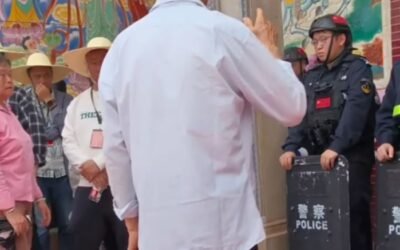
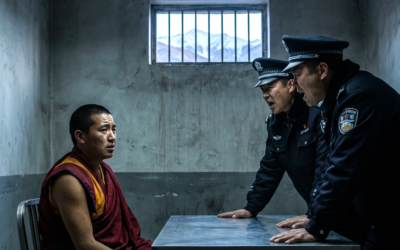
On August 13, more than 300 protesters took to the street in Wulanhua, while the CCP continues to destroy grazing land to eradicate Mongolian traditional culture.
by Massimo Introvigne

Although less well-known than Tibet or Xinjiang, Inner Mongolia, which locals prefer to call Southern Mongolia, is the frequent theater of protests by Mongolians claiming that their traditional culture and identity is being destroyed by the CCP.
The CCP has long identified herders as the backbone of a Mongolian identity that resists sinicization. Its strategy is to deprive the herders of their grazing land under pretexts of “ecology,” “modernization,” or “struggle against poverty.” The Party is persuaded that the herders should thus be compelled to seek other jobs and abandon their traditional identity.
On August 26, 2019, the Chinese government announced new regulations, allowing animal farming companies to appropriate land without need of approval, and without the possibility for local authorities to oppose the appropriation. In Durbed Banner, also spelled Dorbod and called by the Chinese Siziwang (四子王旗), which is under the jurisdiction of Ulan Chab (乌兰察布) prefecture-level city, seven pig farms operated by Han Chinese thus appropriated the ancestral land of local Mongolian herders.
A protest movement followed, and these protests, particularly when covered by foreign media, are not without effect, as the CCP tries to prevent Southern Mongolia from becoming an international human rights issue as Tibet and Xinjiang are. 70 days ago, the seven pig farms suspended operations.
However, the largest one has now started operating again, and more than 300 herders took the street in the county seat of Durbed Banner, Wulanhua (乌兰花, sometimes called Siziwang by the Chinese), on August 13. They tried to enter the local government building, only to be stopped and beaten by the police. The Southern Mongolia Human Rights Information Center posted videos of the protests, and asked again for international support for the herders.

Massimo Introvigne (born June 14, 1955 in Rome) is an Italian sociologist of religions. He is the founder and managing director of the Center for Studies on New Religions (CESNUR), an international network of scholars who study new religious movements. Introvigne is the author of some 70 books and more than 100 articles in the field of sociology of religion. He was the main author of the Enciclopedia delle religioni in Italia (Encyclopedia of Religions in Italy). He is a member of the editorial board for the Interdisciplinary Journal of Research on Religion and of the executive board of University of California Press’ Nova Religio. From January 5 to December 31, 2011, he has served as the “Representative on combating racism, xenophobia and discrimination, with a special focus on discrimination against Christians and members of other religions” of the Organization for Security and Co-operation in Europe (OSCE). From 2012 to 2015 he served as chairperson of the Observatory of Religious Liberty, instituted by the Italian Ministry of Foreign Affairs in order to monitor problems of religious liberty on a worldwide scale.