After having been named and shamed for their abject subservience to Xi Jinping, Musée Guimet and Musée du quai Branly are trying to save their reputation.
by Massimo Introvigne

Or was it just a clerical mistake? A misunderstanding, perhaps? Having been accused of abjectly “bowing to China’s demands to rewrite history and erase peoples,” two leading Paris museums are trying to back off.
What happened, exactly? On September 1, 2024, “Le Monde” published an op-ed signed by la crème de la crème of French academic Tibetologists and experts of Asian art accusing the Musée Guimet and the Musée du quai Branly of having sold their soul to Xi Jinping. The Musée du quai Branly had changed the name “Tibet” to “Xizang,” according to Beijing’s diktat, in its catalogues. The Guimet had changed the title of its “Tibetan” rooms to “Himalayan World” rooms.
The scholars reminded the readers of “Le Monde” that calling Tibet “Xizang” is a historical fraud. Readers of “Bitter Winter” know this already, and with all the details. While they were at it, the French scholars also repeated that “Xinjiang” is a questionable Chinese name for East Turkestan, too, and that neither Tibet nor “Xinjiang” were historically part of Imperial China. They noted, however, that “this is well known to specialists but probably less so to admirers of modern China’s successes, achieved at the cost of economic exploitation of these territories and the relentless Sinicization of these peoples, thanks to the establishment of a dictatorial regime and the Han’s demographic domination.”
Adding that hosting the Confucius Institutes, whose real aim is spreading Chinese propaganda, as some French cultural institutions and universities do, is not acceptable either, the scholars wrote that, “Our institutions want to preserve their access to Chinese research fields, sources and archives at all costs, as well as benefit from the financial largesse and loans of museum objects that depend on the goodwill of the Chinese regime. As a result, they are coaxing the threatening power that Xi Jinping’s China has become and are bowing to its demands to rewrite history and erase peoples.… That French museums should accept to be dictated to in the rewriting of history is a sign of great weakness. Our scientific and cultural institutions must, as a matter of the utmost urgency, reject any interference by undemocratic foreign regimes.”
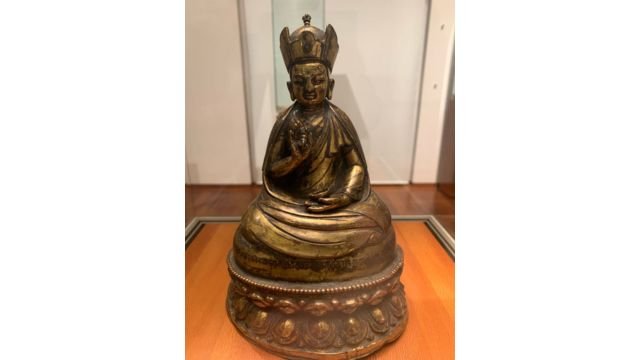
Normally, faced with the power and money of China, these appeals have no consequences. However, the criticism directed at two prestigious (and beautiful) museums was echoed by media all over the world, which ridiculed France and those who took the decisions about Tibet.
For once, it seems that the campaign had some success. After all, French use to say that ridicule kills. Finally, the Musée du quai Branly stated that it “uses the appellation Tibet in its cartels of the permanent collections and has never ceased to use this appellation in its work on the collections.” “Xizang” replaced “Tibet” on the Internet, but this was due to a “technical update in progress that may be misleading.” The Musée Guimet claims that, on the contrary, it keeps using “Tibet” on the Internet, and “Himalayan” means that the same rooms are now devoted to both Tibet and Nepal.
We wait for the results of the “technical updates in progress”—and to what will happen when the international media will look the other way. For the time being, we applaud the French scholars who tried to stop the shame before it would be too late—and perhaps succeeded.

Massimo Introvigne (born June 14, 1955 in Rome) is an Italian sociologist of religions. He is the founder and managing director of the Center for Studies on New Religions (CESNUR), an international network of scholars who study new religious movements. Introvigne is the author of some 70 books and more than 100 articles in the field of sociology of religion. He was the main author of the Enciclopedia delle religioni in Italia (Encyclopedia of Religions in Italy). He is a member of the editorial board for the Interdisciplinary Journal of Research on Religion and of the executive board of University of California Press’ Nova Religio. From January 5 to December 31, 2011, he has served as the “Representative on combating racism, xenophobia and discrimination, with a special focus on discrimination against Christians and members of other religions” of the Organization for Security and Co-operation in Europe (OSCE). From 2012 to 2015 he served as chairperson of the Observatory of Religious Liberty, instituted by the Italian Ministry of Foreign Affairs in order to monitor problems of religious liberty on a worldwide scale.