Places of worship must prove loyalty to the CCP before opening their doors after the coronavirus lockdown. Flag-raising ceremonies are obligatory.
by Han Sheng
All religious venues in China were closed for more than five months to prevent the spread of COVID-19. The Shaolin Temple on Mount Song in the central province of Henan, the Buddhist holy site reputed as “Number One Temple under Heaven” and renowned around the world for its martial arts school, was no exception.
As lockdown restrictions were eased, it was allowed to reopen on June 22, but only on the condition that a grand national flag-raising ceremony promoting patriotism and pledging loyalty to the CCP was organized that day. A requirement each place of worship in China must accept if they want to resume their activities in the post-lockdown era.

At 9 a.m. that day, Shi Yongxin, the abbot of the Shaolin Temple, accompanied by about 100 disciples, led the flag-raising ceremony in the rain. After 1,500 years of promoting Buddhism in China, the temple has succumbed to the CCP’s “sinicization” policy, gradually losing its original values and responsibilities.
“It is so unnatural for monks in traditional robes to take part in a flag-raising ceremony like soldiers,” commented a temple visitor who witnessed the reopening on June 22.
“Strictly controlled by the state, people of faith must follow the Party’s commands,” another visitor added. “The government thinks that there are too many believers, which it sees as a threat to its regime.”
Shaolin Temple monks carry a national flag in a marching drill, reminiscent of a military ceremony.

Proof of “patriotism” has become a prerequisite for religious activity venues to reopen after the lockdown. Even after they are open again, religious activities are still banned or strictly restricted in the name of “epidemic prevention.” Patriotic events, however, are not spreading the virus, according to the CCP.
The famous Nantai Rock Temple in Quanzhou, a prefecture-level city in the southeastern province of Fujian, was allowed to open its doors on June 21, but only if a flag-raising ceremony was organized. A staff member at the temple said that since the government controls religions and demands to prove loyalty to the state, the venue must now hold flag-raising ceremonies weekly and ahead of each monks’ assembly or other religious activity. The temple has no other choice but to obey. Before a small assembly on July 2, the temple abbot led a flag-raising ceremony for a group of about 30 Buddhists.
The flag-raising ceremony at the Nantai Rock Temple on July 2.

The Religious Affairs Bureau of Quanzhou also demands local religious venues to have the national flag on display throughout the week, regardless of the weather: raise it on Monday and lower it on Friday. The flag must be kept in pristine condition—unfaded and undamaged.
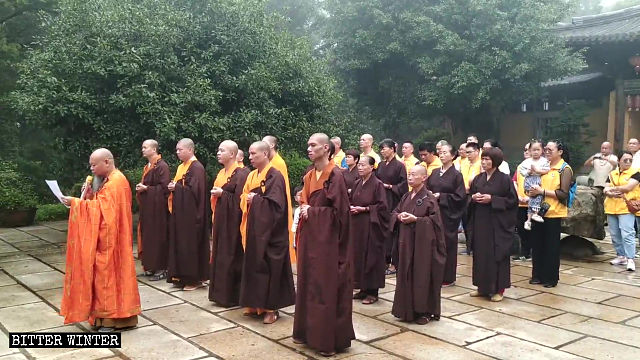
On June 30, the eve of the 99th anniversary of the founding of the CCP, the United Front Work Department (UFWD) of Qingdao city in the eastern province of Shandong gathered monks in the Zhanshan Temple to watch The Founding of A Party, a film about the history of the CCP. “Promotion of Buddhism and most religious activities in the temple are still banned,” one of the temple’s monks explained, adding that they are not even allowed to gather for traditional morning and evening chants.
In late June, imams of some state-run mosques in Shandong’s Liaocheng city were demanded by the city’s UFWD to “commemorate the Party’s birthday” and organize believers to hold a flag-raising ceremony on July 1 even though religious gatherings continue to be banned.
“All mosques, churches, and temples in Liaocheng-administered Linqing city had to hold flag-raising ceremonies; some had over 100 attendees. Is this not a gathering?” a local Muslim questioned the reasoning behind the government’s regulations.

Uses a pseudonym for security reasons.