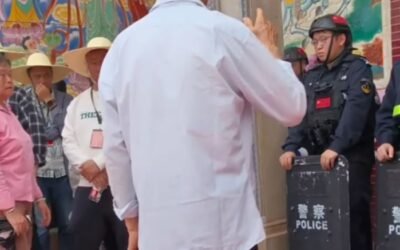
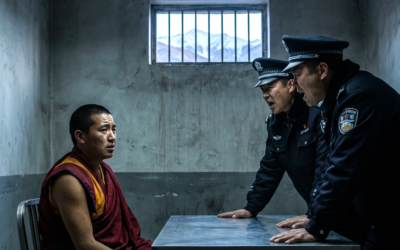
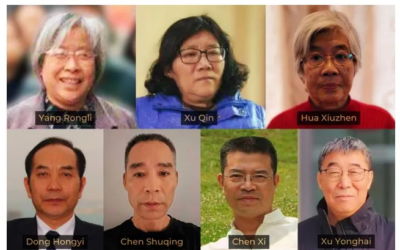
Both local and visiting Taiwanese believers were arrested and charged with being part of a “xie jiao,” although Yiguandao is not in the official list of banned movements.
by Zhao Zhangyong and Massimo Introvigne

This month of December, Taiwanese media revealed that three Yiguandao devotees from Taiwan were detained in Guangdong last October during a police raid against a gathering of believers, together with some 200 citizens of the People’s Republic of China. The news was officially confirmed by the authorities in Taiwan.
The believers were subsequently released but kept under surveillance and told they will be “blacklisted,” and the incident will negatively affect their social credit. They were also told that Yiguandao is a “xie jiao,” i.e., a “movement spreading heterodox teachings” (sometimes less correctly translated as “evil cult”). However, Yiguandao is not included in any officially published list of “xie jiao.”
Yiguandao is a redemptive new religion that was particularly successful in pre-Communist China, gathering some twelve million followers. It was severely repressed by Chairman Mao’s government. Although for various political reasons the CCP preferred to adopt for Yiguandao and other similar groups the label “reactionary secret societies” (fandong huidaomen) rather than “xie jiao,” the latter term was also used and the persecution launched by the Communists after they came to power in 1949 was very similar to late campaigns against the “xie jiao.”
Hong Kong-based scholar David Palmer notes that, as it later happened with Falun Gong and The Church of Almighty God, “all forms of propaganda were deployed against it [Yiguandao], from editorials and speeches by Mao Zedong published in the ‘Peoples’ Daily’ and the rest of the press, to posters, comics, exhibits, denunciation assemblies and even theatrical performances. The name Yiguandao became a synonym of the counterrevolutionary sect and even a favored insult used by children in schoolyards.”
The persecution reached its climax in 1953 and 1954, during which, according to police reports, 820,000 leaders and organizers, and 13 million followers were arrested, with thousands killed in the CCP’s jails. These numbers were so high that scholars suspect that members of other religious groups were arrested and even executed with the false charge of being part of Yiguandao.

The persecution was successful. Yiguandao was almost totally eradicated in Mainland China, although it survived in Hong Kong, Singapore, Thailand, and South Korea, with branches established also in the West among the Chinese diasporas. Divided in numerous independent branches, so that no central organization can claim to control Yiguandao today, the religion maintains some 2,5 million members outside Mainland China. In Taiwan, prominent businesspeople are members, and it has a significant presence in the network of vegetarian restaurants.
Since some of Yiguandao’s Taiwanese businesspeople have invested significantly in China, in the 21st century the religion has quietly returned to the Mainland. Media and scholars have mentioned confidential discussions in the 2010s, favored by Taiwanese businesspeople, to give to Yiguandao some sort of legal existence in China, although these efforts are now made more difficult by President Xi Jinping’s renewed crackdown on all religions. Actually, missionaries from Taiwan sent to China to promote Yiguandao have recently been systematically arrested, and Taiwanese authorities have warned them against these dangerous trips to the Mainland.

Uses a pseudonym for security reasons.