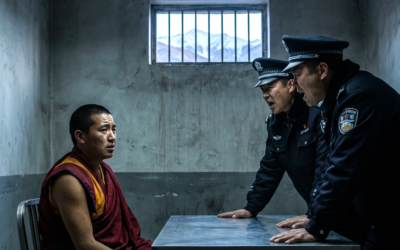
Although not necessarily involving detention, the CCP’s militarized training of Tibetan workers, sent to work far from home, is suspiciously similar to what is being done to the Uyghurs.
by Massimo Introvigne

It is called a vicious circle. Tibet’s CCP boss, Chen Quanguo, was transferred to Xinjiang in 2016, and implemented there against the Uyghurs the repressive strategies he had used against the Tibetans. Now, some of the new repression tools tested in Xinjiang are in turn exported to Tibet.
According to a detailed report by German scholar Adrian Zenz, “lazy” or “backward” Tibetans – including those “excessively attached to religion” – are identified through the same village by village and block by block surveillance system used in Xinjiang. Most of them are small farmers or herders. Their land and animals are confiscated, and replaced with “shares” of collective farms, whose value is hard to assess and possibly non-existent.
The “backward” Tibetans are then dressed in military-like uniforms and subject to intense indoctrination and training, after which they are sent to work far away from their homes, either in a different area of the Tibetan Autonomous Region (TAR) or in other Chinese provinces. The program also applies to areas predominantly inhabited by Tibetans outside of the TAR.
Zenz does not claim that the Tibet and Xinjiang systems are one and the same. There is no evidence that being taken to a militarized workers’ training camp is a form of detention, and the scholar maintains that it is possible that some Tibetans adhere to the program voluntarily, lured by the CCP’s promises of getting a decent salary in the future. However, pressure is intense, indoctrination (including being submitted to anti-religious propaganda) is part of the program, and an element of “coercion” is also present.
The CCP now systematically reacts to research by Zenz by questioning his motivations. CCP minions will no doubt remind us once again that Zenz is an evangelical Christian and believes in “strange” doctrines, including the possibility of an eternal damnation for the wicked and a future glorious return of Jesus Christ. These are doctrines millions of Christians believe in, including Western lawmakers, presidents, and prime ministers. At any rate, they have nothing to do with the quality of Zenz’s scholarship, or the persuasive evidence he offers for his conclusions.
Reuters has found independent confirmation that the militarized program to indoctrinate and relocate Tibetan workers is in fact happening, and this has been confirmed to Bitter Winter by reliable sources in Tibet.

Massimo Introvigne (born June 14, 1955 in Rome) is an Italian sociologist of religions. He is the founder and managing director of the Center for Studies on New Religions (CESNUR), an international network of scholars who study new religious movements. Introvigne is the author of some 70 books and more than 100 articles in the field of sociology of religion. He was the main author of the Enciclopedia delle religioni in Italia (Encyclopedia of Religions in Italy). He is a member of the editorial board for the Interdisciplinary Journal of Research on Religion and of the executive board of University of California Press’ Nova Religio. From January 5 to December 31, 2011, he has served as the “Representative on combating racism, xenophobia and discrimination, with a special focus on discrimination against Christians and members of other religions” of the Organization for Security and Co-operation in Europe (OSCE). From 2012 to 2015 he served as chairperson of the Observatory of Religious Liberty, instituted by the Italian Ministry of Foreign Affairs in order to monitor problems of religious liberty on a worldwide scale.