The Japanese government is claiming there were 500 victims of coerced donations after 2009. This figure is false.
by Patricia Duval
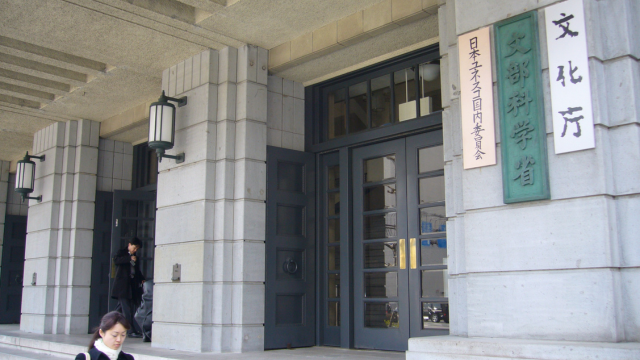
To justify its dissolution request against the Unification Church (“the Church,” now called the Family Federation for World Peace and Unification but still often referred to with the old name), which was granted in first degree by the Tokyo District Court on March 25, officers of the Ministry of Education, Culture, Sports, Science and Technology (MEXT), the Ministry in charge of religious matters, gave some figures to the media in the last few days that exist only in their wildest dreams, in support of their accusation of “continuity of misconduct” by the Church.
To a question on the dissolution order it obtained through the decision of the Tokyo District Court on March 25, 2025, MEXT answered claiming that it has evidence that there were 500 victims who made donations “after” 2009.
This was communicated during an interview by BBC News of one of our scholars yesterday. It appears that MEXT spreads the information to the media that what international scholars say about the Church abiding by its 2009 “Compliance Declaration” is not true.
This claim and the farfetched figures it contains have no factual basis.
Let’s clarify first what the 2009 “Compliance Declaration” is.
The 2009 Compliance Declaration was actually an internal instruction to the Unification Church members. It followed the arrest of some members in 2005 for selling good fortune seals in the street, accused of violating the law on door-to-door sales.
To comply with the law and in consideration of various civil lawsuits filed against it, the Church issued a directive where it gave guidance to its members prohibiting these sales (even, as was the case, for their own private enterprises) and recommending not to mention karma when soliciting donations, nor to encourage substantial donations.
The Compliance Declaration is thus actually a pledge, an internal guidance, which the Church has emphasized to the courts and the media to prove its good faith and desire to act in conformity with the law.
It is the assertion of compliance with this internal instruction to the members that MEXT denounces as false.
MEXT states to the media that they had no other choice than seeking a Court order of dissolution because of the “continuity of misconduct” by the Church even after 2009.

However, the reality of the facts concerning the allegation by MEXT that they provided evidence of 500 victims from after 2009 is as follows.
It is two-fold: one is related to the written statements provided to the Court by MEXT, and the other one to the figures given in the Court decision.
First: In its dissolution request, MEXT relied on 500 written statements in total but those were made by 294 individuals, as some of them wrote several statements.
Out of these 294 victims, 30 were relatives and 3 were two staff members of MEXT and one lawyer from the anti-Unification Church lawyers’ association, who were third parties to the accusation. Also, one turned out to be a current member whose testimony was included to prove her soliciting of donations and one is a follower of another religious group, who misunderstood that she was testifying against the Unification Church.
In total, only 259 former members can be considered “victims” who have written statements for MEXT in the dissolution case.
So MEXT includes family members and other third parties in witnesses’ statements, and had the witnesses write several statements in order to inflate the figures of “victims”. The number of actual “victims”, who made a written statement, is 259 and not 500.
The word “victim” is mentioned here with quotation marks as those former members made donations at the time of their own free will but later “realized” when briefed by anti-Unification Church lawyers that they had been manipulated.
Second: Regarding the 259 former members – a majority of who went through “deprogramming”, i.e. abduction and confinement, and were coerced to recant their faith – approximately 90% had joined more than fifteen years before they made the statement, which was before the 2009 Declaration, including individuals who joined over fifty years before or left the Church decades before.
Amongst those, there were only 19 former first-generation members who joined the Church after the 2009 Compliance Declarations.
18 provided statements prepared through interviews conducted by the MEXT, during which they signed and sealed their statements. These were then submitted as evidence in the dissolution order lawsuit.
The remaining of the 19 individuals was a plaintiff in a past lawsuit against the Church, and MEXT submitted the statement prepared by that plaintiff in the lawsuit.
So the number of “victims” from after 2009 is 19, not 500.
It can be added that amongst those recent “victims,” MEXT and the District Court allowed only two cross examinations by the defense lawyer.
These cross examinations at the hearing in court in December 2024 revealed that the witness testimonies contained contradictions and were unreliable.
Hence, some written statements prepared by MEXT had been falsified.
Additionally, some witnesses cited by MEXT came forward in Japanese media to denounce the re-interpretation and modification of their stories by the Ministry’s agents in order to reshape them into accusatory testimonies for its dissolution request.
Digging further, a member of the Japanese Diet formulated questions to the Government and was answered that the procedure was to be kept secret with no further explanation or denial concerning the witnesses’ claims.
All of this cast doubt on the validity of the incriminating evidence provided by the Japanese authorities to support their claim for dissolution.
It reveals also that MEXT is spreading lies concerning the evidence of 500 victims of donations made after 2009.
As concerns the figures included in the Court decision, the Court found the following figures in its ruling.
From the 1980s to date, the number of claimants who obtained refund in Court is 140, the number of claimants who obtained refund through settlements in court is 448, and the number who obtained refund through settlements out of court is 971, which makes a total of 1,559 for a period of around 45 years.
But all this relates to a long past period where members were massively subjected to deprogramming and afterwards incited to file for damages to prove they recanted their faith.
The vast majority of those donations were made before the 2009 Compliance Declaration, even though some claimants might have continued to make donations thereafter on their own free will. Actually, 179 claimants out of the figures given by the Court included a few donations made after that date.
According to the diagram provided by the defense lawyer based on factual figures and related documents, there has been a continuous decrease of the claims/settlements since 2006, except for a little increase in 2022–2023 due to the media campaigns following Prime Minister Shinzo Abe’s assassination in 2022 presenting the Church as criminal and the incitement measures adopted by the Government.
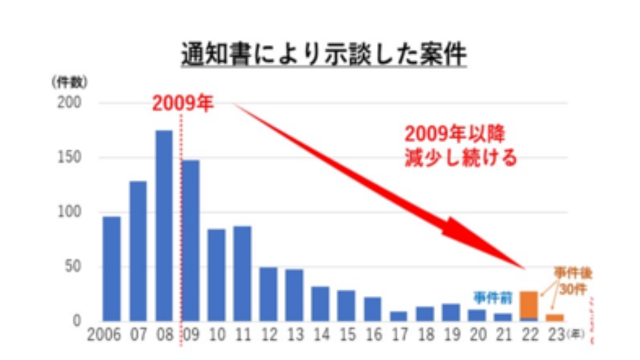
Following Abe’s murder and the scapegoating in the media by the anti-cult and politically motivated National Network of Lawyers Against Spiritual Sales, the Government adopted a whole set of repressive measures against the Church, one of them being the support to former members for suing the Church.
In this regard, the December 2022 law on “unjust solicitation of donations” allows families hostile to their adult relatives’ religious choices and support to the Church to request rescission of donations in place of the donating members.
Additionally, the Government has been advancing attorney fees to sue the Church through the Japanese Legal Support Center (Houterasu), and inciting potential claimants through public announcements of the foreseen dissolution and liquidation of the Church.
In spite of all this incitement, claims against the Church have gone down drastically, even though the anti-Church lawyers are now organizing collective actions for old claimants to file for damages in view of the Church liquidation.
It can be concluded that the Church has stuck to its commitments and followed in good faith its declaration of compliance with the country’s regulations.
As a matter of fact, no violation of existing laws or regulations has been relied upon by MEXT in its dissolution request, or by the Court in its dissolution decision.
The only bases for the dissolution order are the violation of “socially acceptable norms,” which is an unwritten and undefined criterion invented by the courts to sentence the Church to civil torts and to dissolve the Unification Church, and the infringement of “public welfare,” another vague and arbitrary concept used by the Japanese authorities to get rid of undesired religious communities.

Patricia Duval is an attorney and a member of the Paris Bar. She has a Master in Public Law from La Sorbonne University, and specializes in international human rights law. She has defended the rights of minorities of religion or belief in domestic and international fora, and before international institutions such as the European Court of Human Rights, the Council of Europe, the Organization for Security and Co-operation in Europe, the European Union, and the United Nations. She has also published numerous scholarly articles on freedom of religion or belief.