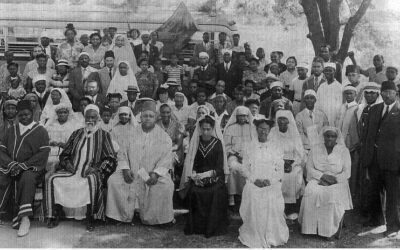
The founder of The Revelation Spiritual Home presents a unique approach to a notoriously elusive category.
Massimo Introvigne*
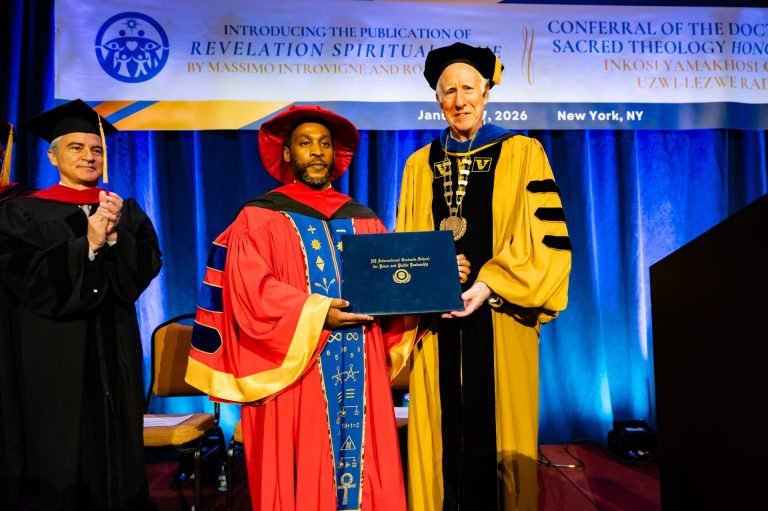
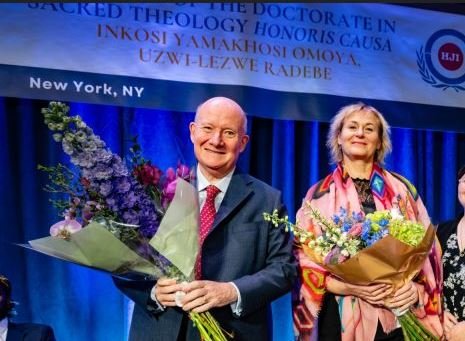
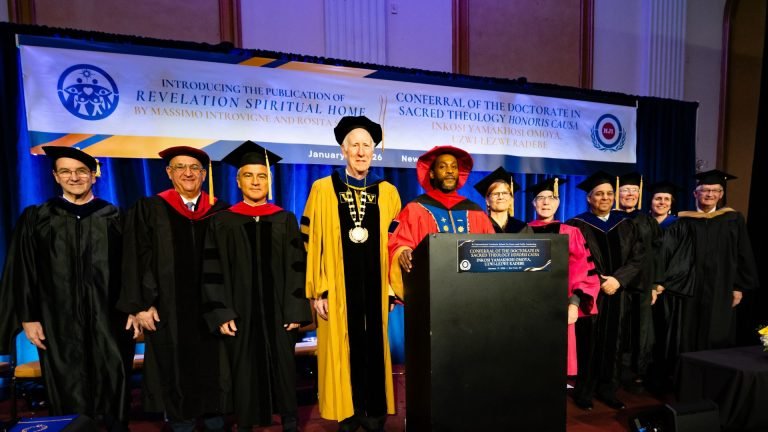
*A paper presented at the American launch of the book by Massimo Introvigne and Rosita Šorytė, “The Revelation Spiritual Home: The Revival of African Indigenous Spirituality” (Cambridge: Cambridge University Press, 2025), and the Honorary Doctorate Ceremony for iNkosi yamaKhosi Omoya IMboni uZwi-Lezwe Radebe
New York, HJ International Graduate School for Peace and Public Leadership, January 17, 2025.
Distinguished colleagues, honored guests, dear friends—old friends I am glad to see here, friends of IMboni iNkosi YamaKhosi oMoya Dr. uZwi‑Lezwe Radebe, and you, friends of dear Mother Han who fill this hall with your devotion and your hope,
allow me to begin with a moment Rosita shortly mentioned that has already entered the shared spiritual memory of two continents. It is a moment that did not take place in a university lecture hall or a ceremonial chamber, but in a cold Korean detention center. It was there, on November 4, that IMboni iNkosi YamaKhosi oMoya Dr. uZwi‑Lezwe Radebe walked through the gates to visit an 82-year-old woman unjustly and cruelly detained, a woman millions call the Mother of Peace.
I begin here because this moment is emotionally powerful—and intellectually revealing. It tells us something essential about the man we honor tonight and about the nature of spirituality itself—its capacity to transcend boundaries, unite people across traditions, and illuminate truths that academic categories often struggle to capture. When IMboni emerged from the detention center, he spoke words that many of you heard and that some of you will never forget. He said that to be there, he had “quickly left everything behind.” He said that good people plant good seeds, but in a fallen world, they often reap little. He said that when he saw Mother Han, she was shining. And he said that energy travels—that even if she could not see the faithful gathered outside, their energy would reach her, strengthen her, and give her courage.
These were not the words of a political operative. They were the words of a man who sees the sacred in the suffering of others. They were the words of a man who recognizes that authentic leaders, even when shaped by different histories and different cosmologies, speak a common spiritual language.
This moment, decisive as it was, is not the subject of my talk tonight. But it is the doorway through which I want to enter, because it allows us to understand something essential about the book that Rosita and I have written, “The Revelation Spiritual Home: The Revival of African Indigenous Spirituality.” It will enable us to understand why we wrote it, what questions we sought to answer, and what conclusions we reached. And it allows us to know why the man at the center of that book, IMboni iNkosi YamaKhosi oMoya Dr. uZwi Lezwe Radebe, is a figure worthy of scholarly interest for universities worldwide, someone whose life and work illuminate some of the most contentious debates in the study of religion today.
When I published my first book in 1983, my mentor told me something I have never forgotten, and I mentioned it in a recent conference in Cape Town. He said that publishing a book is a dangerous act. If you publish a bad book, he said, it is a sin you will keep committing even after your death. Every time someone reads it and absorbs false information, you sin again. But if you publish a good book, he added, you will continue earning merit long after you are gone.
Writing about African Indigenous Spirituality (AIS) carries responsibility. It is a subject that is everywhere and nowhere, ancient and contemporary, visible and elusive, revered and dismissed. It is a subject that scholars have approached with fascination, confusion, admiration, and sometimes condescension. It is a subject that resists easy definitions, that challenges Western categories, that refuses to be neatly classified.
When Rosita and I began our research, we quickly realized that we were entering a field marked by decades of debate. Scholars have argued about whether African Indigenous Spirituality should be considered a religion, a tradition, a worldview, a cosmology, or something else entirely. They have debated whether it is unified or diverse, static or dynamic, and whether it is disappearing or undergoing a renaissance. They have proposed typologies, only to have them challenged. They have tried to map it, only to discover that it flows like a river, changing shape as it moves.
One of the earliest attempts to classify African new religious movements was made in 1967 by Harold Turner, who proposed a typology that included what he called “neo‑pagan African religious movements.” Nobody would use this label today, but it had the merit of indicating that not all spiritual institutions in Africa were Christian or Muslim. Turner was a careful scholar, aware of the dangers of imposing Western frameworks on African realities. Yet even he could not escape the limitations of his categories. His quest for a typology was later critiqued by James Fernandez, who argued that theological debates—so central to Western religion—were rarely the focus in African contexts. Fernandez suggested that typologies often served Eurocentric dialogues more than African realities.
This insight became one of the guiding principles of our book. We realized that African Indigenous Spirituality cannot be understood through the categories of Western theology. It is not a system of doctrines. It is not a set of beliefs. It is not a religion. It is a living, breathing spiritual ecosystem. It is a way of being, a way of knowing, a way of remembering. It is the whisper in the wind, the rhythm in the drum, the dream that will not let you go. It is the sense that the ancestors are near, that the land is alive, that the sacred is not a distant abstraction but a living presence.
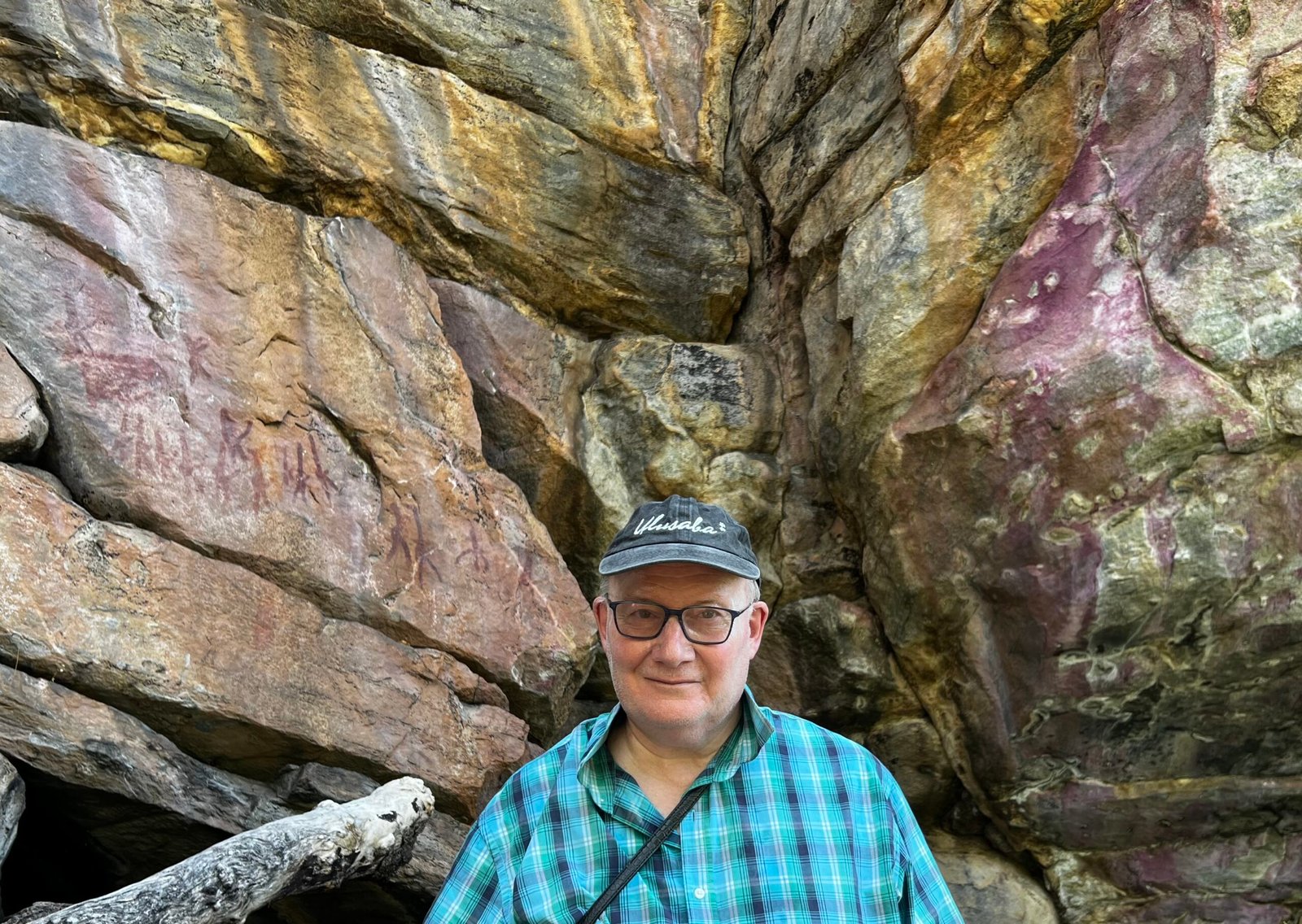
To understand AIS, we had to leave behind the libraries and enter the landscape. We had to stand in the Tsodilo Hills of Botswana, where rock paintings thousands of years old seem to pulse with spiritual energy. We had to listen to the stories of those who entered trances to speak with the unseen. We had to observe rituals, songs, dances, and symbols that carry the memory of generations. And we had to listen to the voices of practitioners, who often define their spirituality not by what it is but by what it is not. It is not religion. It is not tradition. It is not a set of doctrines. It is the breath that animates tradition. It is the fire that gives meaning to ritual. It is the experience that precedes knowledge and is different from belief.
This is why African Indigenous Spirituality is so difficult to define. It is not a system. It is not a “cult.” It is not a footnote. It is a way of being, one that has survived centuries of suppression, first by Christianity, then by Islam, then by colonialism. It is a way of being that has been marginalized, dismissed, and sometimes persecuted. And yet, it is a way of being that is now undergoing a renaissance, as young Africans rediscover ancestral wisdom and blend it with modern tools. The sacred is going digital. There are Instagram posts about ancestral altars, TikTok videos explaining rituals, and WhatsApp groups for spiritual dreams. The ancestors, it seems, have found Wi‑Fi.
But this renaissance is not without risks. Commercialization, misrepresentation, and dilution threaten its integrity. That is why institutions like The Revelation Spiritual Home (TRSH) insist on structure, discipline, and spiritual rigor. They understand that African Indigenous Spirituality is not merely an academic subject of curiosity. It is a site of cultural resistance, a form of epistemic sovereignty. It is a way of saying, We were never spiritually homeless. We were never waiting to be saved. We were never without gods, stories, or sacred places.
This brings me to the central figure of our book: IMboni iNkosi YamaKhosi oMoya Dr. uZwi‑Lezwe Radebe. I want to repeat a comment by Rosita, since it is the center of what we are discussing today: to speak of African Indigenous Spirituality today without speaking of IMboni is impossible. He is not simply a leader. He is a seer. He sees beyond the visible, hears the voice of the spirits, and interprets the messages of the divine world for the people. His title, IMboni, describes a spiritual function as old as Africa itself.
Under his leadership, TRSH has grown with astonishing speed. It has become the largest pan-African institution dedicated to African Indigenous Spirituality. It has attracted millions of followers. And it has done so not through marketing or through strategy alone, but through the power of a leader who embodies the revival of AIS.
But TRSH is not only a spiritual institution. It is also a cultural, economic, and social force. Through Trillion Cart Holdings, founded in 2009, TRSH oversees more than seventy companies. These enterprises range from burial schemes and cosmetics to gyms, restaurants, health supplements, travel agencies, and investment advice. The Siyangakhona Burial Scheme was the first venture, designed to serve individuals excluded from other burial programs. Ubuntu Cosmetics, Black Rhino Gyms, and The Burger Joint & Grill are among the most visible enterprises. Trillion Cart also breeds racing pigeons, a passion of Radebe since childhood, and Ankole cattle, linking economic activity to African heritage and symbolism.
Leadership within Trillion Cart includes women in prominent positions, balancing the male-centered spiritual authority of TRSH. Members are encouraged to become financially autonomous through distributorships and micro‑businesses. Many move from distributorships to independent companies, supported by the African Centre of Excellence, which trains entrepreneurs. TRSH also sponsors cultural and educational initiatives. The Dr. S.B. Radebe Foundation distributes food and blankets, grants and scholarships, and establishes libraries in African townships. The Trillion Dollar Kids Club promotes financial literacy among children, inspired by Radebe’s own childhood experiences. Sports clubs, choirs, theatrical troupes, and publishing houses further extend the institution’s reach. In 2023, Radebe was elected African coordinator of the African Forum for Religious and Spiritual Liberty, reflecting his commitment to inter-spiritual dialogue and freedom of religion or belief.
TRSH’s organization is deliberately structured to replicate the spiritual hierarchy in the physical world. Just as IMboni Radebe is regarded as the head of a spiritual nation, so too is he seen as the leader of a physical community. His revelations are presented as of national significance, and he is recognized as the Spiritual Guider of Langalibalele II, the reigning king of the AmaHlubi, his ethnic group. The institution’s leadership model thus combines spiritual authority, cultural custodianship, and economic empowerment. It is both hierarchical, with Radebe at the apex, and decentralized, with local leaders managing branches and members encouraged to develop agency and autonomy. This dual structure reflects TRSH’s conviction that spirituality and material life are inseparable, and that empowerment must extend from ritual to economics and from healing to entrepreneurship.
Of course, no movement of this scale grows without challenges. TRSH has faced scrutiny from South Africa’s Commission for the Promotion and Protection of the Rights of Cultural, Religious and Linguistic Communities (CRL). In 2015, the CRL launched hearings on the commercialization of religion. Radebe refused to present TRSH’s financial records, arguing that the requests violated constitutional protections. The CRL’s chairperson attempted, unsuccessfully, to have him arrested for contempt. A member of TRSH was jailed for sending a spiritual warning to the chairperson. Although the CRL proposed legislation requiring all religious organizations to register and disclose finances, no such law was enacted. Scholars warned that the proposals risked undermining religious freedom. In the last few months, however, the CRL has again scrutinized religions and proposed controls. Vigilance continues to be needed. Freedom of belief in Africa, as elsewhere, has many enemies.
The anti-cult campaign in South Africa reached its zenith in 2017, with news outlets portraying new religious and spiritual movements as dangerous. Media coverage depicted TRSH as powerful and influential, often with suspicion. Critics argued that TRSH’s integration of spirituality and commerce risks exploitation, while supporters insisted it offers opportunities otherwise denied to marginalized communities.
The challenges faced by TRSH reflect broader tensions across Africa. TRSH positions itself as both defender of African Indigenous Spirituality and innovator in business, a combination that attracts both admiration and hostility. As one early scholar observed, TRSH succeeds because it speaks to the hope that the city’s failed aspirations can be restored, that its pollutants can be cleansed, and that the people and things lost in its streets will return home safely.
Tonight, as we launch a book and celebrate the conferral of an honorary doctorate upon IMboni iNkosi YamaKhosi oMoya Dr. uZwi‑Lezwe Radebe, we are not only presenting an institution and honoring a man. We are celebrating freedom of religion or belief. We are honoring a continent reclaiming its spiritual voice. We are honoring the revival of a wisdom that colonialism tried to erase but could not extinguish. And we are honoring the extraordinary convergence that took place in a Seoul jail—the convergence of two leaders, two spiritual lineages, united by courage, by compassion, and by the conviction that truth must be defended, even when it is costly.
As scholars, moments like these compel us to reflect not only on the subjects we study but on the posture with which we approach them. African Indigenous Spirituality is not simply another entry in the catalogue of world religions and spirituality; it is a living, breathing universe of meaning. And if we, as academics, wish to understand it, we must begin by acknowledging that our usual instruments—our typologies, our definitions, our inherited categories—are often blunt tools for a reality that is subtle, fluid, and deeply experiential. Too frequently, scholars have approached AIS as if it were an archaeological artifact, something to be excavated, classified, and placed behind glass. But AIS is not an object. It is a voice. It speaks through rituals, through dreams, through landscapes, through the memories of communities. To study it responsibly, we must learn to listen.
Listening, however, is not a passive act. It requires a willingness to be unsettled. It requires us to take practitioners’ emic perspectives seriously, even when they challenge the frameworks we have inherited from Western religious studies. When an IMboni speaks of hearing the gods and the ancestors, or when a sangoma describes entering a trance to communicate with the unseen, our task is not to translate these experiences into categories that make us comfortable. Our task is to understand what these experiences mean within their own cosmological logic. This is not an easy shift. It demands humility—the humility to admit that our academic training, valuable as it is, does not grant us automatic authority over the worlds we study.
Humility, however, is only part of the task. We must also be willing to interrogate our own tools. Many of the typologies that have shaped the study of African spirituality were developed in colonial contexts, often by scholars who, despite their best intentions, viewed African spiritualities through the lens of Christianity or secular rationalism. These frameworks can illuminate certain aspects of AIS, but they can also distort. They can domesticate what is wild, flatten what is multidimensional, and reduce what is sacred to what is merely sociological. If we are to do justice to AIS, we must be willing to ask whether our tools serve understanding or the comfort of familiar categories.
And finally, we must be courageous. To take African Indigenous Spirituality seriously is to challenge some of the foundational assumptions of Western religious studies. It is to acknowledge that the sacred does not always manifest in the ways we expect. It does not always come in the form of scripture, or clergy, or doctrine. Sometimes it comes in the form of beads worn around the neck. Sometimes it comes in the form of a dream that refuses to fade. Sometimes it comes in the form of a dance that carries the memory of generations. To recognize these as legitimate expressions of the sacred is not to romanticize AIS; it is to respect it.
This, ultimately, is what our book attempts to do. It is not an attempt to define AIS once and for all—such a task would be impossible. It is an attempt to approach it with the seriousness it deserves, to listen to its practitioners, to question our own assumptions, and to acknowledge that African Indigenous Spirituality is not waiting for academic validation. It is already alive, already evolving, already speaking. The question is whether we, as scholars, are prepared to hear it, which today means taking off our shoes and accessing the platform from which IMboni iNkosi YamaKhosi oMoya Dr. uZwi Lezwe Radebe speaks to us.
As scholars, we often speak in abstractions. But African Indigenous Spirituality is not an abstraction. It is a presence. It is a force. It is a fire. And tonight, that fire burns brightly in this room.

Massimo Introvigne (born June 14, 1955 in Rome) is an Italian sociologist of religions. He is the founder and managing director of the Center for Studies on New Religions (CESNUR), an international network of scholars who study new religious movements. Introvigne is the author of some 70 books and more than 100 articles in the field of sociology of religion. He was the main author of the Enciclopedia delle religioni in Italia (Encyclopedia of Religions in Italy). He is a member of the editorial board for the Interdisciplinary Journal of Research on Religion and of the executive board of University of California Press’ Nova Religio. From January 5 to December 31, 2011, he has served as the “Representative on combating racism, xenophobia and discrimination, with a special focus on discrimination against Christians and members of other religions” of the Organization for Security and Co-operation in Europe (OSCE). From 2012 to 2015 he served as chairperson of the Observatory of Religious Liberty, instituted by the Italian Ministry of Foreign Affairs in order to monitor problems of religious liberty on a worldwide scale.